
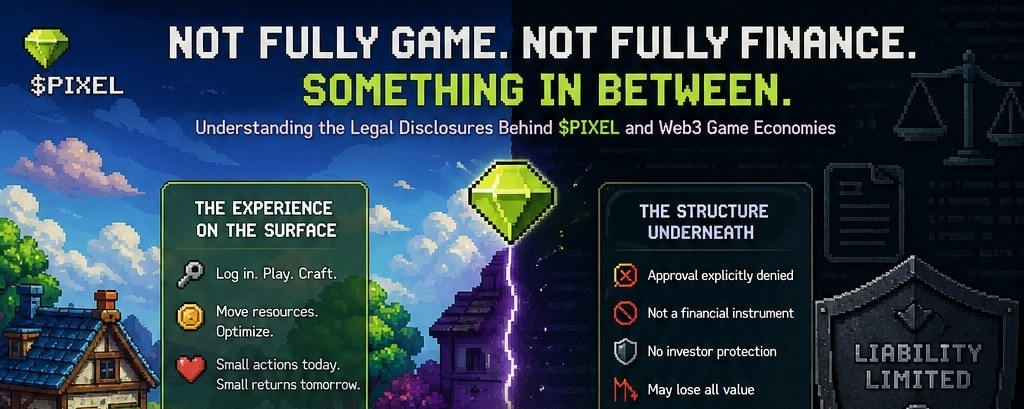
I keep noticing something about these statements and it does not feel random.
I have been thinking about this for a while not in a technical way more like just reading those legal disclosures around Pixel and similar Web3 games and feeling like there is a second layer of conversation happening underneath the game itself.
You know those sections where it says things like approval is not granted this is not a financial instrument, no investor protection may lose all value liability is limited self-declared compliance only and everything must be fair, clear and not misleading.
At first I used to scroll past it like everyone does. But I started actually pausing on it and it feels like it is not just legal text it is almost like a boundary marker, a quiet way of saying: "you are stepping into something that behaves like finance but is not allowed to be treated as finance."
In Pixel and the PIXEL ecosystem specifically the interesting part is how normal the experience feels on the surface. You log in you play, you craft you move resources around maybe you optimize your time a bit. It feels like a game loop actually in some moments it feels of relaxing there is a positive side to it simple progression, clear actions and that satisfying loop of doing something today and seeing small returns tomorrow that part is genuinely well designed.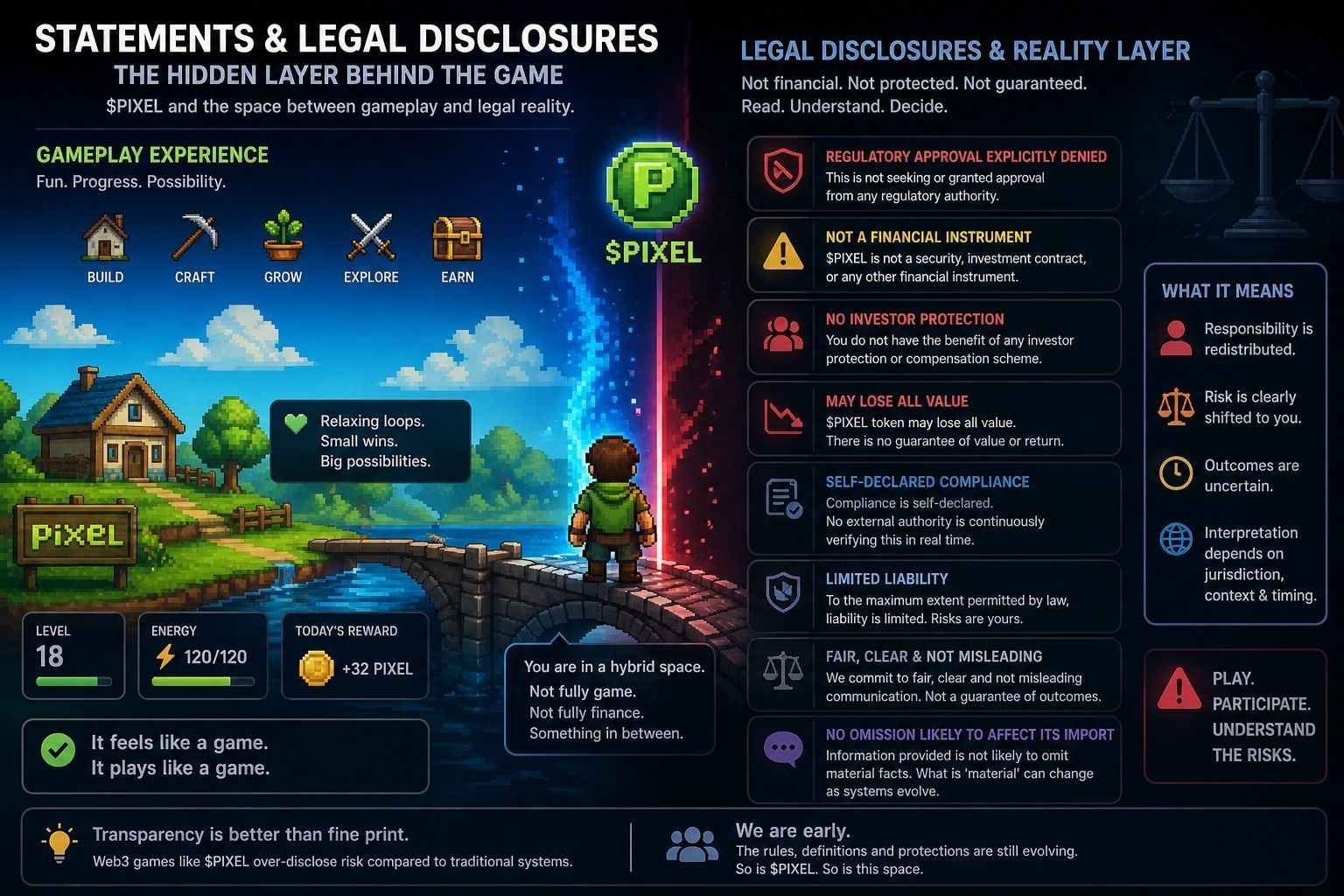
Then you read the disclosures again and it shifts your perception a little.
The phrase "regulatory approval explicitly denied" is the one that sticks in my mind it does not just say "we are not regulated" it almost over-clarifies that it is not trying to be part of any approved system and I keep wondering why it needs to be said so directly it is like drawing a thick line around responsibility before anything even starts.
And then there is "fair, clear and not misleading" that sounds reassuring at first but when you think about it more it is not a guarantee of fairness in outcome it is like a promise about communication style the words can be clear but the system behind them can still be unpredictable that gap between clarity of language and clarity of outcome is something I can not unsee now.
Self-declared compliance is another one it sounds almost casual when you read it like "we believe we are compliant". It also quietly means no external authority is fully backing that claim in real time so the responsibility shifts slightly not fully on the Pixel issuer, not fully on regulators but kind of floating in between. I do not know that feels important.
What really changes the feeling is the repeated emphasis on liability limitations it is not one line it shows up in different forms and I start thinking if something goes wrong if systems break if Pixel token value drops hard if mechanics change the structure is already pre-written to say "this was expected and responsibility is limited".
Then there is the line that always sounds dramatic no matter how many times you read it the Pixel token may lose all value.
It is strange because in-game it never feels like that is happening you are still playing, still earning still moving things around but legally that possibility is always sitting underneath everything like a risk layer that never disappears.
What does "no investor protection" actually mean in practice that is something I keep coming to because players might not always think of themselves as investors but behaviorally sometimes it looks similar, time, effort, resources, expectations of return even if it is just in-game utility so when protection is explicitly denied it kind of reframes the whole experience without changing the experience itself.
One thing I find interesting and I am not fully sure what to make of it is how these disclosures actually protect the Pixel issuer more than they inform the player it feels like they create a legal shield first and then a communication layer second, not necessarily bad just structured in a way where risk is clearly redistributed away from one side.
But at the time I do not want to say it is purely negative there is a positive observation here too the honesty of stating risks so directly is at least more transparent than many traditional systems that hide risk in fine print in a way Web3 projects like Pixel are almost over-disclosing compared to older digital economies they tell you "this might fail completely" in a way most platforms never do.
Still that does not fully remove the tension.
Because when you combine "no instrument" "no investor protection" and "may lose all value" with a game that still has economies, Pixel tokens, trading behavior and player optimization you end up in this weird hybrid space, not fully game, not fully finance something in between that does not have a clean definition yet.
And maybe that is the part I keep circling back to the legal language is trying to stabilize something that is still evolving. In doing so it also reveals how unstable the Pixel category itself is.
I also wonder how institutional players look at this if everything is self-declared compliance and liability is heavily limited does that automatically reduce participation or do they just treat it as exposure I do not really know.
And another thing, what risksre intentionally vague because some phrases are broad enough to cover almost any outcome, "market risk" "system changes" "economic adjustments" they are true, but also flexible enough to absorb surprise events without breaking the framework.
When I compare this to stock prospectuses those feel heavier more structured more enforced here it feels lighter faster more adaptable, but also less anchored, like speed traded for certainty.
What does "no omission likely to affect its import" even fully protect against in a Pixel game economy it sounds solid legally but in fast-changing systems what counts as "material" can shift quickly.
And enforceability that is another question I do not have an answer for these statements exist, yes but how they are interpreted in edge cases probably depends on jurisdiction, context and timing it is not as straightforward as it looks on the surface.
So I am left in this space again.
A game that feels playable and light on one side and a structure that feels heavy and protective on the other.
Maybe that contrast is intentional maybe it has to be like this for anything at this scale.
Maybe we are still early, in understanding what these hybrid Pixel systems actually are supposed to be.
Not fully sure what this is yet $PIXEL
