
There are only two ways a token can die.
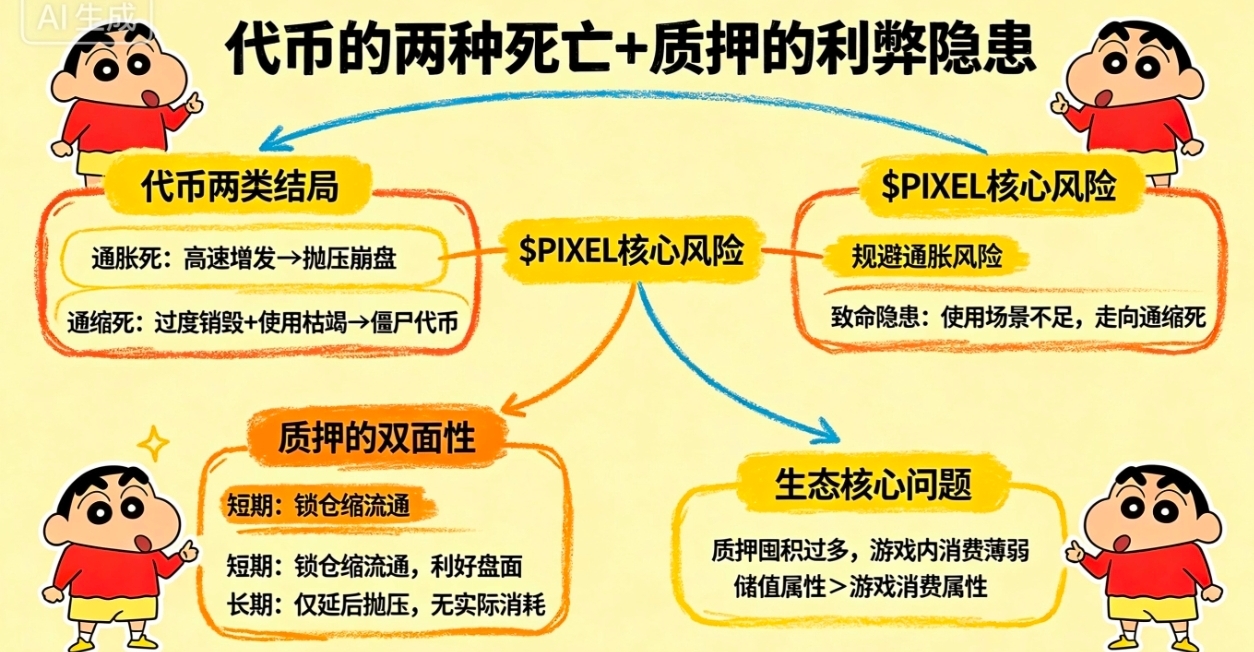
In Web3, a token has only two endings:
The first type is called 'inflationary death.' Issuance is too fast, selling pressure is too high, and the price goes to zero.
The second type is called 'deflationary death.' Too much is burned, but no one is using it, becoming a 'zombie token.' The price doesn't go to zero, but there are no trades, no holders, and no discussions—it quietly fades away.
$PIXEL's biggest risk isn't the first type. The project team is quite cautious about controlling inflation. Its risk is the second type—not that too many people are selling, but rather that too few are using it.
Is staking delaying death, or accelerating it?
This leads to a counterintuitive observation:
Staking reduces the circulating supply, which is bullish in the short term. But if the locked $PIXEL doesn't flow into the in-game spending scenarios and instead goes straight to exchanges when unlocked, then staking is just delaying the sell pressure instead of removing it.
The real cure isn't 'locking for longer', but 'spending more'.
Currently, the main spending scenarios for $PIXEL are: land tax, skin purchases, event tickets, and guild deposits. These scenarios are good, but the total volume isn't enough.
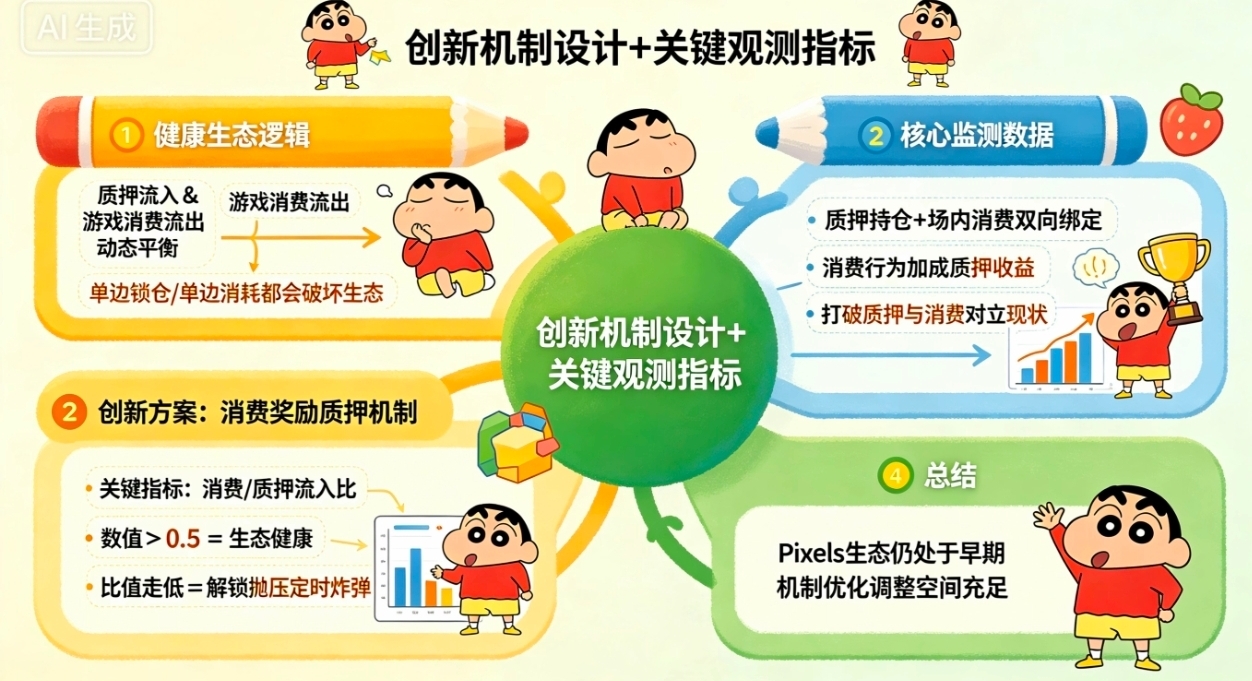
A healthy utility token ecosystem should achieve a dynamic balance between 'inflow of funds into staking' and 'outflow to spending scenarios'. Too much inflow turns the token into a pure storage tool, disconnected from the game's essence. Too much outflow means the token is in short supply, increasing trading friction.
Where is this balance point? No one knows. But Pixels is clearly leaning towards the 'inflow side'—everyone is locking, and no one is spending.
A design worth trying.
If Pixels could introduce a 'spending reward mechanism' within the staking system, would it change the situation?
For example: you staked 1000 PIXEL.
During the staking period, if you additionally spend 200 PIXEL on land upgrades or skin purchases, your staking rewards increase by 5%.
The essence of this design is to make 'locking up' and 'spending' positively correlated, rather than opposing forces.
Currently, there are almost no Web3 games that have attempted this. Most projects keep staking and spending as two separate lines. Pixels has the opportunity to be the first to bridge them.
A key signal.
In the next six months, I'll be watching one metric: the weekly 'spending/staking inflow ratio' of $PIXEL.
If this ratio climbs from under 0.3 to above 0.5, it indicates that the token is 'being used', rather than 'being locked'. If the ratio continues to drop, it signals that staking is creating an increasingly larger 'ticking time bomb'—the day it unlocks and flows into exchanges.
The staking ecosystem of Pixels is still very young. It's not too late to adjust now.
What was the most you spent on $PIXEL? Share it in the comments.