
I thinking about 🤔
I was just exploring Pixels one evening without any plan. I was not trying to find anything new. I was just moving around and checking small details. Then I came across something called Realms. At first I thought it was just another area in the game. But I stayed a bit longer and started noticing something different.
It did not feel like a normal map.
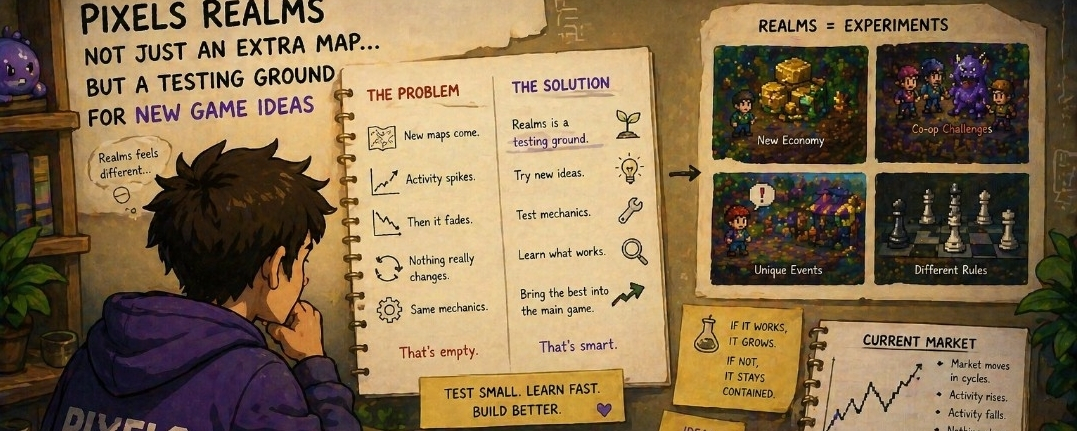
I have seen this pattern many times in Web3 games. New maps get added to keep players interested. They look fresh for a while. People explore them. Then activity slows down. Nothing really changes in the system. It is just more space with the same mechanics.
That is where things usually feel empty.
The problem is simple. Most games add content but not new ideas. They expand the world but they do not change how the game works. So even when things look new they feel the same after some time.
That is what I expected here too.
But Realms did not feel like that to me.
It felt more like a testing ground. A place where new ideas can exist before becoming part of the main system. Not everything felt polished. Not everything felt permanent. But that is what made it interesting.
It felt like the game was experimenting.
The idea started to make sense when I thought about it. Instead of changing the main game directly they create a separate space. In that space they can try different mechanics. Different reward systems. Different ways for players to interact.
If something works it can grow.
If it does not it stays contained.
That feels more controlled.
In most Web3 games changes come too fast. New features get added without testing. Systems break under pressure. Players lose trust. It becomes hard to fix things once they are already part of the main game.
Realms feels like a way to avoid that.
It gives room to test without risking everything. It allows ideas to evolve slowly. It also gives players a chance to experience something new without forcing it on everyone.
That changes how development feels.
It becomes less about rushing updates and more about learning what actually works. That kind of approach feels more stable in the long run.
It also changes how I see the game.
It is not just a fixed system anymore. It feels like something that is still growing. Still adjusting. Still trying to understand what players actually enjoy and what holds value over time.
Of course this is not perfect.
A testing space can feel confusing. Some players may not understand what is temporary and what is permanent. If there is no clear direction it can feel scattered. There is always a risk when ideas are still being explored.
And pressure will test it.
If too many experiments happen at once it can feel messy. If good ideas do not move into the main system then the value of testing becomes unclear. Balance matters here as well.
Right now the market is still moving in cycles.
Some Web3 games grow quickly. Then they lose attention just as fast. Activity rises and falls. New features come and go. Nothing feels stable for long.
Pixels is also moving through this phase.
There are moments where activity feels strong. Then quieter periods. Realms itself feels like part of that process. Not a finished feature. But something that is still finding its role.
That is normal.
What matters more is how it evolves over time.
If Realms becomes a place where strong ideas are shaped before entering the main game then it could become very important. It could help the system grow in a more controlled way. It could reduce the risk of sudden changes breaking everything.
If not then it may just feel like another extra area that people visit for a while and then forget.
I do not see it as just an اضافی نقشہ.
It feels more like a quiet layer of development inside the game. A place where the future of the system is being tested in small steps.
I am not fully convinced yet.
But I am interested enough to keep exploring it.
Because systems that take time to test ideas often last longer than those that rush them.
For now I will keep watching how Realms changes. How ideas move from there into the main game. And how players respond over time.
Still learning.
Still cautious.
