
I’m watching Pixels the way you watch something quietly from the sidelines, not rushing to judge it, just letting it unfold. I’ve been thinking about how familiar everything in this space has started to feel—how quickly you can recognize the pattern of a project before you even understand what it’s trying to be. After a while, you stop reacting to big claims and start paying attention to smaller signals instead. Tone. Pacing. What’s being emphasized—and what isn’t.
That’s where Pixels caught my attention. Not because it’s loud or trying to position itself as the next big shift, but because it isn’t. It feels more measured. More patient.
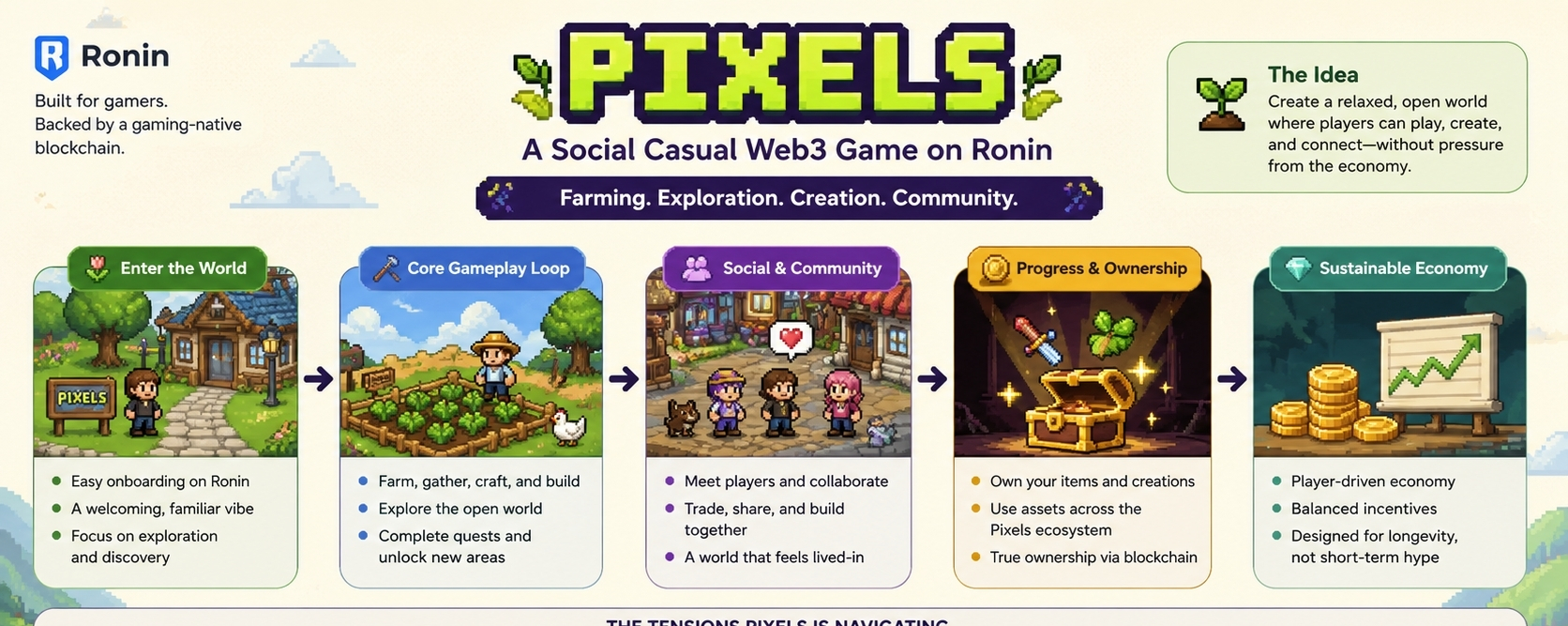
Pixels runs on the Ronin Network, and on paper it’s simple: a social, casual Web3 game built around farming, exploration, and creation. But I’ve learned not to take simplicity at face value. Sometimes it’s genuine. Other times it’s just a softer entry point into something much more transactional underneath.
Still, there’s something about how Pixels presents itself that feels… less forced. You’re not immediately pushed into thinking about optimization or returns. You’re not asked to understand a system before you’ve even spent time inside the world. Instead, it leans into slower actions—planting, harvesting, moving around, interacting. Things that don’t demand urgency.
And I keep coming back to that feeling: the absence of urgency.
Because urgency is usually the first thing you notice in Web3 games. The sense that you should be doing something now, maximizing something now, before it’s too late. Pixels doesn’t seem to operate that way, at least not on the surface. It gives you room to just exist in it for a bit. And honestly, that’s rare enough to stand out.
But I’m also careful not to take that at face value.
There’s always a deeper layer with these kinds of projects. The question isn’t just how it feels to start—it’s what it asks from you over time. That’s where things tend to shift. A game might feel relaxed in the beginning, but gradually, the underlying economy starts to shape behavior. What was once casual becomes calculated. What felt like play starts to feel like participation in a system.
With Pixels, I’m still trying to figure out where that line sits.
The farming loops are a good example. They’re familiar, almost comforting. You plant something, wait, come back, collect it. It’s the kind of rhythm that can either become genuinely satisfying or quietly repetitive, depending on why you’re doing it. If you’re doing it because it feels good to maintain something over time, that’s one experience. If you’re doing it because it feeds into a reward structure, that’s another.
And sometimes those two things blur together in ways that are hard to notice at first.
I’ve been thinking a lot about that tension—between playing because you want to and playing because it makes sense to. Web3 games often sit right in the middle of that. They try to merge enjoyment with incentive, but the balance is fragile. Tilt too far one way, and it stops feeling like a game. Tilt too far the other, and the economy starts to lose its pull.
Pixels seems like it’s trying to hold that balance more carefully than most. The social layer, for example—players sharing space, interacting, building alongside each other—feels like an attempt to ground the experience in something more human. Not just systems, but presence. That matters. People tend to stay longer in places that feel lived-in, even if nothing particularly dramatic is happening.
But again, I hesitate.
Because even social systems can become part of the same loop. Another way to keep activity going. Another layer of engagement that ultimately feeds back into the same structure. It’s not always easy to tell the difference between something that’s naturally forming and something that’s been designed to sustain momentum.
And then there’s the pacing.
Pixels feels slower than most projects in this space, and I can’t quite decide if that’s its strength or a temporary phase. Slowness can be intentional—it can create space for habits to form, for players to settle in without pressure. But it can also be fragile. In an environment that constantly pushes for growth and activity, slow systems can get reshaped over time to meet those expectations.
So I don’t assume it will stay this way.
What I do notice is that Pixels isn’t trying too hard to impress. It’s not leaning on big narratives or exaggerated promises. It feels like it’s testing something quieter: whether people will keep coming back to a world that doesn’t constantly demand something from them.
That’s a simple idea, but not an easy one.
Because attention in this space is often tied to movement—new features, new incentives, new reasons to stay engaged. Pixels seems to be asking a different question: what if people stayed without needing all of that?
I don’t have an answer yet. And I’m not sure the project does either.
But that uncertainty is part of what makes it interesting to watch. It hasn’t fully revealed what it wants to be. It’s still somewhere in between—a game that could lean more into experience, or slowly drift toward the same patterns that define everything else around it.
For now, I’m just observing.
Not expecting too much, not dismissing it either. Just paying attention to how it evolves, how it treats its players over time, and whether that initial sense of calm holds—or quietly gives way to something more familiar.