
Why do so many people say they want “ownership” in games, yet still choose to spend most of their time in traditional ones where they own nothing at all? It’s a simple observation, but it points to a deeper tension in Web3 gaming: maybe ownership, by itself, was never the main thing players were looking for.
Before projects like Pixels (PIXEL), much of the blockchain gaming space was built around a strong assumption — that giving players financial control over in-game assets would naturally make games more engaging. In theory, it made sense. If players could own, trade, and potentially profit from their time, why wouldn’t they be more invested?
But in practice, things didn’t unfold that way. Many early games felt less like games and more like systems to manage. Players logged in not because they enjoyed the experience, but because they felt they had to — to earn, to maintain assets, or to keep up with changing token dynamics. When the rewards slowed down, so did the players. What was missing wasn’t better economics, but a reason to care beyond economics.
Developers tried to fix this in different ways. Some adjusted reward models, others added more features or deeper token systems. Still, many of these efforts stayed focused on improving the financial layer rather than rethinking the experience itself. The result was often the same: complexity increased, but genuine engagement didn’t.
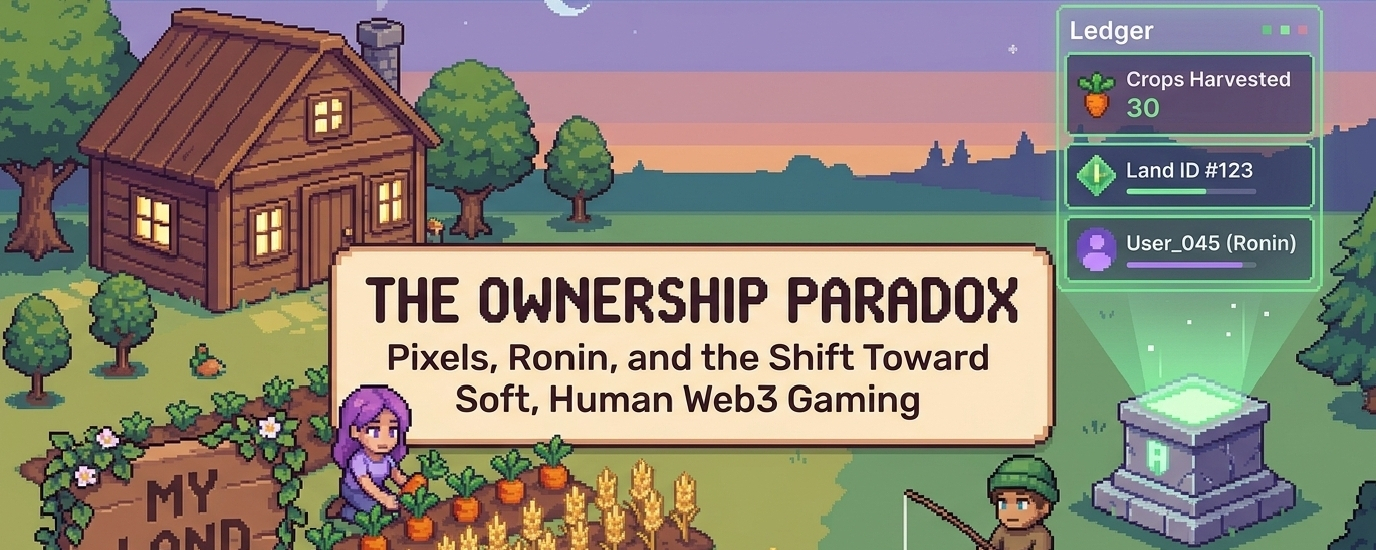
Pixels takes a noticeably different route. Built on the Ronin Network, it doesn’t present itself as a revolutionary financial system. Instead, it feels more like something familiar — a calm, social farming game where players plant crops, explore, and interact with each other in a shared space. The blockchain is there, but it’s not constantly demanding attention.
That choice changes the tone of the experience. Instead of asking, “How much can I earn here?” the game quietly encourages a different question: “Do I actually enjoy spending time here?” Ownership still exists, but it’s not pushed to the front. It becomes something that supports the experience rather than defining it.
There’s something intentional about that simplicity. The mechanics are easy to understand, and the world is designed to feel approachable. You don’t need deep knowledge of crypto to get started, and you’re not immediately overwhelmed by complicated systems. In a space that often leans toward over-engineering, this restraint stands out.
But that doesn’t mean the approach is without challenges. Simplicity can make a game welcoming, but it can also make it feel limited over time. Players who are used to more complex or competitive experiences might find less depth than they expect. And for those who entered Web3 gaming mainly for financial reasons, the quieter approach may feel less attractive.
There’s also the question of whether reducing the visibility of blockchain actually solves the original problem, or just shifts it. Even if ownership is less emphasized, it still exists in the background, along with the expectations and behaviors that come with it. Some players may still treat the game as an economic space, while others may ignore that layer entirely. Keeping those two mindsets balanced is not easy.
The reliance on the Ronin Network adds another layer to consider. While it helps with speed and lower costs, it also means the experience is tied to a specific ecosystem. Players aren’t just engaging with a game, but with the rules and limitations of that network. For some, that won’t matter. For others, it might.
In terms of who benefits, the answer is mixed. Casual players who just want a relaxed, social game may find Pixels comfortable and easy to enjoy. People already familiar with crypto might appreciate the ownership aspects without feeling overwhelmed. But complete newcomers could still face small but real barriers, especially when dealing with wallets or digital assets for the first time.
What Pixels seems to suggest is not that Web3 gaming needs bigger ideas, but perhaps softer ones. Instead of trying to change everything about games, it experiments with blending blockchain into something that already works. It doesn’t reject ownership, but it also doesn’t insist that ownership is the most important part.
Whether that balance holds over time is still uncertain. If players stay, it will likely be because they enjoy the experience itself, not just what they can extract from it. And if they leave, it may show that even a more human approach to Web3 gaming still hasn’t fully answered the original question.
So maybe the real issue isn’t whether players can own parts of a game, but whether that ownership actually makes the game feel more worth their time in the first place.