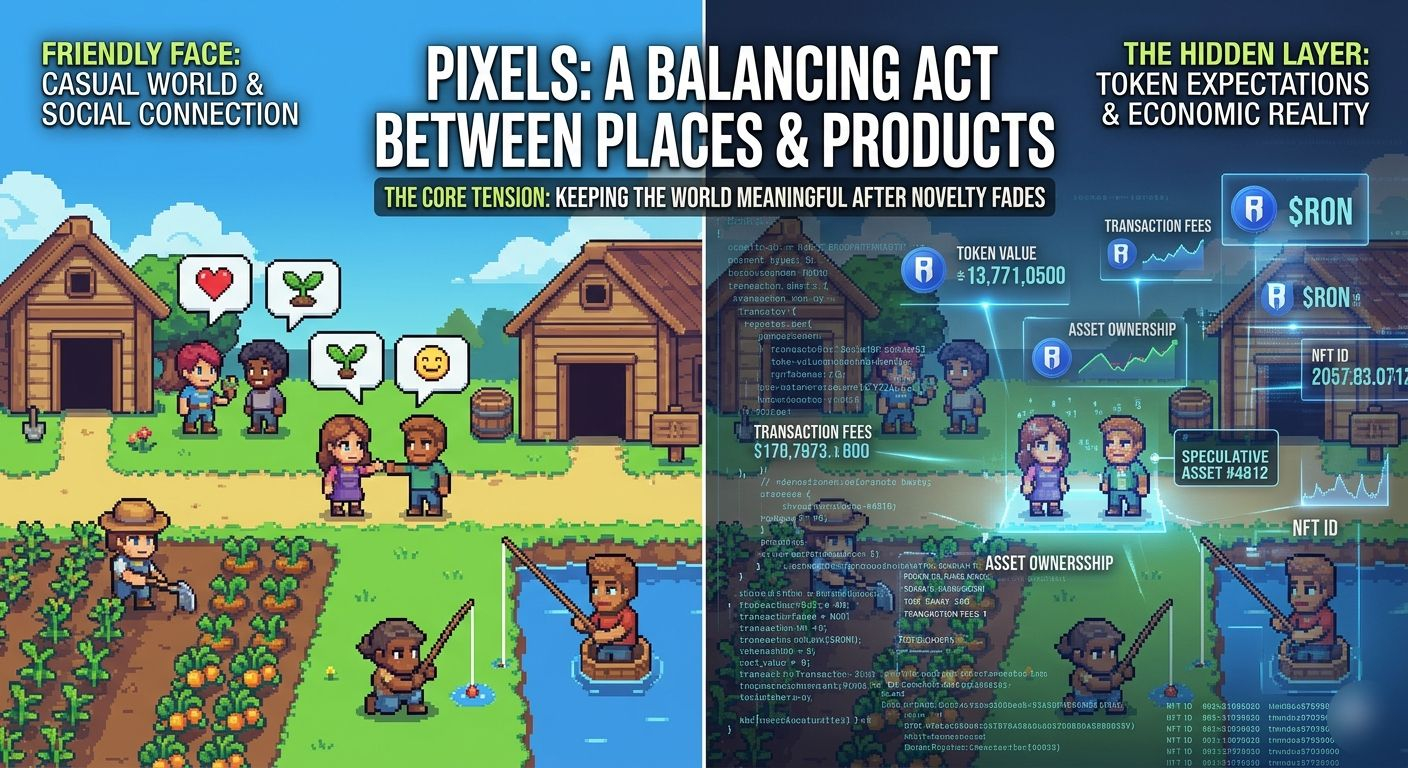
I’m watching Pixels the way I usually watch projects that sit somewhere between a game, a social layer, and a blockchain experiment. It is easy to look at something like this from a distance and reduce it to a simple story about farming, exploration, and creation on Ronin, but that is not really what I am seeing. I am seeing the same tension I keep seeing across this industry: a product wants to feel casual and welcoming, while the infrastructure underneath still carries the weight of crypto assumptions, token expectations, and the constant pressure to justify itself beyond speculation. At first it sounds simple. A world to enter, tasks to do, things to build, people to meet. But reality is different. The second a project tries to make “social” and “Web3” sit in the same chair, the room changes.
What stands out to me is not the fantasy of an open world, but the practical problem of keeping an open world meaningful after the first impression fades. I’ve seen enough blockchain games to know that a clean pitch can disappear fast once the loop becomes obvious. Real systems don’t work in extremes. They do not survive on pure novelty, and they also do not survive on pure financial incentive. That’s where things get interesting. Pixels is trying to hold attention through routine, through accumulation, through the quiet satisfaction of farming or building or just existing inside a shared space. That sounds almost too ordinary for crypto, which is probably why I find it more believable than the louder, more overdesigned projects. Still, I’m not fully convinced yet. A calm surface does not guarantee a strong economy, and a friendly interface does not erase the harder questions underneath it.
I keep coming back to this idea that blockchain games often fail not because the technology is impossible, but because the design is forced to carry too many conflicting goals. They want retention, speculation, ownership, community, liquidity, and resilience all at once. That is a heavy list for any product, let alone one that also has to feel fun. In the case of Pixels, the Ronin connection matters because it suggests an attempt to reduce friction in a space that has historically been overloaded with it. That trade-off is always visible if you look closely enough. Less friction usually means better onboarding, but it also means the project has to prove its depth elsewhere. A smooth first session is not the same as a durable economy. A charming art style is not the same as a lasting reason to return. Execution will decide everything.
The more I watch this category, the more I think the hardest part is not building a game at all. It is building a stable social reason to remain inside the game when the market is quiet, when token chatter cools down, when incentives stop looking dramatic, and when the crowd moves on to the next shiny chain or protocol. That is where a project like Pixels faces the same problem as many others: it has to justify itself as a place, not just a product. A place has habits. A place has memory. A place gives people something to do even when they are not trying to optimize. That sounds small, but it is actually the whole game. If the world feels empty without constant rewards, then the design was never really social. It was transactional.
I’ve been listening to how people talk about these projects at conferences and in online discussions, and there is always this split between the people who care about the experience and the people who care about the economics. Usually the first group is more hopeful and the second group is more suspicious, but honestly I understand both. The hopeful view says that casual games can onboard people into Web3 through familiarity rather than force. The skeptical view says that most players do not care about on-chain ownership unless the game itself is worth their time. I think the skeptical view is closer to reality, but not entirely right either. Ownership can matter, just not in the abstract. It matters when it removes friction, when it gives continuity, when it makes the world feel persistent. It does not matter much when it is used as decoration.
This is where it gets complicated for Pixels, because the project lives inside a category that has already been burned by its own narratives. People have seen too many “play-to-earn” structures collapse under their own weight. They have seen economies inflate, users chase yields, and then the social layer disappear the moment the incentives weaken. So any new project has to work against that memory. It cannot simply say “this time is different.” It has to show patience. It has to show restraint. It has to avoid overpromising what the token can do. That is difficult in crypto, where the market keeps rewarding loud claims and punishing nuance. Yet nuance is exactly what a serious project needs if it wants to last.
When I look at the farming and creation angle, I see a design choice that makes sense, even if I am cautious about it. Farming is legible. Creation is sticky. Exploration is what gives people the illusion of freedom while still giving the system structure. That combination has been proven in traditional games for a reason. The question is whether the blockchain layer adds enough value without distorting the loop. If every action becomes too financialized, the game turns brittle. If the chain layer is too invisible, then the project risks becoming just another game with a wallet attached. That balance is hard. Maybe harder than the industry admits. I keep hearing people say “mass adoption” as though it is a marketing milestone, but adoption is actually a design problem. People stay when the product respects their attention.
I also think about the architecture side of this, because even when a game feels casual, the underlying system has to absorb serious pressure. Scaling is not just about throughput. It is about how much complexity the user is forced to carry. It is about whether the experience can stay coherent when more people arrive, when assets multiply, when markets react, when governance changes, when regulation gets louder. And regulation will get louder. It always does. Projects that touch ownership, digital assets, and social coordination do not get to pretend policy is someone else’s problem. They have to assume that every visible success attracts scrutiny. That means careful decisions around custody, incentives, disclosures, and user expectations. It also means a project like Pixels cannot survive on the idea that the market will always interpret it generously. Markets rarely do.
I’m looking at the broader Web3 gaming landscape, and I think the real competition is not another game on another chain. It is attention itself. The user is always choosing between convenience and commitment, novelty and continuity, entertainment and effort. Most crypto games ask for too much too early or too little too late. Pixels seems more aware of that trap than some others, but awareness is not the same as immunity. The project still has to prove that its rhythm works after the novelty fades. That means the loops have to be pleasant enough to repeat and deep enough to avoid becoming chores. That is a narrow path. A project can easily become too shallow for serious players and too demanding for casual ones. This industry loves middle-ground rhetoric, but real product work lives in the tension between those extremes.
I keep seeing the same mistake over and over: teams confuse visible activity with durable engagement. A crowded event, a trending post, a spike in wallet activity, a temporary reward chase all of that can look impressive from a distance. But I have learned to read the quieter signs. Are people returning because they want to, or because they are still chasing a curve? Are they speaking about the world itself, or only about expected upside? Are they creating habits, or only extracting value? Those questions matter more than launch-day enthusiasm. In a project like Pixels, the answer will come from retention quality, not just headline numbers. And retention quality is hard to fake. People can be onboarded. They cannot be forced to care.
At this stage, I see Pixels as one of those projects that could either settle into a credible niche or get pulled apart by the usual crypto gravity. The design idea is understandable. The setting has enough social texture to matter. The Ronin ecosystem gives it a recognizable home. But the industry is full of projects that looked coherent until real usage exposed the seams. That is why I stay cautious. I am not dismissing it. I am just not willing to confuse a polished premise with a solved problem. The only thing that really convinces me now is whether the system can keep working when the noise drops. Whether the economy feels fair when players are not being aggressively rewarded. Whether the social layer still feels alive when nobody is trying to sell the story.
That’s where things get interesting for me. Not in the pitch, but in the maintenance. Not in the launch, but in the months after. Not in the promise of a lively open world, but in the discipline required to keep one from becoming hollow. I keep coming back to this idea because it seems to separate serious projects from everything else. A good crypto game does not need to scream for attention every day. It needs to earn repeat presence. It needs to make the ordinary parts of participation feel worth returning to. That is harder than it sounds, and probably why so few teams really get there. Pixels may be aiming in the right direction, but the industry has taught me to respect ambition only after it survives contact with reality.