

I started noticing something that did not quite sit right but also did not fully break the experience
On the surface everything felt consistent calm loops of planting harvesting moving and returning a rhythm that seemed designed to be trusted rather than questioned It was easy to fall into it easy to believe that time spent would naturally convert into progress
But that assumption began to feel less stable the longer I stayed inside it
Pixels presents itself as a world where activity is visible and effort feels tangible You move you act you receive something in return The feedback is immediate enough to keep you engaged and just delayed enough to suggest that something deeper might be accumulating beneath it
At first I accepted that structure without resistance It resembled other systems I had seen before where repetition builds familiarity and familiarity builds a sense of control But over time I began to notice that not all movement carried the same weight Not all actions seemed to pass through the system in the same way
Some actions returned value quickly and predictably Others felt like they disappeared into something less visible as if they were processed but never truly counted
That was the first moment where the surface began to separate from what might exist underneath it
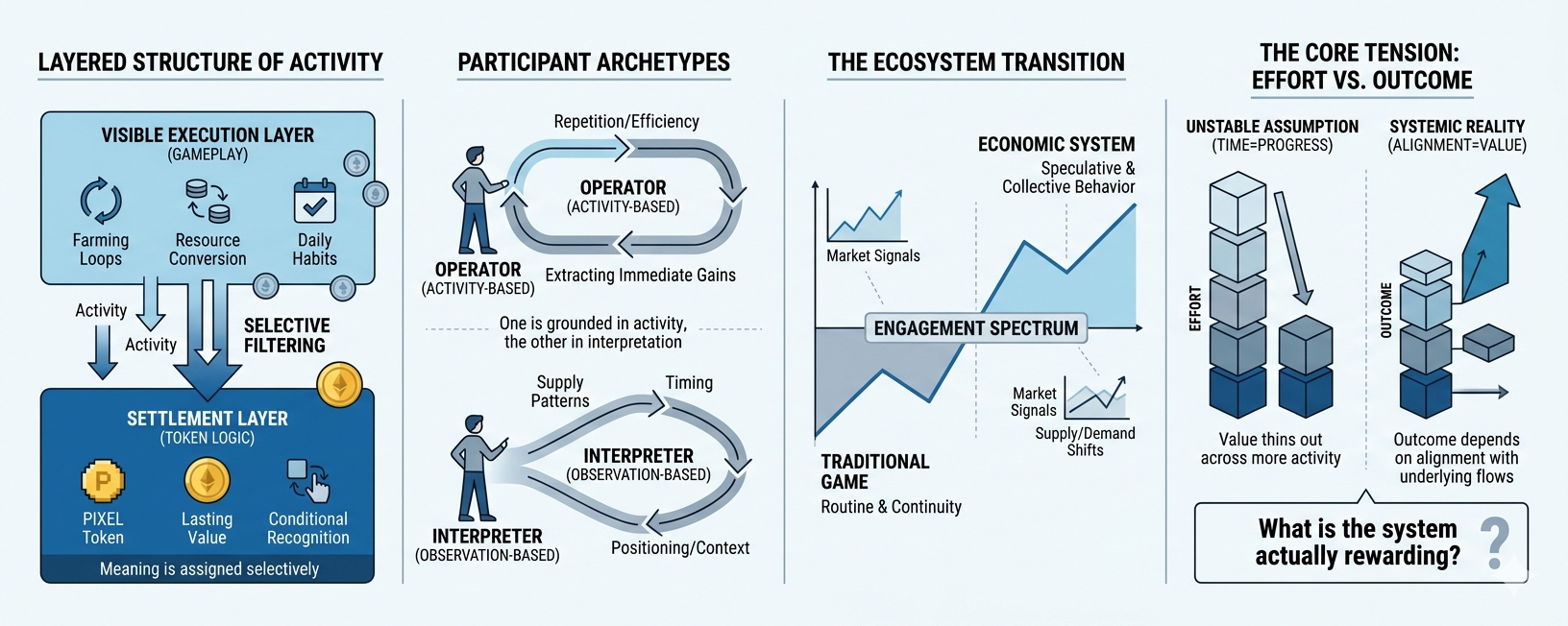
The visible layer is straightforward enough Farming exploration resource conversion small loops that reinforce themselves through repetition Coins circulate within this layer giving the impression of continuity and local progress It feels self contained almost complete
But it is not complete
There is another layer that does not present itself as directly one that operates with different rules and different thresholds for what is considered meaningful
The presence of PIXEL introduces a different kind of logic Not a replacement for the visible system but something that filters it Not everything that happens on the surface translates cleanly into this deeper layer and the transition between them is not always clear
This is where the structure begins to feel less like a game and more like a system that evaluates rather than simply rewards
I started to think about it in terms that did not initially belong to games at all The visible actions began to resemble an execution layer where activity is processed but not necessarily finalized The deeper token layer felt closer to a settlement layer where only certain actions are recognized as having lasting value
And the distance between these two layers is where most of the tension seems to exist
Two players can spend similar amounts of time within the same world performing similar actions following similar loops and yet arrive at very different outcomes Not because one worked harder but because one moved in ways that aligned more closely with what the system ultimately recognizes
Effort is visible but value is selective
This distinction is subtle at first almost easy to ignore especially when the loops themselves are satisfying enough to sustain attention But over time it becomes harder to avoid The question shifts from what am I doing to what is actually being counted
And those are not the same question
Some players continue to operate within the visible loops refining efficiency improving speed optimizing repetition They become better at executing the surface layer extracting as much as possible from what is immediately available
Others begin to step slightly outside of it Not entirely leaving but observing They start to notice patterns in supply in timing in how certain resources move through the system while others stagnate They begin to position themselves rather than simply act
The difference between these two approaches does not always appear immediately but it accumulates
One is grounded in activity the other in interpretation
Over time interpretation seems to carry more weight
This is where the environment begins to resemble something closer to a market than a traditional game The dynamics are no longer limited to predefined mechanics They emerge from interaction between participants from shifts in supply and demand from subtle forms of competition that are not always visible
Resources become more than items they become signals Prices reflect not just scarcity but behavior Bottlenecks appear not because they were designed that way but because players collectively move toward or away from certain actions
There is no explicit instruction guiding this but the system still shapes it
In that sense it is not neutral
Some behaviors are amplified rewarded more directly more consistently Others are absorbed quietly processed without leading to meaningful accumulation It is not that those actions fail they simply do not cross whatever threshold exists between execution and settlement
They remain local
Coins circulate within their loops reinforcing the sense of progress without necessarily contributing to something that persists beyond them
This layered structure changes how progression feels It is no longer a straight line of effort leading to outcome It becomes something more conditional more dependent on alignment with underlying flows that are not always transparent
And once that becomes visible even partially it is difficult to return to the earlier assumption that time alone is enough
The system does not reject activity it just filters it
That filtering creates a quiet hierarchy not between players in an obvious sense but between behaviors Some actions lead somewhere others stabilize in place
The distinction is rarely announced
It is discovered slowly through experience through small inconsistencies that begin to form a pattern
At some point the role of the player begins to shift
It stops feeling like playing in the traditional sense and starts to resemble participation in something that exists independently of any single user The environment does not adapt to you as much as you adapt to it
And adaptation requires awareness
Not just of mechanics but of context of timing of how other participants are moving within the same system
There is a kind of silent competition embedded in this Not aggressive not explicit but persistent Players are not only interacting with the environment they are indirectly shaping each other outcomes through collective behavior
Undercutting positioning waiting choosing when to act and when not to act
These are not typical game skills yet they become relevant here
Which raises a question that does not resolve easily
Is this still a game in the way we usually define it or is it something closer to an economic system that happens to be experienced through gameplay
The answer does not seem fixed
It depends on how one engages with it
For some it remains a routine a set of habits repeated daily not because they lead to optimal outcomes but because they create a sense of continuity Something predictable in an otherwise variable system
For others it becomes more speculative a space to observe test and position with the understanding that outcomes are shaped by factors beyond individual control
Both forms of engagement coexist neither fully replacing the other
Which might be part of what sustains the system
But it also introduces a different kind of pressure
The presence of a token layer tied to broader dynamics means that supply does not exist in isolation Unlocks distribution external sentiment these factors begin to influence what happens inside the environment even if indirectly
If participation grows alongside supply the system can absorb it
If not the imbalance becomes harder to ignore
Value begins to thin out across more activity
And the filtering becomes more pronounced
Again not through explicit restriction but through subtle shifts in what is recognized as meaningful
This is where the earlier sense of discomfort returns
The loops still function the world still feels coherent the actions still produce results
And yet something does not fully align
The relationship between effort and outcome remains unstable
Not broken but conditional
It works but only within certain boundaries that are not always visible
Which leads back to the initial observation
That not all activity inside this system carries the same weight
Some of it passes through and settles into something that persists
Some of it circulates without ever crossing that threshold
And the difference between those two outcomes is not always tied to how much is done but to how closely it aligns with what the system is designed to recognize
I am still not sure whether that makes it more interesting or more uncertain
Maybe both
Because the deeper I look at it the less it feels like a simple loop of action and reward and more like a layered structure where meaning is assigned selectively rather than distributed evenly
And once that becomes visible even slightly it changes how everything else is perceived
Maybe the real question is not how to play better but what the system is actually rewarding
At some point it stops being about what you do and starts being about what the system allows to matter