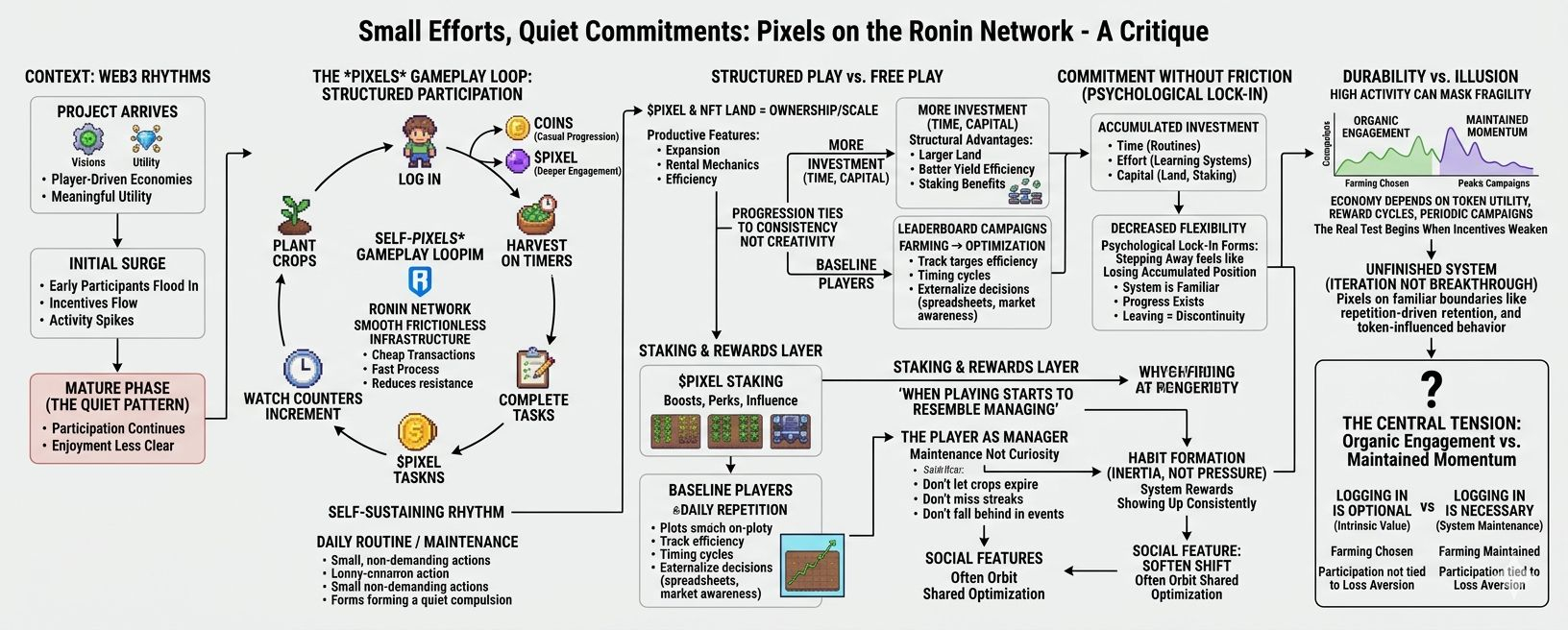

I’ve spent enough time in Web3 ecosystems watching wallets connect, tokens launch, and virtual worlds promise ownership to recognize a familiar rhythm. Projects arrive with visions of player-driven economies and meaningful utility. Then comes the surge: early participants flood in, incentives flow, activity spikes. For a while, everything feels productive. But gradually, a quieter pattern emerges one where participation continues, even as enjoyment becomes less clear.
This isn’t unique to any single game. It’s structural. And Pixels fits into this pattern more than it escapes it.
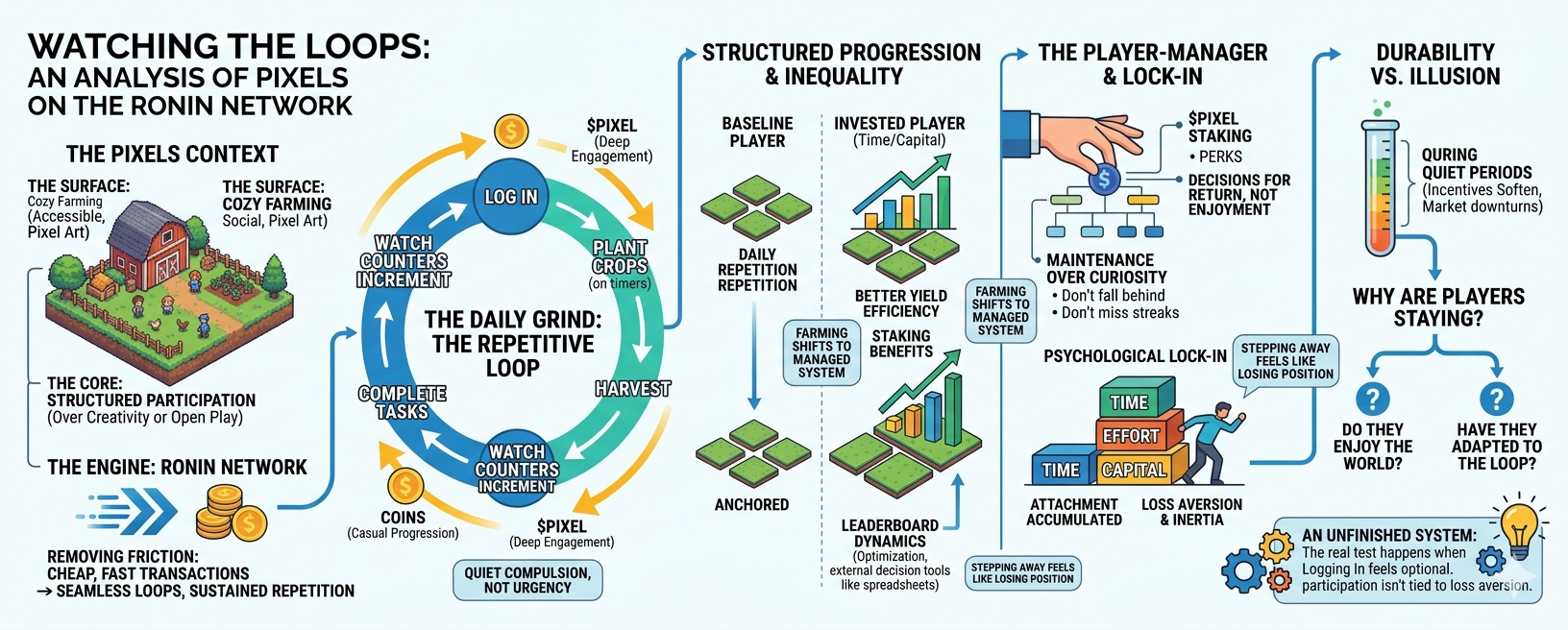
On the surface, Pixels presents itself as a cozy, pixel-art farming and exploration experience. It’s approachable, social, and visually light. But over repeated sessions, what stands out isn’t creativity or open-ended play it’s the emergence of tightly structured behavioral loops. You log in, plant crops, harvest on timers, complete tasks, and watch counters increment. Coins for casual progression, $PIXEL for deeper engagement. The loop is simple, consistent, and efficient.
The Ronin Network plays an important role here. By removing friction cheap, fast transactions it allows these loops to feel seamless. Unlike earlier blockchain games where fees interrupted flow, here the system runs smoothly. That smoothness matters. It lowers resistance and makes repetition easier to sustain.
Over time, this creates a quiet compulsion. Not urgency, but routine.
You check tasks. Optimize planting cycles. Visit neighboring farms. Maybe adjust your layout or experiment with production. None of it feels demanding in isolation. But collectively, these small actions form a rhythm that’s easy to return to and harder to step away from.
Structured Play, Not Free Play
Pixels doesn’t push players toward chaos or creativity first. It nudges them toward structured participation.
The dual-currency system reinforces this. Off-chain Coins keep the experience accessible, while $PIXEL and NFT land introduce ownership and scale. Land isn’t just cosmetic it’s productive. It allows expansion, rental mechanics, and increased efficiency. Farming shifts from a personal activity into something closer to a managed system.
At first, progression feels rewarding. Each cycle produces visible output. Skills increase. Systems unlock. But over longer periods, a different pattern emerges: progress becomes tied less to creativity and more to consistency.
Those who invest more time, capital, or both gain structural advantages:
Larger land
Better yield efficiency
Access to staking benefits
Meanwhile, baseline players remain anchored to daily repetition. The system doesn’t block them it simply scales unevenly.
Leaderboard campaigns intensify this dynamic. What begins as casual farming gradually shifts toward optimization. Players start tracking efficiency, timing cycles, and even externalizing decisions spreadsheets, calculations, market awareness. The game expands beyond itself.
When Playing Starts to Resemble Managing
The staking and rewards layer deepens this shift.
Staking Pixel unlocks boosts, perks, and influence. In-game actions generate token exposure. The line between “playing” and “working the system” becomes blurred. Players begin to make decisions not just based on enjoyment, but on return.
This isn’t necessarily negative it’s coherent design. But it changes the relationship between player and game.
Daily logins become less about curiosity and more about maintenance:
Don’t let crops expire
Don’t miss streaks
Don’t fall behind in events
This is where habit formation takes hold. Not through pressure, but through continuity. The system rewards showing up consistently, quietly.
Social features soften this. Visiting other farms, seeing personalized spaces, interacting with others these moments add texture. But even here, interaction often orbits around shared optimization:
Which crops are most profitable
How to maximize output
When to enter or exit events
The social layer exists, but it frequently aligns with economic behavior.
Commitment Without Friction
As time accumulates, so does attachment but not always in obvious ways.
Players invest:
Time (daily routines)
Effort (learning systems)
Sometimes capital (land, staking)
Gradually, flexibility decreases. Not because the game forces it, but because stepping away feels like losing accumulated position. This is where psychological lock-in forms not through excitement, but through inertia.
You keep logging in because:
The system is familiar
Your progress exists inside it
Leaving means discontinuity
This isn’t unique to Pixels. It’s a recurring pattern in Web3 gaming where ownership promises autonomy, but often results in subtle dependency.
Activity remains high. Metrics look strong. But the underlying question shifts:
Is this sustained by new interest, or by existing commitment?
Durability vs. Illusion
Pixels does show awareness of earlier GameFi failures.
There are attempts to:
Introduce token sinks (VIP systems, spending mechanics)
Balance inflation
Emphasize social engagement over pure extraction
Ronin provides stable infrastructure. The experience is smoother than previous iterations of blockchain games. There is polish here more than most.
But the core tension remains unresolved.
The economy still depends on:
Token utility
Reward cycles
Periodic campaigns
And when those incentives weaken whether through market conditions or internal adjustments the real test begins.
Do players stay because they enjoy the world?
Or because they’ve adapted to the loop?
High activity can mask fragility. Systems can appear stable while relying heavily on already-committed users. The difference between organic engagement and maintained momentum isn’t always visible from the outside.
An Unfinished System
Pixels and projects like it aren’t failures. But they aren’t breakthroughs either.
They represent iteration:
Better infrastructure
More refined loops
Improved accessibility
Yet they remain within familiar boundaries:
Repetition-driven retention
Token-influenced behavior
Progress tied to consistency over creativity
The systems are still evolving. Their real evaluation won’t happen during peak campaigns or bullish cycles, but during quieter periods when incentives soften and only intrinsic value remains.
That’s when patterns become clear.
When logging in feels optional rather than necessary.
When farming is chosen, not maintained.
When participation isn’t tied to loss aversion.
Final Thought
In the end, the question isn’t whether the system works it clearly does.
The real question is more subtle:
Are players engaging because they want to… or because the loop has learned how to keep them there?
And that distinction, over time, is what will define whether something lasting is actually being built—or just carefully sustained.