When I first started looking at Pixels (PIXEL), I thought I had a pretty solid grasp of the typical Web3 gaming mechanics. After all, the play-to-earn model isn’t exactly new. The basic idea seemed straightforward enough engage in farming, explore, and create within a digital world, earning tokens as you go. At first, it felt like just another familiar loop: play, earn, repeat. But as I spent more time with it, something started to feel off. Not in an obvious way, but in the quiet mechanics at work beneath the surface.
It wasn’t about the game’s visuals or the simple farming activities notit was something about the rhythm. The loop was almost too calm. I’d log in, plant crops, maybe gather some resources, and then log out. The rewards weren’t overwhelming, and there was no rush. I might’ve been missing something, but it started to feel like I was engaging in a longer game—one that wasn’t immediately about making quick profits or leveling up rapidly. I might be wrong, but the more I thought about it, the more I realized that this system, like many others in Web3 games, isn’t about loud, flashy mechanics. It’s about quiet shifts that gradually reshape behavior. And that's where the game’s true power lies.
The core structure is deceptively simple. Pixels encourages players to engage in a daily rhythm of farming and creation. The “play, earn, repeat” pattern is smooth and predictable, yet the outcomes aren’t as obvious as they seem. It’s easy to dismiss this as yet another farming simulator with a tokenized economy. But that simplicity, that apparent lack of urgency, actually hides a deeper design choice: the game doesn’t reward you loudly it just nudges you toward more subtle forms of engagement. It’s in how you’re drawn back into the game day after day, without any overt compulsion.
As time passed, I started to notice how the system was actually reshaping my behavior, but in ways that weren’t immediately apparent. There was no countdown ticking down to tell me how long I had left to “earn” or how many levels I’d climbed that day. It felt like a subtle shift from intense achievement-seeking to a more habitual form of play. It wasn’t about rushing to make the most of every minute. Instead, it was about routine—a small, steady rhythm that makes you feel like you’ve accomplished something without ever telling you, “Hey, look, you’re progressing.” The system wasn’t celebrating individual moments of success; it was gradually weaving them into a long-term behavioral pattern.
It wasn’t just about farming crops, either. It was the underlying feedback loop that I began to realize was working its magic. Every time I logged in, I’d have a sense of small but important things to do. No grand rewards, no rushing. It made me want to come back—not because there was an immediate benefit, but because the game was doing something behind the scenes. This was the system learning and adapting, observing its players and adjusting how it interacted with us. It wasn’t just responding to our actions; it was gathering data to compress feedback loops, allowing for near real-time adjustments. The more I interacted, the more the system learned my behavior, and in return, I was nudged back in without even thinking about it.
What struck me most was how the Pixels economy wasn’t about individual moments of success. It wasn’t about collecting massive rewards or climbing leaderboards. Instead, it was about a continuous rhythm of interaction—players moving through loops of farming, crafting, and exploring. This behavior was being captured and redirected in ways that seemed subtle, but when I started thinking about it, the broader picture began to emerge. The game wasn’t just looking at how often players engaged; it was tracking how that engagement fed into the broader economy. It was converting behavior into value, but it wasn’t through a single, isolated transaction. It was spread out, distributed over time, and collected in ways that were harder to trace but still effective.
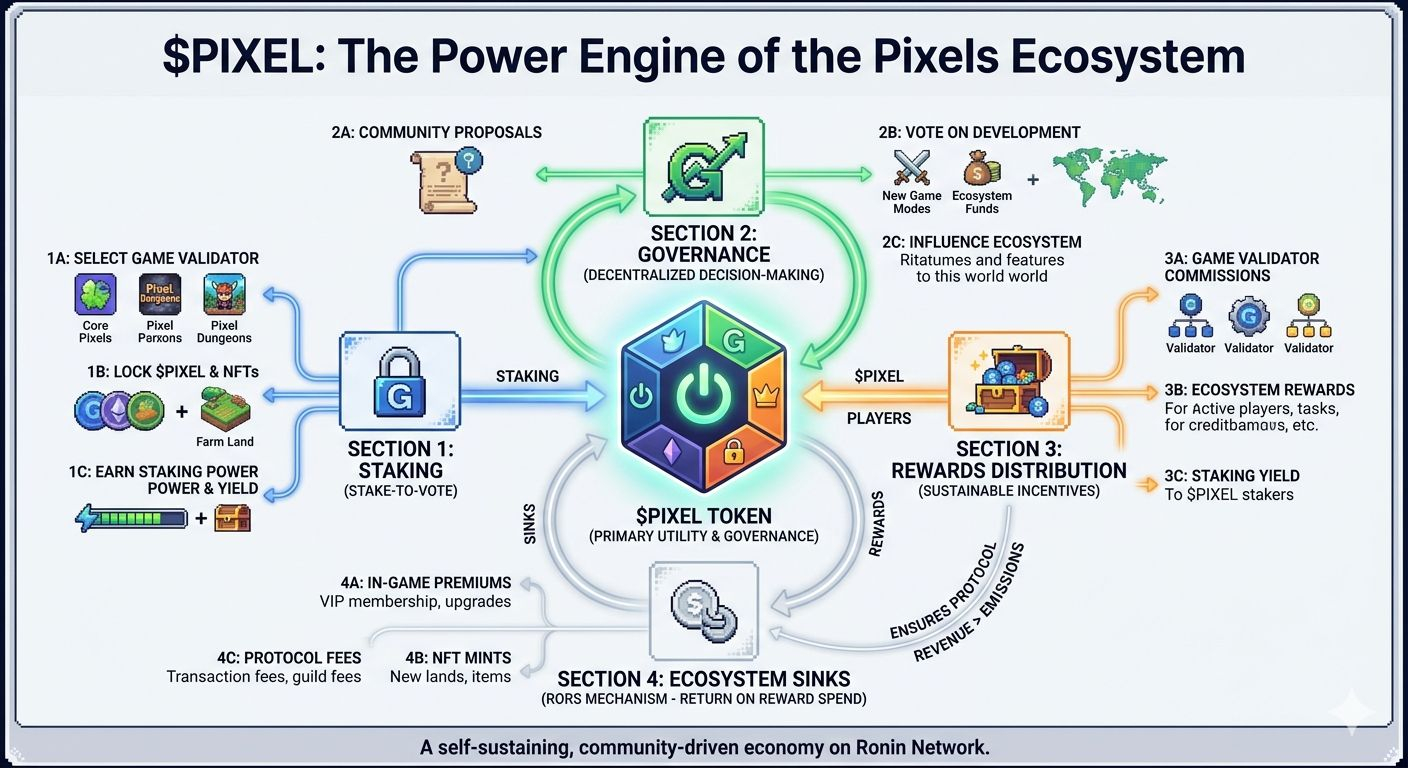
And that’s where the token layer, $PIXEL, comes in. At first glance, $PIXEL might seem like just another reward mechanism, but it’s much more than that. It’s a behavioral instrument—an anchor that ties players to the system without needing constant external incentives. It’s utility, not just in-game rewards but as part of a broader ecosystem that spans multiple environments. Whether it’s used to trade resources, craft new items, or participate in larger community-based activities, the token has a role beyond being a simple exchange medium. It’s an integral part of the way behavior is shaped and controlled. The demand for $PIXEL doesn’t just come from speculation or hype; it emerges naturally as part of the system’s design—driven by repeated actions, players’ behavioral patterns, and a layer of utility that doesn’t have to shout for attention.
This isn’t a flashy game. It doesn’t rely on the kind of overt excitement that some might expect from a Web3 experience. Instead, it leans into the subtler aspects of engagement. The $PIXEL token, with its utility across different loops and environments, becomes a critical piece of this subtle dance. Players aren’t just collecting tokens—they’re engaging in a long-term rhythm that ties their behavior directly to the value being generated. And while this might seem quiet, it’s anything but trivial. The more I thought about it, the clearer it became that this is the real genius behind the design: the token isn’t just a reward—it’s an operational mechanism that guides behavior, adapts to players, and reorients the economy without needing constant external stimuli.
But like any system, there are risks. Scaling is one obvious concern. As more players come in, the subtle mechanisms that work so well on a small scale may start to show their cracks. There’s also the danger of dilution—especially if integrations with other platforms or games aren’t strong enough to support the ecosystem. How do you ensure that the system doesn’t collapse under its own weight as it tries to scale? And how do you balance player engagement with the broader economic needs of the platform? These questions don’t have easy answers, but they’re part of the growing pains of any evolving system.
And then there’s the issue of fragility. Pixels relies heavily on its player base being engaged, and that base is not homogeneous. Different players interact with the game in different ways, and it’s easy for a game like this to find itself losing some of its most engaged users if the system isn’t continuously adapting to their behavior. This creates a risk where a small change in player behavior can have outsized consequences on the broader system.
But at the same time, that’s part of the broader shift we’re seeing in the industry. It’s no longer about attention or marketing spend driving a game’s success. It’s about behavior—how players engage, how they adapt, and how systems can be structured to encourage not just participation but long-term sustainability. It’s not about creating the next big thing; it’s about building something that quietly reshapes the way we interact with digital worlds and how value flows through them.
In the end, Pixels isn’t just another game. It’s a living system, quietly nudging us toward new ways of thinking about value, engagement, and the role of tokens in creating lasting behavioral change. I don’t know where it’s all headed, but I’m beginning to think it’s less about chasing the next big thing and more about understanding how systems don’t change loudly they reshape behavior quietly. As I continue to engage with the game, I can’t help but wonder: in a world where efficiency is increasingly prioritized over personal identity, what does it mean to truly own something in a decentralized world? Are we all just participants in a larger economic infrastructure, or do we still have a say in how that system evolves?