
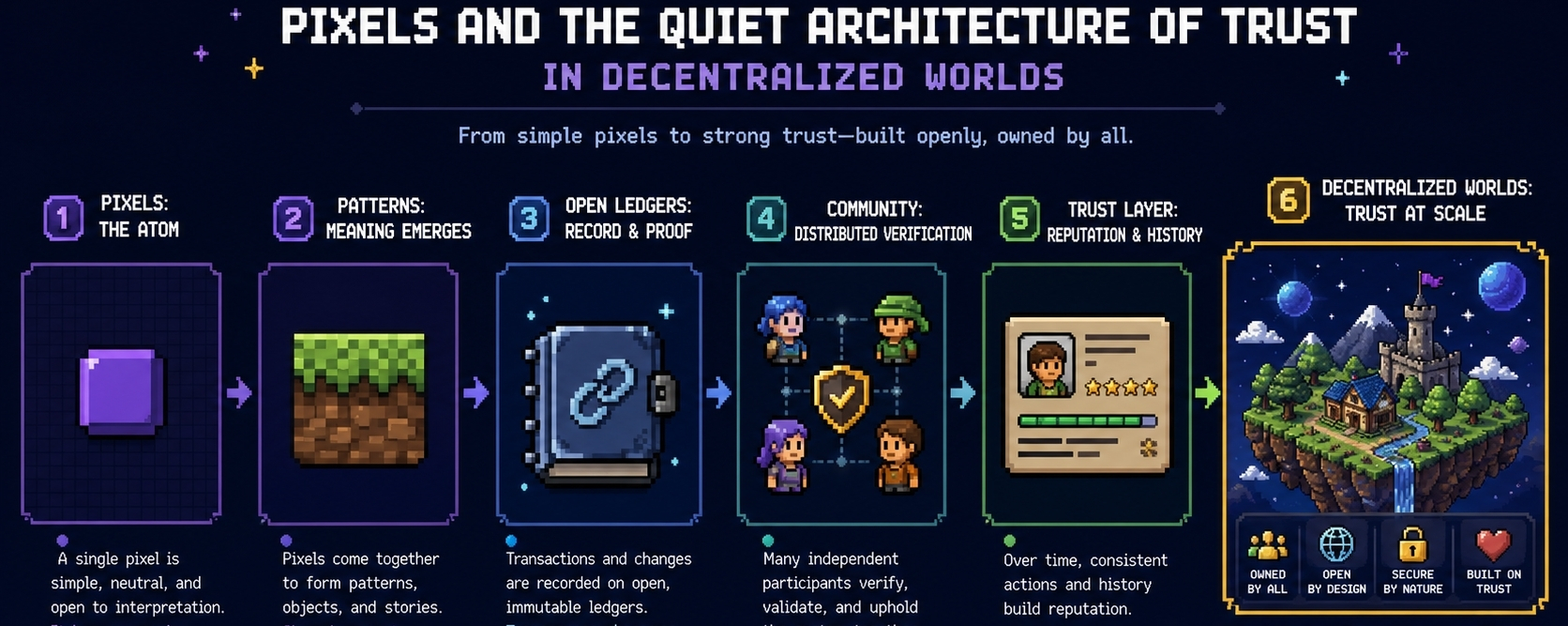
I keep coming back to Pixels, not because it demands attention, but because it quietly holds it. At first, it feels almost too simple to matterplanting crops, wandering around, interacting with others in a soft, unhurried way. But the longer I sit with it, the more I start to sense that the surface is just a thin layer over something more interesting.
What I’m noticing isn’t really about the game mechanics themselves. It’s about how people behave when the system steps back just enough. There’s no heavy-handed structure forcing outcomes, yet things don’t fall apart. Players find their rhythm. They trade, they return, they form habits that slowly turn into patterns. It doesn’t feel engineered in the traditional senseit feels like something that grows.
I find myself paying attention to how little friction there is around ownership. The underlying blockchainrunning through Roninis doing its job quietly, almost invisibly. Assets belong to players in a way that feels settled, not constantly questioned. And because of that, people stop focusing on proving ownership and start focusing on using it. That shift is subtle, but it changes everything. When you don’t have to think about whether something is yours, you start thinking about what you can build with it.
Over time, I’ve started to see that what’s forming here isn’t just a game economy. It’s a kind of social fabric. Not the loud, performative kind you see on typical platforms, but something softer. Trust isn’t assigned or calculatedit accumulates. You begin to recognize names, behaviors, small consistencies. Someone who shows up regularly, someone who trades fairly, someone who contributes without being asked. None of this is formally tracked, yet it carries weight.
This makes me think about how coordination usually works online. Most systems try to solve it by tightening controlmore rules, more tracking, more optimization. Pixels seems to move in the opposite direction. It provides just enough structure to keep things coherent, but leaves enough space for people to figure things out themselves. And interestingly, they do.
There’s something almost ecological about it. Instead of forcing balance, the system allows imbalances to appear and then resolve through interaction. Supply and demand aren’t fixedthey shift based on behavior. Roles aren’t assignedthey emerge. Some players become traders, others focus on production, some just exist socially. It’s not perfectly efficient, but it feels alive.
I also can’t ignore the way time behaves here. In many digital spaces, everything feels temporary, like it could reset at any moment. But in Pixels, there’s a quiet persistence. What you do today has a way of lingering. Land, items, relationships—they don’t disappear into abstraction. This continuity creates a different mindset. People act with a bit more care, not because they’re forced to, but because it feels natural to do so.
The more I think about it, the more it feels like an experiment in how minimal a system can be while still supporting meaningful cooperation. It doesn’t try to eliminate uncertainty or human unpredictability. Instead, it seems to rely on it. And somehow, that makes the system feel more stable, not less.
What stays with me is the sense that Pixels isn’t trying to impress anyone. It’s not loud about what it’s doing. But beneath that simplicity, it’s exploring a deeper idea—how digital environments can support trust without over-defining it, how people can coordinate without being tightly managed, how systems can guide behavior without scripting it.
I’m not sure most people notice this when they first step into it. I didn’t either. But the longer I watch, the more it feels like the real story isn’t the game itselfit’s the quiet structure underneath, shaping interactions in ways that feel almost invisible, yet surprisingly durable.