

routine player activity into a steady, repeatable economic loop. That loop is the foundation. Not excitement, not speculation. Just continuity that holds even when attention shifts elsewhere.
It works because participation is not treated as decoration. It is treated as input. Small actions, repeated over time, begin to carry structure. Nothing about it feels loud, but the design gradually builds a system where value is earned through consistency rather than spikes of activity.
This is where most GameFi systems struggle. Pixels does not solve it completely, but it moves closer than earlier models. Slowly.
Very slowly.
Simple explanation of what the project does
At a basic level, Pixels is a browser based social farming environment where players grow resources, complete tasks, and interact with others while building digital land-based progress. The loop is familiar on the surface. Plant, harvest, upgrade, repeat.
But the interaction layer is where it shifts. Player actions are tied to progression systems that extend beyond cosmetic rewards, connecting directly to the broader in-game economy and token flow linked to PIXEL.
It is not just farming. It is structured repetition with economic feedback.
There is a difference. Small, but important.
Each action has delayed consequences rather than immediate gratification. That delay changes player behavior more than the mechanics themselves.
What’s happening underneath
Underneath the visible gameplay, the system behaves like a controlled resource engine. Inputs are time, attention, and coordination. Outputs are progression, resource accumulation, and token-linked rewards.
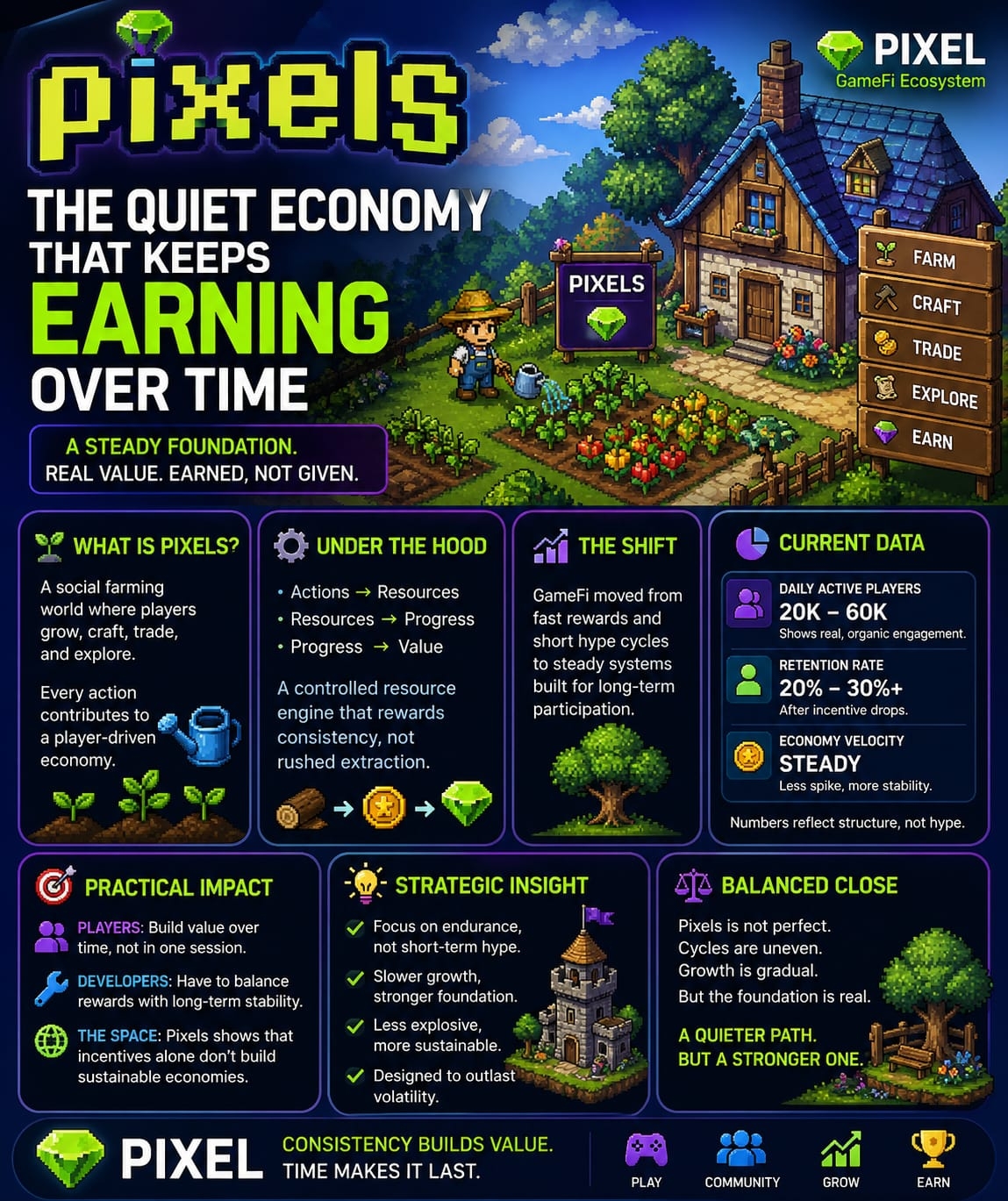 The key mechanism is not complexity. It is pacing. Rewards are not concentrated in single moments but distributed across cycles. This reduces volatility in engagement patterns and stabilizes participation.
It also creates friction, but not in a negative sense. More like weight. The system resists rapid extraction of value, which forces longer interaction spans.
That resistance is intentional.
And it matters.
Because without it, most GameFi economies collapse into short extraction windows followed by disengagement. Pixels tries to stretch that window into something continuous, even if imperfectly.
Historical shift
Earlier GameFi models were built around acceleration. Fast rewards, rapid token emissions, aggressive incentives. The assumption was simple: more rewards equal more participation.
That assumption did not hold for long.
Players adapted quickly, extracted value faster, and left. The systems could not stabilize because they depended on external attention rather than internal structure.
Pixels represents a quieter shift away from that approach. Instead of maximizing short term yield, it distributes interaction over time. Not fully new, but noticeably more restrained.
This restraint changes how the economy behaves. It stops treating every player action as an immediate monetization event and instead builds layered progression.
The shift is not dramatic. It is gradual. Almost hesitant.
But noticeable.
Current data with context
At its peak activity phases, Pixels has recorded daily active participation in the range of tens of thousands of users, fluctuating with seasonal updates and incentive cycles. The important detail is not the peak itself, but the retention pattern that follows it.
Where many GameFi projects lose most users within weeks, Pixels retains a smaller but persistent base that continues interacting even during lower reward periods. That difference in retention rate, often estimated to hold above 20 to 30 percent of active users after incentive drops, signals structural engagement rather than purely reward-driven behavior.
The exact numbers shift, but the pattern remains stable. That stability is the point.
Token velocity tied to PIXEL also reflects this. Instead of extreme spikes followed by deep inactivity, the movement is more distributed. Less explosive. More consistent.
Consistency here is not exciting. But it is functional.
And function matters more than excitement in long systems.
Practical implications
For players, this structure changes expectations. You are not optimizing for single session gains. You are building accumulation over time. That changes decision making even in small actions.
For developers, it introduces constraints. Reward systems cannot be too aggressive or they destabilize the loop. They also cannot be too weak or engagement fades. Balancing that becomes an ongoing adjustment rather than a fixed design choice.
For the broader GameFi space, Pixels demonstrates something uncomfortable. Incentives alone are not enough. Without structural pacing, systems collapse into short term cycles regardless of funding or branding.
There is a quiet lesson here.
Sustainability is not created by scale. It is created by rhythm.
Strategic insight
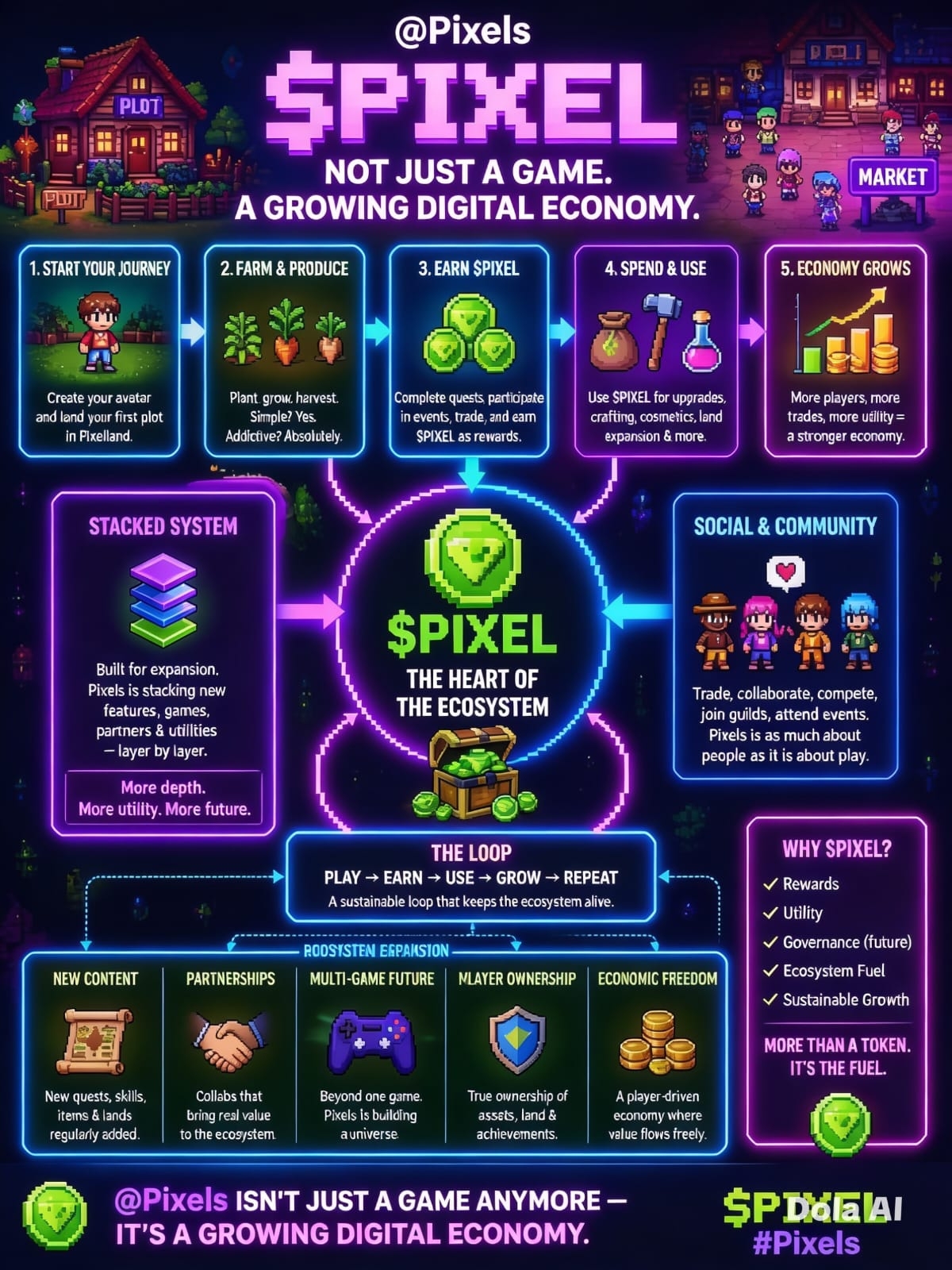 The underlying strategy behind Pixels is not expansion through hype cycles but endurance through controlled repetition. It does not attempt to outpace attention. It attempts to outlast volatility.
That approach creates limitations. Growth is slower. Monetization peaks are less aggressive. But it also reduces fragility.
A system built on steady participation can absorb shocks better than one built on sudden inflows. That is the tradeoff.
And it is not evenly understood in the GameFi space yet.
Most projects still chase acceleration. Pixels leans toward stability, even when it costs visibility.
That decision is not perfect. It creates friction with users expecting faster returns. But it also creates a more grounded baseline economy that does not fully reset after each cycle.
Underneath it all, the design is closer to infrastructure thinking than entertainment thinking.
That distinction is subtle but important.
Balanced close
Pixels does not resolve the tension between gameplay and economic systems. It only reorganizes it into something more manageable. The friction is still there. It just spreads out over time instead of concentrating in bursts.
The result is not smooth. It is uneven. Some cycles feel active, others feel slow.
That unevenness is part of the structure, not a failure of it.
In practical terms, what it offers is not a breakthrough model but a steadier one. A system where participation accumulates rather than spikes. Where value is not extracted quickly but earned gradually.
It holds together because it does not overreach its own mechanics.