
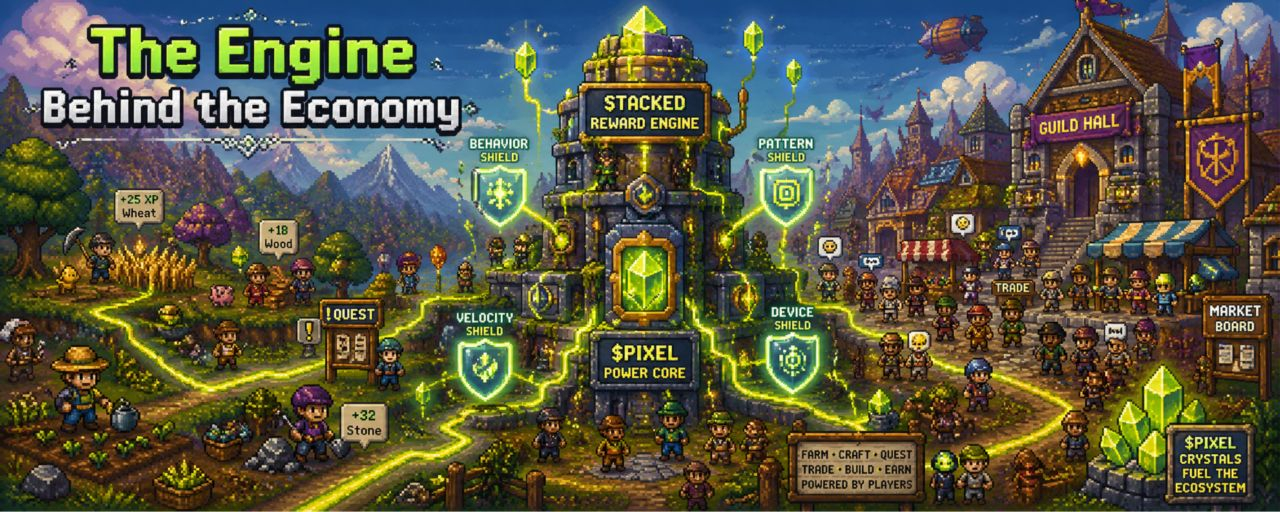

At first, I thought Stacked was another rewards layer.
Quest boards with better tooling.
Maybe smarter incentives.
But the more I looked at it, the less that framing made sense.
It may be more useful to think of Stacked as infrastructure.
That’s a very different idea.
1. Maybe Rewards Aren’t the Product
Most people focus on rewards.
But what if rewards are not the product — just the mechanism?
What if the actual product is behavior optimization?
That’s where the AI game economist becomes interesting.
It shifts the question from:
“How do we give rewards?” -to- “How do rewards improve retention, revenue and long-term player value?”
That feels much bigger.
2. The Ad-Tech Parallel Feels Hard To Ignore
The “redirect ad spend to players” thesis may be the boldest part of the model.
Studios already spend heavily on growth.
But much of that value leaks to intermediaries.
If some of that spend can go directly to engaged players instead— that changes incentives.
And maybe changes growth itself.
That starts looking surprisingly close to performance marketing infrastructure.
Not traditional GameFi.
3. The Moat Might Be the Real Story
Anyone can launch quests.
Few can build fraud-resistant reward infrastructure at scale.
That may be where Stacked has a deeper moat than people realize:
anti-bot systems
behavioral intelligence
reward experimentation
production-tested economics
Those aren’t features.
That looks more like infrastructure.
4. What If $PIXEL Is Expanding Beyond Game Utility?
This may be the overlooked part.
If Stacked grows across more games, $P$PIXEL uld become more than a game token.
It may evolve into a broader rewards and loyalty layer.
That expands the narrative.
And possibly the opportunity.
