

As soon as I opened the dashboard, I was shocked by the data. In April 2026, Ronin's activity hadn't even dropped. My first reaction was, this game must be really resilient, right? A lot of people still think of Pixels as just a pixelated version of FarmVille or a place to farm tokens. But honestly, if you're still stuck in that mindset, you’re likely to miss out on this real wave of profit.
What’s the biggest fear for Web3 games right now? It's not that nobody's playing, but that there are more bots than humans.
Back in the day, those P2E games were basically just everyone mining together, then bailing out, leaving the project drained and retail traders bagholding. But this time, Pixels pulled off something pretty slick in the iterations of Chapter 2 and Chapter 3. They introduced something called Stacked.
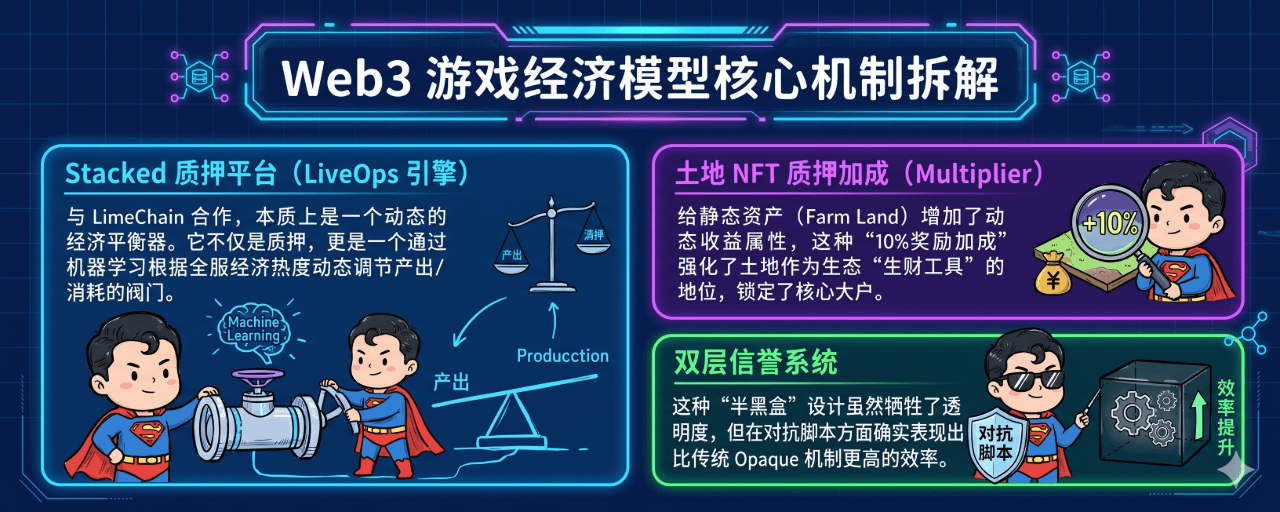
My first reaction was, isn't this just a rebranded staking platform? But after studying the whitepaper closely, I realized I was wrong. It’s essentially an AI-driven dynamic rewards engine.
A representative example is the counter-intuitive selection mechanism; many projects are open for business, but this one tailors its offerings based on user behavior. Its Reputation System has now evolved to a second layer, quietly tracking your actions. If you operate like a bot, even if you're not using a script, your reward weight will be reduced.
Previously, people were entering to sell and pull out. Now? They’re collaborating with external brands, bringing in USDC and gift cards. This breaks the cycle of 'wool coming from the sheep,' introducing fresh blood from outside.
I increasingly feel that Pixels' ambition is no longer just to create a game; it's setting a standard for the entire industry of blockchain gaming: how to maintain a virtual economy without new retail investors entering, relying instead on internal circulation and external ad revenue.
Let's talk about something practical, which is money. $PIXEL Total supply is 5 billion tokens, and as of today (late April 2026), the circulating supply is about 66%.
Why do I emphasize this number? Because the most intense institutional unlock period is almost over.
I checked the on-chain data, and the latest advisor unlock was on April 19th, with another wave of about 91.18 million tokens releasing on May 19th. By previous logic, this should be a significant bearish signal. But looking at the market, it's actually quite stable. Why's that?
First, the land staking lock-up bonus. If you have a Farm Land NFT and stake $PIXEL, you can earn an additional 10%. This nesting of staking is effectively locking up liquidity in the market.
Secondly, the Multi-Game Staking is the smartest feature, in my opinion. Pixels has turned into a distribution platform. Other games wanting to advertise in Pixels' traffic pool must have users stake $PIXEL for dividends. In short, it has essentially created a pass into the Web3 gaming world.
Many people are crying over the unlock schedule, but I'm focused on the absorption capacity post-unlock. If these tokens are picked up by projects looking to build an ecosystem, that’s not dumping; that’s just a change of hands.
Of course, I'm not just mindlessly hyping it.
I support their efforts against bots and for ecosystem expansion; it truly is one of the few projects in Web3 with real human engagement. Over a million daily active users isn't a joke.
But I question its Reputation System, which still feels like a black box. I have a friend who played honestly for six months, only to be flagged as suspicious due to a cross-chain operation, and his score was slashed. Such collateral damage is extremely harmful to real players. Plus, while they introduced USDC rewards, the bulk is still in tokens. If the market turns bearish, can this model withstand selling pressure? That's a big question mark for me.
To this day, looking at Pixels, it’s not just a game; it's a survival experiment. Pixels' current Chapter 3 and the migration of Ronin to OP Stack are essentially reinforcing its moat. It’s no longer a casually exploitable blockchain game; it’s gradually evolving into a massive digital economic empire.
Same old rule: DYOR.