
I used to think I could recognize growth when I saw it.
In most games, growth has a familiar texture: more players, more activity, more visible output. In Pixels, that surface-level expansion is everywhere. Fields are constantly being planted and harvested. The task board refreshes with new objectives. There’s movement in every directionavatars crossing land, resources circulating, crafting loops spinning endlessly. At a glance, it feels like a living economy scaling upward.
But the longer I stayed inside it, the more that sense of growth started to feel like an illusion.
Not a falsehoodjust something incomplete.
Because while activity clearly increases, it doesn’t always translate into proportional outcomes. The system looks like it’s expanding, but the rewards don’t consistently follow that expansion. And that’s where the shift begins: what if what I’m seeing isn’t true economic growth, but a redistribution of a fixed reward structure?
That question reframes everything.
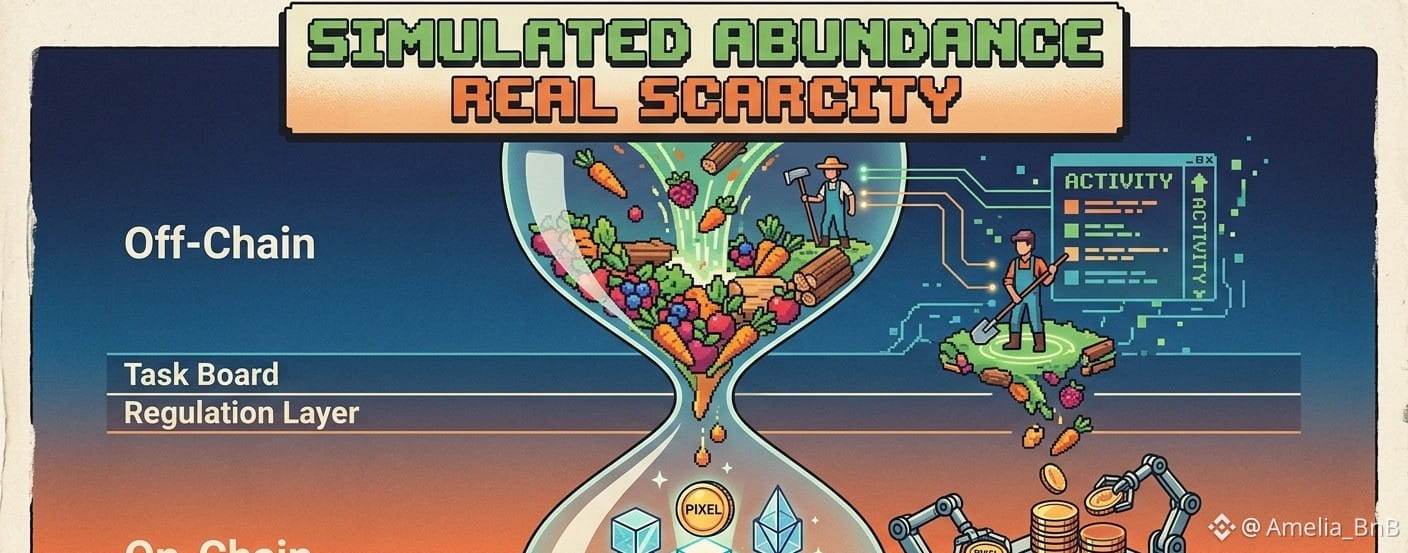
Pixels runs on top of the Ronin Network, and one of the most important design choices is how it separates gameplay from economic settlement. Almost everything I doplanting crops, managing energy, crafting items, moving through loopshappens off-chain. That layer is effectively infinite. It can scale without friction, without meaningful cost, without constraint.
And that’s intentional.
Because the moment value tries to cross into the on-chain layerinto the PIXEL tokenthat’s where limits begin to matter. That’s where economic reality starts to assert itself. Tokens can’t be emitted infinitely without consequence. They carry liquidity implications, price pressure, and long-term sustainability concerns.
So the system creates a boundary.
Off-chain, everything feels abundant. On-chain, everything is constrained.
And between those two layers sits the most interesting mechanism in the entire game: the task board.
The task board feels like opportunity. It refreshes frequently, presents new goals, and gives the impression that value is continuously being generated. But over time, I started noticing that the rewards didn’t feel like they were expanding alongside activity. Instead, they felt… allocated.
As if each cycle wasn’t creating new value, but distributing from a pre-defined pool.
You can feel it in subtle ways. Some sessions feel generous, others feel compressed. The tasks are there, the effort is the same, but the outcomes fluctuate. Not randomlyjust not linearly.
That’s when it starts to look less like an open economy and more like a regulated one.
In Web3 systems, there’s always a pressure point: the moment when simulated activity tries to convert into real, extractable value. Pixels seems acutely aware of that boundary. It can’t allow unrestricted token outflow without risking destabilization, so it likely employs internal balancing systemssomething akin to a reward outflow regulation layerto control how much value actually escapes into the on-chain environment.
You don’t see this system directly.
But you feel it.
It shows up as inconsistency, as shifting reward density, as subtle divergence between players who appear to be doing similar things. It suggests that activity alone isn’t the deciding factor. What matters is how that activity interacts with the system’s current statewhere rewards are being directed, what behaviors are being reinforced, and how the overall economy is being balanced in real time.
This creates a closed-loop environment.
Not closed in the sense of being static, but closed in the sense that value doesn’t simply expand outward. Instead, it circulates, redistributes, and reallocates. When one part of the ecosystem feels rewarding, another part often feels thinner. When one loop becomes efficient, it tends to saturate. And when it saturates, the system adjusts.
So growth becomes something different.
It’s no longer about increasing total opportunity for everyone. It’s about shifting where opportunity exists at any given moment.
That’s a fundamental departure from traditional game economies. In most games, growtheven if unevengenerally means expansion. More content, more rewards, more ways to progress. In Pixels, growth feels more like internal rebalancing between two forces: off-chain abundance and on-chain scarcity.
And that tension defines everything.
There are also signs that this system operates with a kind of behavioral awareness. Across millions of player actions, patterns emergewhat people farm, how they move, where they spend time, what loops they optimize. It’s not hard to imagine that these patterns feed into internal models that influence how rewards are distributed.
Not in a reactive sense, but in a predictive one.
If a certain loop becomes too dominant, rewards may thin out. If another area becomes underutilized, incentives may quietly increase. The system doesn’t need to tell players what to doit can guide them by adjusting outcomes.
That creates an invisible feedback loop.
Players adapt to rewards. The system adapts to players. And somewhere in between, behavior itself becomes the primary variable being managed.
Even staking mechanisms seem to fit into this broader picture. When players stake PIXEL, they’re not just locking tokensthey’re participating in a kind of capital allocation layer. That capital can influence which parts of the ecosystem receive attention, development, or reward emphasis. It’s less about passive yield and more about directing economic gravity.
So when I think about progression now, I don’t see it the same way.
It’s not a straight line upward. It’s movement within a dynamic system of allocation.
Grinding more doesn’t necessarily create new value. It increases the probability of intersecting with where value is currently being distributed. That’s a very different model from traditional effort-reward alignment. It’s less deterministic, more probabilisticless about input and output, more about timing, positioning, and behavioral fit.
And that brings me back to the original illusion.
The world looks like it’s growing. And in a sense, it isactivity is increasing, participation is expanding, the system is becoming more complex. But economically, that growth isn’t necessarily additive. It’s distributive.
The system isn’t designed to expand infinitely.
It’s designed to sustain itself.
Which means regulating how much value flows out relative to what flows in. It means balancing player engagement with economic stability. And it means constantly reshaping the environment so that no single strategy can extract too much, too quickly.
In that context, effort takes on a different meaning.
It’s no longer just about optimizing loops or maximizing output. It’s about understanding how the system decides what behavior is worth rewardingand adapting to that decision as it evolves.
Because in the end, Pixels doesn’t just respond to what I do.
It responds to how I fit into the balance it’s trying to maintain.
