
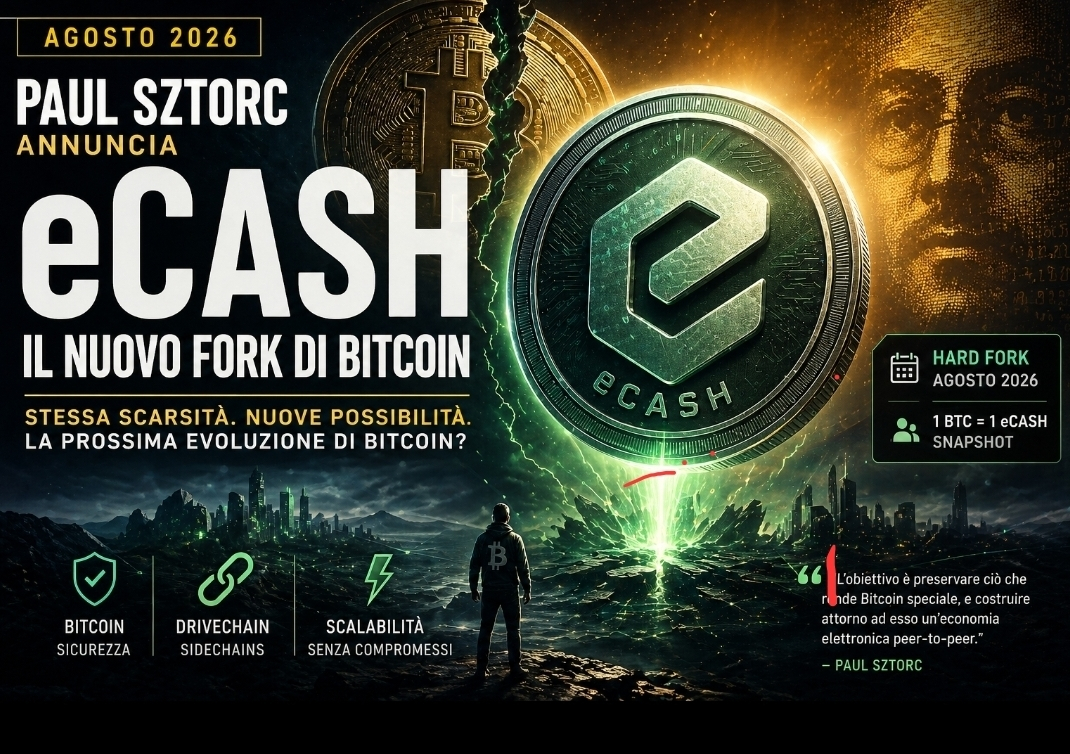
For years, Paul Sztorc has been working towards a clear vision: making Bitcoin scalable without losing its essence. After years of tinkering within the protocol, he decided to build something new. It's called **eCash**, and it's set to launch in August 2026.
**Who is Paul Sztorc**
Paul Sztorc is a Bitcoin developer and the founder of **LayerTwo Labs**. Since 2015, he has been pushing the **Drivechain** proposal, a tech that would allow Bitcoin to support advanced sidechains without altering the core protocol. In 2017 and 2019, he formalized these ideas in the official proposals **BIP300** and **BIP301**, submitted to the Bitcoin Core developer community.
Those proposals have never been integrated. Sztorc has therefore chosen a different path: to create a new blockchain that implements his vision from the very first block.
**What is eCash**
Announced on April 24, 2026, on X, eCash is a **hard fork of Bitcoin** scheduled for block number **964,000**, expected in August 2026. The software is nearly an identical copy of Bitcoin Core, with the same SHA-256 algorithm, but with a fundamental addition: the Drivechains active from day one.
The distribution is linear and transparent. Those holding Bitcoin at the time of the fork will receive eCash at a **1:1** ratio. Those with 3 BTC will get 3 eCash. Every holder can freely keep, sell, or ignore them. A special tool called *coin-splitter* will allow for easy and secure separation of the two assets.
**The Heart of the Project: The Drivechain**
The Drivechains are the true innovation of eCash. They function as **sidechains anchored to the main blockchain**: secondary chains with their own rules, connected to the mother chain, allowing smooth movement of tokens between the two levels without altering the base protocol.
Miners can participate via *merged mining*, earning additional rewards from the sidechains without extra energy costs. It's a system designed to add functionality without burdening the main network.
At launch, **7 layer 2s already in development** are expected:
🔹 **Truthcoin** — decentralized predictive market
🔹 **Coinshift** — decentralized exchange
🔹 **Photon** — chain resistant to quantum computers
🔹 **Bitnames** — decentralized identity system
🔹 Three additional chains on privacy, NFT, and smart contracts
The stated goal is to build an infrastructure capable of bringing Bitcoin to **billions of users**, overcoming the scalability limits that have hindered mass adoption for years.
**The Funding Mechanism**
Like all forks, eCash will inherit the entire history of the Bitcoin blockchain. Every existing wallet will have an equivalent balance on the new chain at the time of the fork, including wallets that have been inactive for years.
Among these are the addresses associated with the **"Patoshi pattern"**: about **1.1 million Bitcoins** that researchers identify as potentially traceable to Satoshi Nakamoto, never moved since the launch of the network.
Sztorc proposed in his first version of the plan to use a portion of these equivalent eCash tokens — about **500,000**, less than half — to fund the development of the project through early investors. The remaining **600,000** would remain associated with the original addresses.
The logic behind it is practical: a fork without resources risks becoming a **"zombie project"**, unable to attract developers and collaborators before launch. Incentivizing early entrants, according to Sztorc, is what transforms an idea into a functioning network.
It's important to clarify that **no real Bitcoin is being moved**: the operation concerns exclusively the tokens on the new eCash chain, which does not exist yet. The original BTC remains intact in their addresses.
In light of the debate generated, Sztorc has already published a **second version of the plan** that does not include this component. The final structure of the funding is still being defined.
**Timeline**
🔹 **2015** — First public proposal of the Drivechains
🔹 **2017** — Presentation of BIP300 to Bitcoin Core
🔹 **2019** — Presentation of BIP301 to Bitcoin Core
🔹 **April 24, 2026** — Official announcement of eCash
🔹 **Summer 2026** — Bug bounty and network stress test
🔹 **30 days before the fork** — Client freeze
🔹 **August 2026** — Fork live at block 964,000
**What Sets It Apart from Previous Forks**
eCash does not include "Bitcoin" in the name, a deliberate choice to avoid the confusion that hurt Bitcoin Cash in 2017. The initial mining difficulty will be reduced to facilitate participation in the startup phases, and anti-replay tools are planned to protect users during the transition.
The most novel element compared to any previous fork — Bitcoin Cash, Bitcoin SV, Bitcoin Gold — is the layer 2 architecture operational from block zero. No Bitcoin fork has ever tried to start with already functioning sidechains.
**The Debate in the Community**
The Bitcoin community has divided, as often happens in front of the most ambitious proposals.
Supporters of the project, like writer and bitcoiner **Steve Patterson**, see it as a concrete answer to an unsolved problem: "There are only a couple of serious options to scale Bitcoin — larger blocks or real sidechains. Sztorc is finally building the second path."
Those who are more cautious raise questions about the name overlap with the existing eCash **XEC** — born from the Bitcoin Cash ABC fork in 2021 — and about the impact certain design choices might have on the external perception of the Bitcoin world.
The sentiment analysis of the responses to the announcement on X showed a prevalence of skeptical positions, with about **80% of comments** critical of the project in its initial form. Data that illustrate how much work remains to be done on the trust and communication front.
**What Happens Now**
In the coming weeks, the final technical details, summer bug bounties, and the release of the stable client 30 days before the fork will arrive. August 2026 is near.
eCash is the most ambitious experiment ever attempted in the history of Bitcoin forks. If the Drivechains work on a real scale, they will provide valuable data to the entire ecosystem. If they don't take off, they will add a new chapter to the story of great ideas that failed to find the necessary critical mass. In any case, the project has already opened an important debate on the technical and governance direction of Bitcoin.
**💬 And you, what do you think?**
Can Paul Sztorc's eCash really solve Bitcoin's scalability issues?
**A)** The idea is interesting, but it's too early to judge
**B)** I prefer Bitcoin to stay simple and not fragment into forks
**C)** A fork will never have the trust and liquidity of the original Bitcoin
**D) Yes, the Drivechains are the solution Bitcoin has been waiting for years**
Leave your response in the comments! 👇
$BTC #Binance #crypto #PaulSztorc
https://eCash.com