
The funny thing about open systems is that the limits aren’t obvious at first. That’s kind of the whole appeal. They feel open. Welcoming. Like anyone can walk in, look around, and get involved.
And technically, that’s true.
But open and equal? Those are two very different things.
An open door just means you can enter. It doesn’t mean you’ll get a great seat. It definitely doesn’t mean you’ll move through the room at the same speed as everyone else. Some people stroll in and immediately know where to stand. Others spend half the night figuring out where the snacks are.
That’s what makes Pixels so interesting.
At first glance, it looks almost disarmingly simple. A farming game. Plant crops, gather resources, craft items, wander around, chat with people. Nothing too intimidating. Which, honestly, is part of its genius.
Because once you spend real time with it, you realize it’s not just a game. Not really. It’s a system. A carefully tuned one. And like any good system, it’s obsessed with one thing above all else: friction.
That’s the real story here.
Most people look at PIXEL and see the obvious. A reward token. You play, you earn, you stack tokens. Standard Web3 stuff. Action in, token out.
Sure. That’s part of it.
But it’s not the interesting part.
I’ll be honest, after watching how the economy actually behaves, it’s pretty clear that PIXEL isn’t mainly about earning. It’s about removing inefficiency. It exists to cut through drag. To smooth over delays. To keep players moving.
That’s a completely different role.
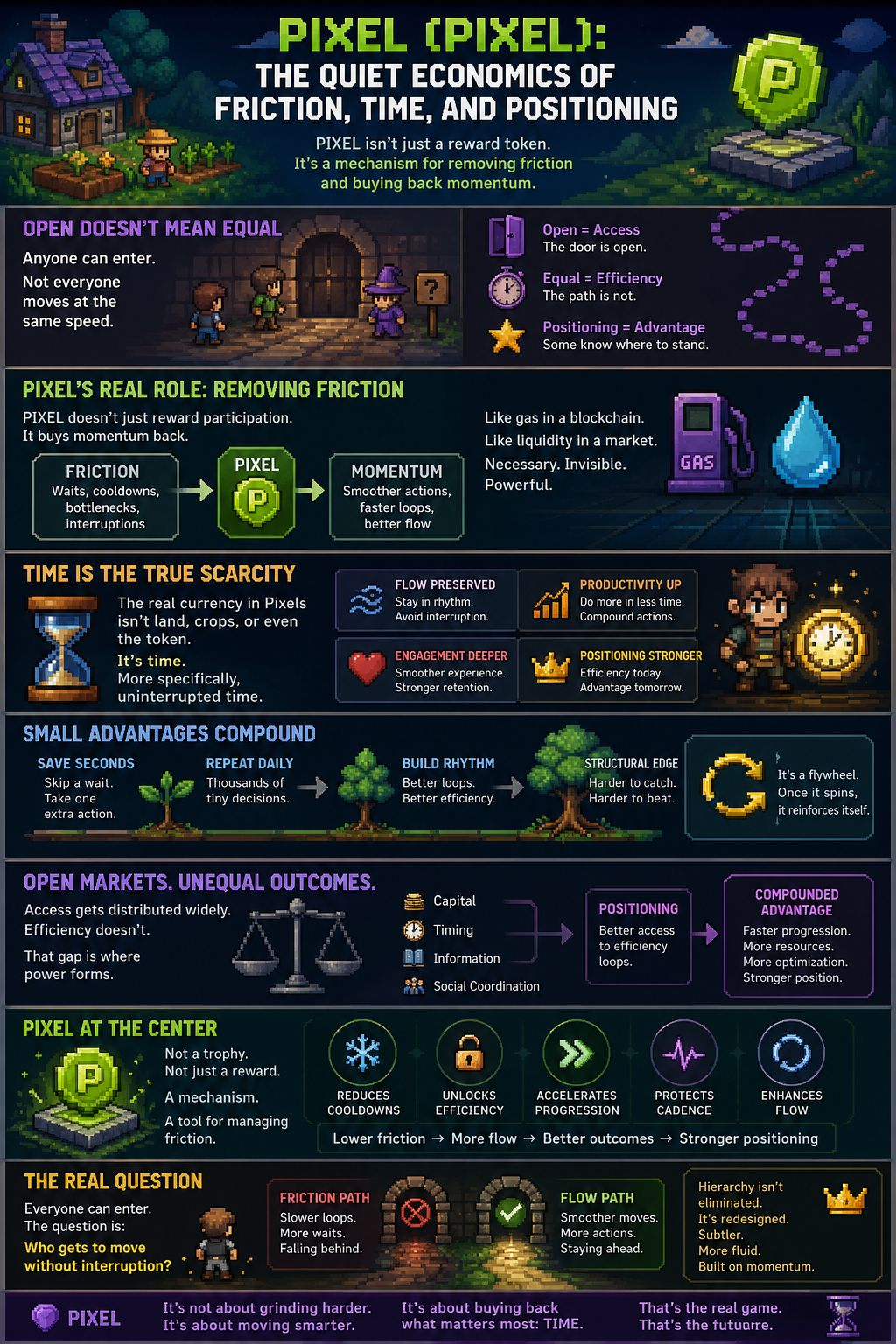
PIXEL doesn’t just reward participation. It buys momentum back.
And in a system like this, momentum is everything.
Look, people will tolerate grind. They always have. Gamers will repeat the same loop a thousand times if the reward makes sense. They’ll optimize routes, memorize patterns, and shave seconds off every action. I’ve seen this before in games, in markets, honestly in almost any competitive system.
What people hate is interruption.
Waiting. Delays. Bottlenecks. Those moments where the system tells you to stop when all you want to do is keep going. That tiny break in rhythm? It matters way more than people realize.
Flow is incredibly valuable.
Actually, scratch that. It’s priceless.
And not just in games. Everywhere.
That’s why PIXEL functions less like a prize and more like infrastructure. Think of blockchain gas. Think of market liquidity. Nobody gets excited about those things at parties well, at least not normal parties but they matter because they make movement possible.
That’s exactly what PIXEL does inside the Pixels economy.
It lowers the cost of movement.
It clears bottlenecks. It cuts idle time. It helps players move from one action to the next without getting stuck in unnecessary friction. Once you see that, the whole design starts to click.
Because the real currency in Pixels isn’t land. It isn’t crops. It isn’t even the token itself.
It’s time.
More specifically, uninterrupted time.
And that’s where things get interesting.
Humans care a lot about continuity. We like momentum. We like progress that feels smooth. The second that rhythm breaks, frustration creeps in. Slowly at first. Then all at once.
So when a system offers a way to preserve that rhythm, people notice. And yes, they’ll often pay for it.
That decision might seem small in the moment. A few minutes saved. A cooldown skipped. One extra action completed because you didn’t have to wait around.
No big deal, right?
Wrong.
Systems rarely change because of one massive decision. They change because of thousands of tiny ones. Repeated over and over until they stop looking tiny.
That player who consistently saves time isn’t just moving faster. They’re building a different operating rhythm. A better one. More efficient. More reliable. Harder to catch.
Small advantages don’t stay small.
They compound.
Then they snowball.
Then suddenly they’re structural.
And that’s the part people sometimes miss about Pixels. Yes, it’s open. Anyone can join. Anyone can participate.
But it absolutely favors people who are positioned well.
That positioning might come from capital. Or timing. Or information. Sometimes social coordination. Usually some combination of all of them.
That’s not a flaw. That’s the design.
Pixels didn’t accidentally build this dynamic. It’s baked right into the architecture.
And to be fair, Pixels isn’t unique. Every open market works like this. Every single one.
Access gets distributed widely.
Efficiency doesn’t.
That gap is where power forms.
Because once someone gets an efficiency edge, the system starts reinforcing it. Faster progression leads to more resources. More resources unlock more optimization. More optimization leads to even faster progression.
It’s a flywheel. A very familiar one.
And once it starts spinning, good luck slowing it down.
So when people ask what gives PIXEL utility, they often focus on the wrong things. Rewards. Emissions. Distribution. Those matter, sure.
But they’re not the heart of it.
PIXEL reallocates one of the scarcest resources in any digital economy: attention-weighted time.
That’s the real asset.
It helps players stay in flow. It protects cadence. It reduces interruption. Over time, those benefits turn into higher productivity, deeper engagement, stronger influence, and, ultimately, better positioning inside the ecosystem.
That’s why Pixels feels so deceptively casual.
It looks relaxed. Friendly. Maybe even simple.
It’s not.
Underneath the bright colors, the farming loops, and the social layer sits a tightly engineered economy built around throughput, attention, and incentives. Every wait state matters. Every shortcut matters. Every optional acceleration tells you exactly what the system values.
And what it values is continuity.
That’s why the PIXEL token sits at the center of everything. Not as a trophy. Not just as a reward.
As a mechanism.
A tool for managing friction.
That’s what you’re really looking at.
So the big question isn’t whether Pixels lets people participate. Of course it does.
The better question is this: when everyone can enter, who gets to move without interruption?
That’s where hierarchy forms.
Not through locked doors.
Through smoother paths.
And honestly, that might be the most important thing to understand about where systems like this are heading. They’re not eliminating hierarchy. They’re redesigning it. Making it subtler. More fluid. Less about explicit exclusion and more about who can convert resources into uninterrupted momentum most effectively.
That’s the real game.
The one underneath the farming, the crafting, and the token rewards.
And once you see it, you really can’t unsee it.
