
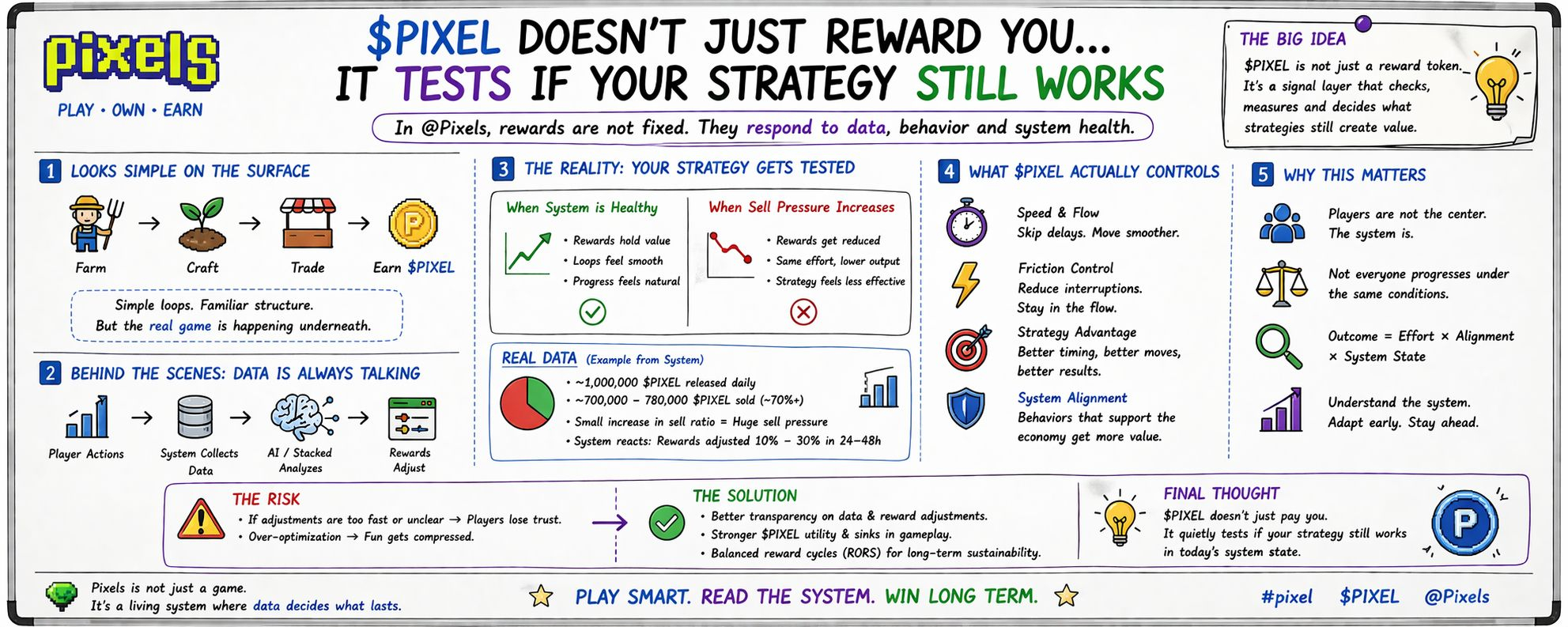
I didn’t realize when it started, but at some point my routine stopped feeling stable. Same farm loop, same timing… but outcomes were not holding the same weight anymore. Not broken, just slightly shifting. That’s when it hit me — maybe the system is not rewarding actions directly, it’s checking if your approach still fits the current state.
And that changes how you look at everything.
Inside @Pixels , progression still looks simple on the surface. You farm, craft, trade, repeat. But under that, there’s a layer where behavior gets measured. Whitepaper talks about data-driven rewards and RORS, meaning rewards are treated like capital, not giveaways. So when ~1M pixel enters daily and a large portion gets sold, the system doesn’t ignore it… it reacts.
Not loudly. Quietly.
I tested a loop where I was making around 180–200 $PIXEL daily. Same method, same effort. But after a few days, it dropped closer to 140–150. No patch, no visible change. That’s where it feels less like reward reduction and more like strategy re-evaluation. The system isn’t stopping you… it’s asking if this behavior still deserves the same output.
So effort alone is not enough anymore.
What matters is alignment. If too many players push the same extraction path, value spreads thinner. If behavior supports economy flow — trading, spending, holding — it holds better weight. That’s where piutility becomes deeper. It’s not just speed or progression, it’s part of the feedback loop that connects action → data → reward.
That’s a different kind of system design.
There is a risk here. If adjustments feel too fast or unclear, players lose sense of control. But solution is already visible in direction — better sinks, stronger utility layers like upgrades, and more transparent patterns. Whitepaper already points toward this with smart targeting and sustainable reward cycles.
So it’s not negative… it’s evolving.
Right now, $PIXEL doesn’t just sit as a reward token. It behaves more like a signal layer inside the system. It reflects what works, what doesn’t, and how fast the environment is adapting. Two players can do the same thing, but results depend on timing, behavior, and system state.
And maybe that’s the real shift.
It’s no longer about playing better loops. It’s about understanding when your loop stops working… and adjusting before the system moves ahead of you.