
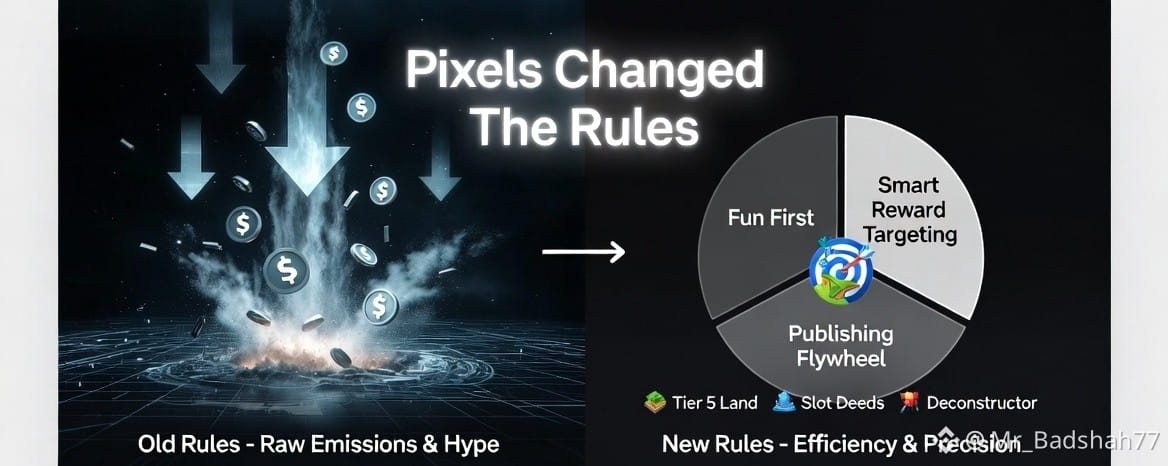

I can’t stop thinking about how Pixels is approaching growth. Most Web3 games I’ve played chased numbers the old way — flood the system with tokens, blast incentives, and hope the hype keeps players glued. After hundreds of hours farming, upgrading, and watching the economy breathe, I’m starting to believe Pixels is quietly trying to rewrite those rules.
It began when I revisited their three pillars: Fun First, Smart Reward Targeting, and the Publishing Flywheel. On paper they sound clean. In practice, especially after Tier 5 dropped on April 15, they’re starting to reshape how the whole ecosystem feels from the inside.
Fun First still holds surprisingly well. Even with all the new layers, I can lose myself in the cozy rhythm of planting, harvesting, and optimizing routes without constantly staring at token prices. That base enjoyment feels intentional — like the foundation everything else is built on.
But it’s the second pillar, Smart Reward Targeting, that has me pausing mid-game. Instead of rewarding raw volume like the old play-to-earn loops, the system now seems designed to identify and reward actions that create longer-term value. After Tier 5 introduced 105 new recipes, specialized T5 industries (only workable on NFT lands), and the revamped Deconstructor, this shift became visible.
Land is no longer just a passive asset. With Slot Deeds taking up only 20% of your land’s capacity and requiring 30-day renewal, there’s this quiet pressure to stay active and strategic. You can’t simply buy once and coast. The Deconstructor adds another interesting twist — turning old industries into rare materials using heart fragments. It feels less like endless extraction and more like a careful circular flow.
That’s where the new rules of growth quietly emerge.
Old GameFi measured success by how fast users piled in and how aggressively tokens were emitted. Pixels appears to be betting on something more demanding: reward efficiency, data quality, and sustained player behavior. The idea is elegant on the surface — richer player data from genuinely engaged users leads to smarter targeting, which improves retention, which lowers acquisition costs and attracts higher-quality games into the ecosystem. A true flywheel.
Yet I catch myself hesitating sometimes. Before committing resources to a Tier 5 industry or renewing a Slot Deed, that small pause makes me wonder: Is this added complexity filtering out casual players who gave the game its early lively feel? Are we slowly creating two economies — one for relaxed farmers and another for serious economic optimizers?
The Deconstructor turning “The Machine” into something that strategically breaks down and rebuilds value is clever. It introduces scarcity and decision-making that feels more mature than pure grinding. At the same time, it raises a real question — does this sophistication risk making the game feel less accessible over time?
Ronin provides solid rails underneath — smoother onboarding, wallet integration, and liquidity that lets value move more naturally. That infrastructure supports the model, but it can’t carry the weight if the fun or the targeting starts to slip.
What I find most intriguing is this departure from “scale at any cost.” Growth here feels tied to precision and compounding rather than massive one-time emissions. It’s a more disciplined approach, but also more fragile. If the core fun weakens or the reward targeting misses the mark, the entire flywheel could stall. On the flip side, if it keeps working, Pixels might prove that Web3 gaming can move beyond boom-and-bust cycles toward something more sustainable.
I’m still observing. Some sessions it feels like a genuine evolution in design. Other times I wonder whether we’re trading the chaotic joy of early days for a more calculated, efficient machine.
What do you think — is this smarter, more targeted approach the future of Web3 gaming growth, or are we losing something essential in the pursuit of better systems?
This is for educational purposes only ~ NFA, DYOR.