
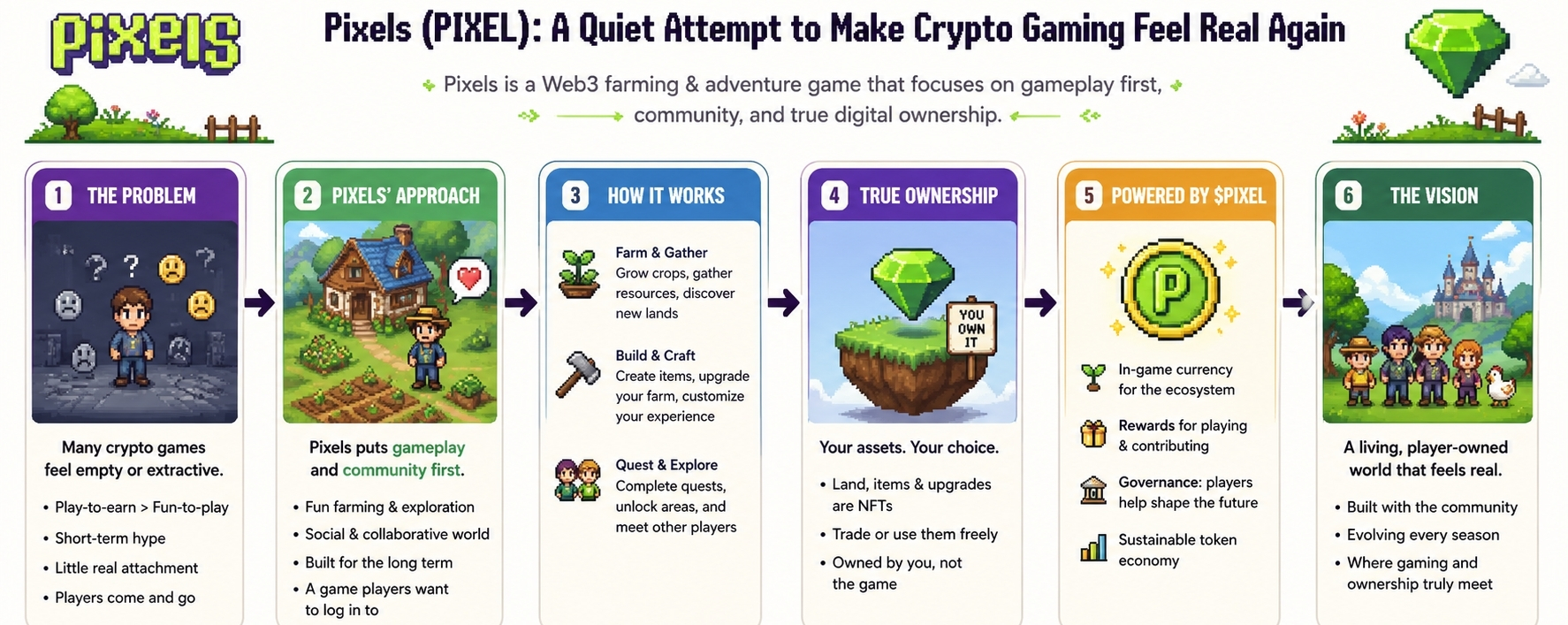
I keep looking at Pixels (PIXEL) the way I look at most things in crypto these days—with a bit of distance and a lot of memory. After watching this space for years, it’s hard not to notice the pattern. A new idea shows up, people rush in, timelines fill with bold claims, and for a while it feels like everything is about to change. Then slowly, the noise fades, attention moves somewhere else, and you’re left wondering what actually stuck. It happens more often than anyone likes to admit.
Pixels landed on my radar quietly, almost like background noise at first. A Web3 farming game, social, open world, built on Ronin. If you’ve been around long enough, that description alone feels familiar. We’ve seen games promise digital ownership, player-driven economies, and entire virtual worlds that were supposed to rival traditional gaming. Most of them struggled to keep people around once the early excitement wore off. So naturally, my first reaction wasn’t curiosity—it was hesitation.
But sitting with it a little longer, Pixels started to feel less like a pitch and more like an attempt to simplify something crypto often overcomplicates. At its core, it’s just about farming, exploring, and interacting with other players. That’s it. No heavy explanation needed. You plant things, you move around, you build, you connect. These are ideas people already understand without needing to learn anything about tokens or networks. And maybe that’s where it becomes interesting—not because it’s revolutionary, but because it’s familiar.
One thing crypto still struggles with is asking normal people to care about things they never needed to care about before. Wallets, gas fees, networks—these are barriers, even if the industry pretends they’re not. A game like Pixels seems to be trying to hide most of that behind something simple and approachable. If someone can just log in and play without thinking too much about the underlying tech, that’s already a step forward. But saying that is easy. Doing it well, consistently, over time—that’s where most projects fall apart.
And then there’s the bigger question: will people stay? It’s one thing to attract users with curiosity or even financial incentives. It’s another thing entirely to build something they return to because they genuinely enjoy it. Games live and die on engagement, not promises. If the world starts to feel empty, repetitive, or purely transactional, people drift away. We’ve seen that story before, especially in crypto gaming, where earning often overshadowed playing.
There’s also the reality that crypto moves at a speed that doesn’t always match the real world. Building a lasting game takes time—updates, feedback loops, community building. Traditional gaming studios spend years refining experiences. In contrast, crypto often expects traction almost instantly. That mismatch creates pressure, and not every project handles it well.
So where does that leave Pixels? Somewhere in the middle, I think. It doesn’t feel like a breakthrough, but it doesn’t feel empty either. It feels like a project trying to ground itself in something people already enjoy, instead of chasing the next big narrative. And in a space that constantly reinvents its story every few months, that alone stands out a little.
Maybe Pixels finds its rhythm and builds something people genuinely care about. Maybe it ends up as another experiment that fades as attention shifts again. It’s hard to say. But at the very least, it’s pointing toward something more real—something built around how people actually behave, not just how the market wants them to behave. And in crypto, that’s a direction worth paying attention to, even if you’re not fully convinced yet.