
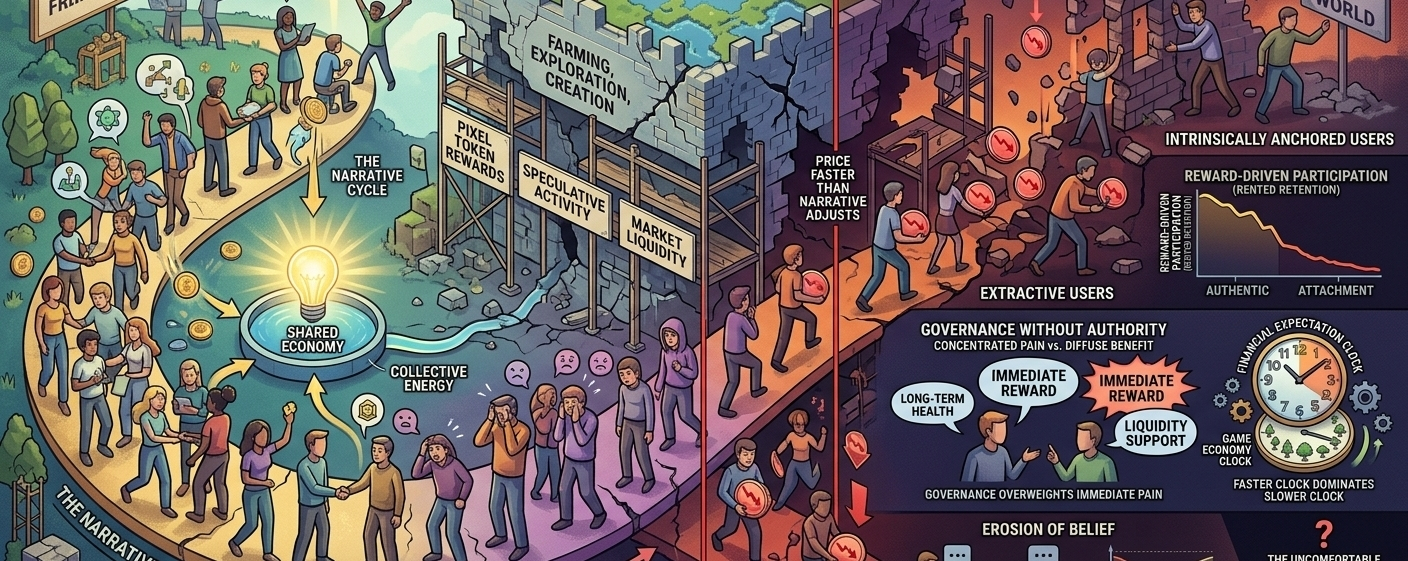
I study systems by watching what happens when prices fall faster than narratives can adjust. In calm markets, almost any coordination model can appear coherent. Participation looks voluntary, incentives look aligned, and users often confuse momentum with trust. But economic stress removes the luxury of interpretation. It compresses time, sharpens incentives, and forces every participant to reveal what they are optimizing for. When I look at Pixels and the wider logic surrounding PIXEL as coordination infrastructure, I am less interested in the game loop than in what happens when the social fabric of the system is asked to absorb loss instead of distribute upside.
The first thing I usually examine is whether participation is intrinsically anchored or externally subsidized. Many decentralized systems grow by rewarding early activity, but rewards often hide a deeper fragility: users may be coordinating around extraction rather than around shared purpose. In expansion phases, that distinction is easy to ignore because both groups behave the same way. They log in, transact, recruit others, and generate visible activity. Under pressure, however, motives separate quickly. The user who values the world stays longer than the user who values the payout. That sounds obvious, but the non-obvious part is how quickly the departure of extractive users damages everyone else. They are often the same users creating liquidity, volume, and perceived relevance. When they leave, they do not merely reduce noise; they remove scaffolding.
In Pixels, this matters because social economies depend on repeated interaction. A world built around farming, exploration, and creation relies on the expectation that other people will also be there tomorrow. Once that expectation weakens, each individual becomes more rationally short-term. Why invest time building status, assets, routines, or relationships inside a world that may thin out next month? Stress converts community behavior into inventory behavior. Participants stop asking what they can grow and start asking what they can exit. That psychological shift is more damaging than any price chart because it changes the time horizon of the average user.
I have watched capital rotate through enough narratives to know that retention statistics during bullish periods are often misunderstood. They are treated as evidence of loyalty when they may simply be evidence of opportunity. If users remain because rewards outweigh friction, then retention is rented, not earned. The pressure point is not user count; it is the reason users stay. Once rewards shrink or token expectations cool, the system must discover whether it built attachment or dependency. Those are very different assets.
The second pressure point is governance without credible authority. Decentralized communities often celebrate voice, but under economic stress voice becomes conflict. Scarcity creates competing claims: builders want funding, users want better rewards, traders want liquidity support, long-term holders want discipline. Everyone can justify their position through the language of alignment. Yet incentives, not intentions, determine outcomes. If a decision imposes concentrated pain on one group and diffuse benefit on another, the harmed group reacts faster and louder. That means governance tends to overweight the most immediate pain rather than the most durable solution.
This creates a subtle behavioral consequence. When participants believe every difficult decision will be politicized, they begin pricing governance risk into every action. Builders hesitate to commit. Users hesitate to invest time. Markets discount future promises. The protocol may still have votes, forums, and community rituals, but authority becomes performative if no constituency accepts necessary sacrifice. I have seen this repeatedly: systems advertise decentralization as legitimacy, then discover that legitimacy is weakest when trade-offs become real.
For Pixels, the structural trade-off appears clear to me. A highly open, player-owned economy can attract creativity and energy, but openness also limits the ability to centrally stabilize behavior when incentives turn negative. The more freedom participants have to optimize individually, the harder it becomes to preserve collective balance during downturns. Tight controls may protect resilience but reduce the sense of ownership. Loose controls may preserve ownership but amplify volatility. There is no elegant escape from that tension.
Another non-obvious issue is that game economies and financial expectations operate on different emotional clocks. Games ask for patience, experimentation, identity formation, and delayed mastery. Markets ask for immediate repricing. When token volatility enters a social world, the faster clock often dominates the slower one. Instead of asking whether a mechanic is fun or sustainable, participants ask whether it is profitable this week. Design choices then get interpreted through yield rather than play. Even if developers never intended that framing, the market imposes it. Once imposed, it is difficult to reverse because users adapt their behavior to the metric being rewarded.
I do not think disbelief arrives dramatically. Most systems do not collapse in one event; belief erodes through small revisions. A skipped login here, a lower bid there, a creator who stops creating, a guild that goes quiet, a market spread that widens. None of these moments look fatal in isolation. Together they reveal a coordination engine losing synchronization. People still say they support the project while quietly reducing exposure. That gap between language and allocation is where truth lives.
The uncomfortable question I would ask is simple: if financial upside disappeared for a year, would the remaining participants be enough to regenerate the world, or would they only be enough to remember it? I do not ask this to be cynical. I ask because every protocol eventually meets the boundary between economic incentive and genuine commitment, and many teams discover too late that they were measuring the wrong one.
From where I stand, PIXEL matters less as an asset than as a signal system. It routes expectations, rewards behavior, and expresses confidence. But signals can coordinate growth and panic with equal efficiency. When belief is rising, that machinery looks elegant. When belief fades, the same machinery can transmit doubt faster than any patch can contain it.