
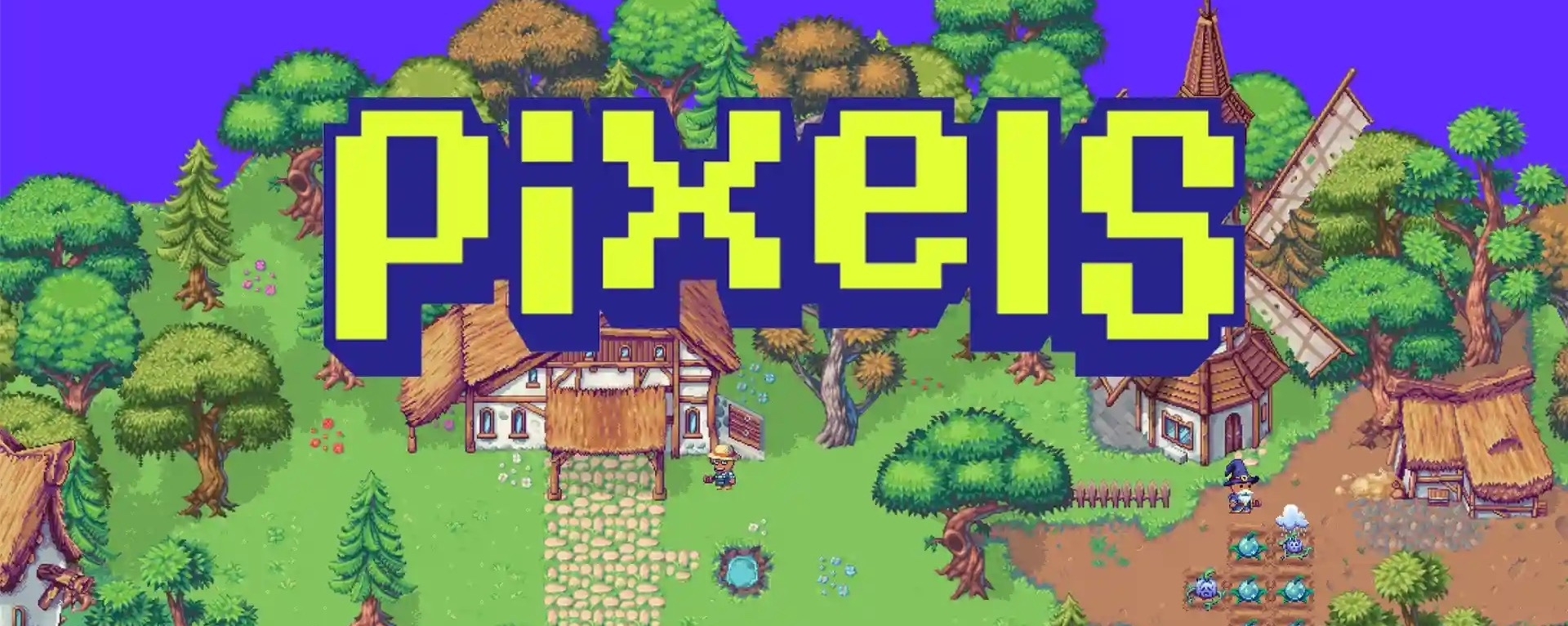

When I first settled into a farming style Web3 game like Pixels, it felt like stepping into something that had finally aligned with the original promise an open economy where effort translates into ownership, where time spent cultivating land or optimizing production loops accrues into assets that are actually mine. Not stored on a company server, not revocable by a single authority, but anchored on-chain.
At least, that’s how it feels at the surface.
The longer I stayed, the more I found myself paying attention to the edges of that feeling. Not the obvious mechanics planting, harvesting, trading but the conditions that made those actions meaningful in the first place.
Because ownership, I’ve learned, is less about what you hold and more about what you can do without permission.
And that’s where the certainty begins to soften.
I can hold a plot of land as an NFT. I can accumulate tokens through gameplay. These are verifiable, transferable, undeniably “mine” in a technical sense. But their value doesn’t exist independently. It’s inseparable from the continued operation of the game itself the servers, the interfaces, the logic that interprets what that NFT actually is inside the world.
If Pixels disappears, my ownership persists in form but collapses in function.
So what I really own is not a self-contained asset, but a relationship. A dependency disguised as autonomy.
That realization didn’t arrive all at once. It came into focus more clearly when Pixels shifted its underlying infrastructure—migrating to a different blockchain network.
From a user perspective, the transition was smooth enough. Assets were bridged, accounts reconnected, the world resumed almost seamlessly. It was framed as progress: lower fees, better scalability, a more supportive ecosystem.
All of which made sense.
But beneath that, something quieter stood out.
If this entire economy—land, crops, tokens, identity—can be relocated from one chain to another, then what exactly is the foundation here? Where does the system actually live?
It doesn’t feel as decentralized as the narrative suggests. It feels portable, but not necessarily independent.
The choice of blockchain, I realized, isn’t a neutral detail. It’s a deep structural commitment. Each network comes with its own validators, its own governance realities, its own points of failure. When a game like Pixels builds itself within that environment, it inherits those characteristics.
And when it decides to move, that decision doesn’t emerge from a diffuse, decentralized consensus of players. It comes from a much smaller locus of control—developers, core contributors, stakeholders with the ability to execute.
I didn’t meaningfully participate in that decision. I adapted to it.
Which raises a subtle but important distinction: participation in a system does not necessarily translate to influence over its foundations.
There’s a kind of control here that doesn’t announce itself. No one forces you to stay. Your assets are liquid, transferable. You can exit at any time.
But leaving carries friction.
Liquidity is tied to specific ecosystems. Communities concentrate around particular chains. Marketplaces, tools, and integrations don’t evenly exist everywhere. Even attention—the thing that ultimately drives value—clusters in predictable ways.
So while the system is open in theory, it’s directional in practice. It nudges you toward staying, not through restriction, but through accumulated gravity.
Over time, what began as a voluntary choice starts to feel like a path with fewer and fewer viable alternatives.
And that’s where decentralization starts to blur into something else—not centralization in the traditional sense, but a kind of soft coordination that still shapes outcomes.
The same pattern appears when looking at how visibility works.
In principle, everything exists on-chain, accessible to anyone. But in reality, discovery is mediated. New players don’t interact with raw smart contracts; they go through interfaces, curated marketplaces, onboarding funnels. These layers determine what gets seen first, what feels important, what appears valuable.
So while access is technically permissionless, attention is filtered.
And filtered attention is its own form of power.
Governance adds another layer to this complexity. Many of these ecosystems include voting mechanisms—tokens that grant influence, proposals that shape the direction of the game.
I’ve engaged with those systems. They’re not meaningless. They allow for a degree of participation that traditional games never offered.
But they operate within boundaries.
Players can often vote on parameters—reward rates, minor economic adjustments, feature priorities. These are operational decisions. They shape the experience, but they don’t redefine the system.
What remains largely out of reach are the foundational choices: the architecture of the game, the underlying infrastructure, the distribution of authority in moments of crisis.
Those decisions tend to stay centralized, even if that centralization is framed as temporary or necessary.
And maybe it is necessary. Systems need maintenance. Exploits need to be patched. Someone has to act when something breaks.
But it does create a layered reality of governance—one visible and participatory, the other structural and insulated.
The difference between the two is where most of the power resides.
This becomes especially clear during moments of stress.
Across different ecosystems, there have been instances where the ideal of decentralization meets the reality of failure validator concentration, bridge exploits, network outages. In those moments, the response is rarely decentralized in the way the narrative suggests.
Decisions are made quickly, often by a small group with the authority to intervene. Systems are paused, patched, or reconfigured.
And while those interventions are often necessary, they reveal something fundamental: decentralization, as it exists today, is conditional.
It holds under normal conditions. Under pressure, it tends to contract.
The migration I experienced within Pixels feels like a quieter version of the same dynamic.
A system reconfigures itself at a foundational level. Users follow, not because they’re coerced, but because the cost of not following is higher than the cost of adapting.
Fragmentation would mean abandoning assets, communities, accumulated progress.
So the path of least resistance becomes the path of collective movement.
Which makes the dependence feel voluntary—but also deeply embedded.
After enough time observing these patterns, I’ve started to question the language we use.
“Ownership” suggests autonomy. “Decentralization” suggests distributed control.
But what I see in practice is something more nuanced.
I hold assets, but their meaning depends on systems I don’t control. I participate in governance, but within constraints I didn’t define. I can leave, but not without cost.
That doesn’t make the system invalid. It just makes it different from the idealized version often presented.
Maybe what these environments offer isn’t pure ownership, but a new form of participation—one that is more economically aligned, more transparent, more flexible than traditional models, but still shaped by underlying structures of control.
And maybe that’s enough. Or maybe it’s just an intermediate stage.
Either way, it leaves me with a question I can’t quite resolve:
If worlds like Pixels can shift beneath us migrating, evolving, reconfiguring according to decisions we don’t fully influence then are we actually holding ownership in any meaningful sense..