
I keep coming back to this strange little moment I had while playing Pixels. I was just watering crops, nothing serious, chatting with someone in-game about land prices and it suddenly hit me: am I farming for fun… or am I quietly calculating value?
That question kind of stayed with me.
Most people will tell you a simple story about Pixels (PIXEL). It’s a cozy, social farming game on the Ronin Network. You plant, harvest, explore, craft. It looks like something from an older internet era pixel art, simple mechanics, low pressure. And compared to earlier Web3 games, it does feel different. Less grind-for-money, more play-with-people.
And honestly, that part works. You can log in, do small tasks, talk to others, and it feels… normal. Almost like the Web3 layer doesn’t matter.
But that’s only half the story.
Because after a while, something subtle starts to shift. You notice which actions actually earn something. You start thinking about efficiency what crop gives better returns, how to use your time better, whether owning land changes your position.
It’s not forced. It just… creeps in.
And that’s where Pixels becomes more interesting—and a bit uncomfortable.
The game is trying to balance two worlds at once. One is familiar: a relaxing game where time is just time. The other is financial: where time quietly converts into something measurable, tradable, maybe even speculative.
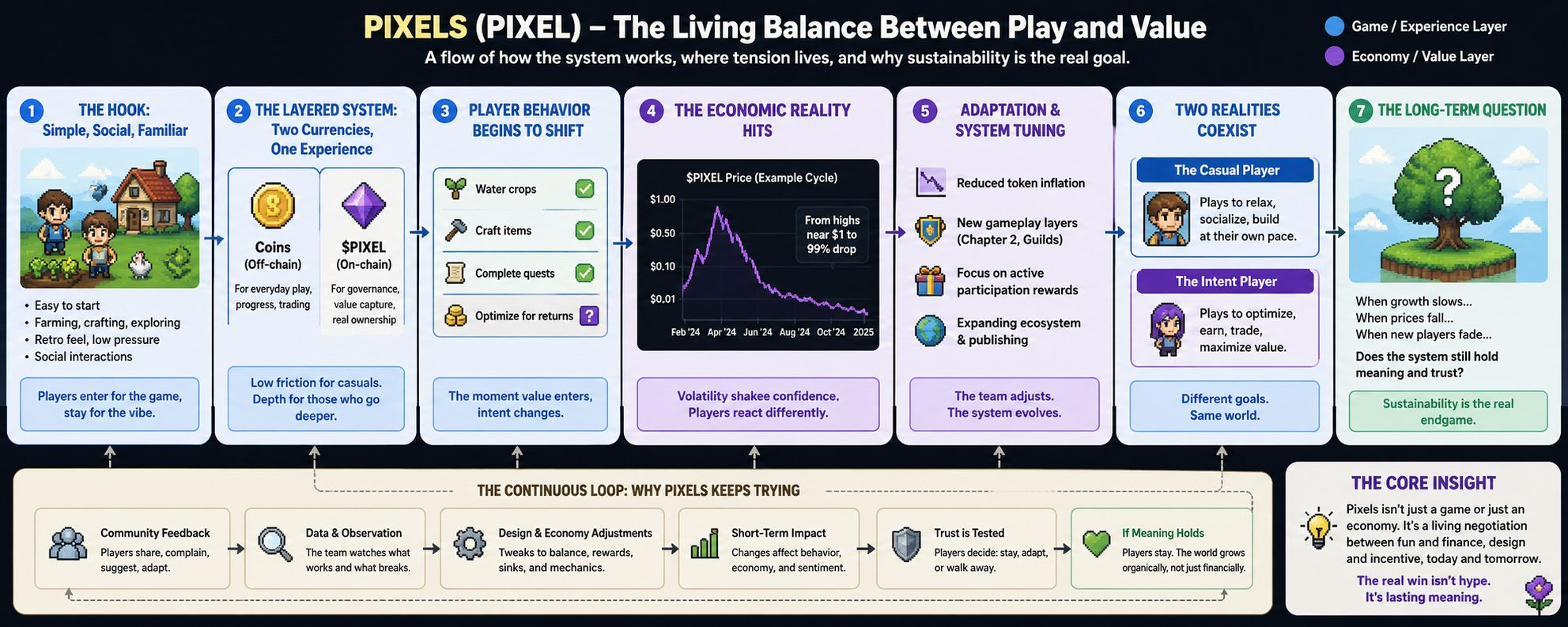
To manage that tension, Pixels does something clever. It separates the experience. There are soft in-game coins for everyday play, and then there’s $PIXEL the token layer that carries real economic weight. So if you’re casual, you don’t feel overwhelmed. If you’re deeper in, you start seeing the system underneath.
It’s a smart design.
But here’s the thing design can guide behavior, but it can’t fully control it.
I remember talking to someone in-game who said, “I used to just farm randomly… now I only do what pays.” That one sentence says a lot. The system didn’t tell them to do that. The economy did.
And we’ve seen how fragile that layer can be. The $PIXEL token had its moment strong launch, high attention and then like many tokens, it dropped hard before stabilizing. That kind of cycle isn’t just about price. It changes how people feel inside the game. Some players leave. Others become more cautious. A few double down.
The atmosphere shifts.
To their credit, the Pixels team hasn’t ignored this. They’ve been adjusting things reducing inflation, adding more structured gameplay like guilds, and trying to reward actual participation instead of passive farming. It feels less like a finished system and more like something being tuned in real time.
And maybe that’s the real story here.
Pixels isn’t trying to “solve” Web3 gaming in one shot. It’s learning, in public, what breaks and what holds.
Because the real challenge isn’t getting players in. Pixels has already shown it can attract huge numbers at one point, it was one of the most active games on Ronin. The harder question is what happens after that initial wave.
When growth slows down… does the system still feel meaningful?
When fewer new players arrive… does the economy still make sense?
When prices drop… do people still enjoy playing?
That’s where most systems fail not at launch, but under pressure.
What I find interesting is that Pixels hasn’t collapsed under that pressure. It’s adjusted. Quietly, sometimes imperfectly, but consistently. That suggests something deeper than just good timing.
It suggests resilience.
And maybe that’s the real “moat” here not the token, not the gameplay loop, but the ability to keep the system coherent as things change.
Because inside Pixels, there are really two types of players living side by side.
One logs in to relax, chat, and slowly build something. The other logs in with intent to optimize, earn, and extract value. Neither is wrong. But they don’t always want the same things.
And the game has to serve both… without letting one destroy the other.
That’s a delicate balance.
If everything becomes about earning, the game loses its soul. If nothing has value, the Web3 layer becomes irrelevant. So Pixels keeps walking this narrow line, adjusting incentives, tweaking systems, trying to keep both sides alive.
I don’t think it has fully figured it out yet.
But maybe that’s okay.
Because the more I think about it, the more I realize this isn’t really about farming, or tokens, or even Web3. It’s about something simpler and harder at the same time.
It’s about whether a system can respect your time.
Not just reward it today, but still make it feel meaningful tomorrow.
And that’s not something you can design once and be done with. It’s something you have to keep proving, again and again, especially when things aren’t going well.
So I still log into Pixels sometimes. Not because I expect it to be perfect, but because it’s one of the few places where you can actually see this experiment unfolding in real time.
And I guess I’m still curious what happens if it doesn’t break?