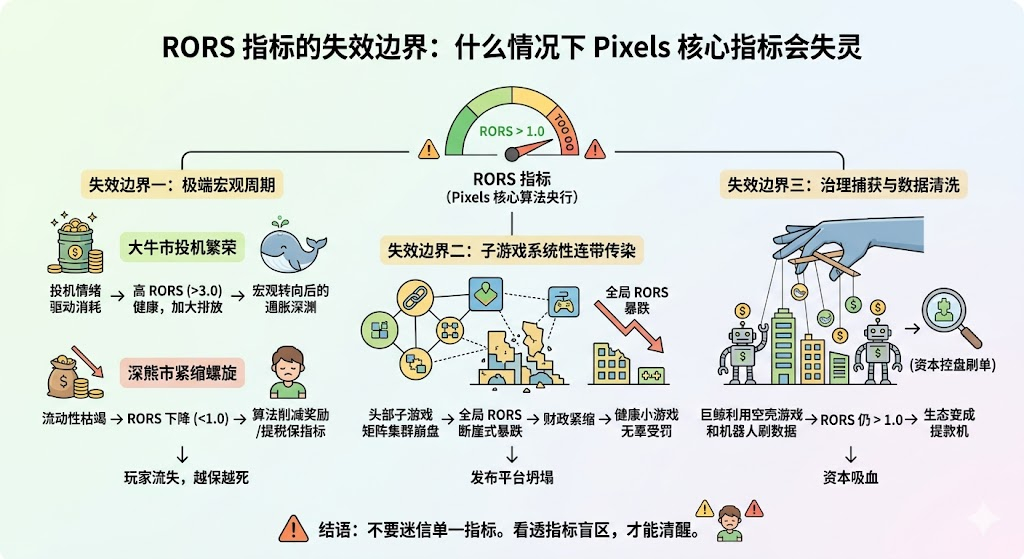
In Pixels' latest strategic white paper, RORS (Return on Reward Spend) is positioned as the ecosystem's 'North Star metric.' The white paper confidently states that as long as RORS is maintained above 1.0 (meaning for every 1 token spent in rewards, it generates more than 1 token in net ecosystem revenue), ... it can completely escape the death spiral of traditional Play-to-Earn and achieve perpetual operation.
From an economic design perspective, RORS really does outperform traditional DAU (Daily Active Users) or trading volume metrics by several dimensions. However, any economic model penned in a white paper assumes the market operates in an 'ideal rational state.' When we stress-test this model in the brutally speculative real-world environment of Web3, we find that the proud algorithm has three extremely dangerous failure boundaries.
This article will peel away the idealized assumptions of the white paper and deeply analyze why the RORS metric completely fails under extreme bull and bear markets, sub-game collective collapses, and capital control, devolving into a 'vanity metric' that obscures ecological crises.
Failure Boundary One: 'Molecular End Distortion' under Extreme Macro Cycles
The core logic of RORS is to assess real consumption within the ecosystem. However, in the extreme bull and bear cycles of the cryptocurrency market, players' 'consumption behaviors' can be severely distorted by macro sentiment, causing RORS to completely lose its ability to evaluate the health of the ecosystem.
In the 'false prosperity' of a raging bull market:
When external funds flood in wildly, leading to a parabolic spike in token prices, all assets within the ecosystem (VIP tickets, land NFTs, sub-game privileges) acquire strong 'financial call option' characteristics. At this moment, players consume tokens en masse to purchase VIP access or upgrade facilities, not for the 'fun' as stated in the white paper, but to gain higher expected returns during a bull market.
This token consumption driven purely by speculative sentiment can instantly push RORS up to 1.0 or even above 3.0. The system's algorithm mistakenly perceives the ecosystem as extremely healthy, thus increasing reward emissions. However, this high RORS is deceptive; once macro sentiment shifts, speculative consumption will drop to zero, plunging the system into an irretrievable inflation abyss.
In the 'tightening spiral' of a deep bear market:
Conversely, in a liquidity-dry deep bear market, the genuine willingness to consume for entertainment drops to freezing point. At this moment, the system's algorithm detects a drop in RORS (below 1.0) and, to forcibly maintain this core metric, the algorithm's self-adjustment mechanism triggers 'smart targeting' punitive measures—substantially reducing rewards for players and sub-games while increasing withdrawal tax rates.
This preserves RORS on the financial statements, but in reality, it constitutes 'ecological suicide.' A sudden drop in rewards will lead to a massive outflow of the already fragile real player base, plunging the ecosystem into a tightening spiral of 'the more you protect the metrics, the less active it becomes.' In these two extreme scenarios, RORS fails to objectively reflect the system's vitality.
Failure Boundary Two: Systemic Contagion from Decentralized Releases
#pixel attempts to create a 'decentralized release platform' by introducing a massive number of sub-games to disperse risk. The white paper suggests that the failure of a single game will not impact the whole. However, RORS, as a global weighted average metric, has a fatal blind spot when faced with a cluster crisis of sub-games.
The domino effect of the sub-game matrix:
Assuming the Pixels ecosystem successfully introduces 20 sub-games, with the top three games accounting for 60% of the total staking volume and activity. If these top three games collapse collectively in a short time due to reasons like core gameplay being cracked, project team going bust, or fatigue from similar games, a massive withdrawal of players will occur, causing them to cash out $vPIXEL.
At that point, the global RORS will experience a cliff-like plunge. To salvage the global metrics, the underlying smart contract of Pixels will automatically initiate a 'fiscal tightening' across the network. As the metrics are calculated globally, this tightening will not only punish the failing top games but also reduce the incentive shares of smaller, healthier mid-tier games.
Healthy mini-games are innocently punished due to the dragging effect of the total ecosystem RORS, preventing their economic models from sustaining and ultimately triggering a domino collapse of the entire release platform. In this case, RORS not only fails to serve as a warning indicator but instead accelerates the systemic crisis.
Failure Boundary Three: Governance Capture and Data Cleansing in the Validator Mechanism
This is the most deeply hidden loophole in the white paper and the easiest for institutional capital to exploit. Pixels creatively proposes the concept of 'games as validators,' entrusting the decision-making power of token emissions to staked funds. This opens a backdoor for large holders and whales to engage in legitimate 'governance capture.'
The 'RORS wash trading' of capital flipping from one hand to the other:
In the eyes of pure data algorithms, it cannot distinguish whether the real players behind the screen are truly passionate or if it is just ruthless capital operation.
Giant whales can adopt the following strategies:
Form a shell development team to create a rough sub-game with token consumption scenarios and integrate it into the Pixels platform.
Utilize substantial capital to stake a massive amount of $PIXEL in this 'shell game pool' to monopolize the ecological emission weight across the network.
To circumvent the RORS review mechanism, capital can utilize scripts for 'data cleansing' within shell games—using a left hand to control a mass of robot accounts to obtain emission rewards, while the right hand allows these accounts to consume $vPIXEL wildly to purchase meaningless items in-game.
For the $PIXEL AI monitoring system, this game not only has a massive staking volume but also exhibits extremely vigorous internal consumption, with its local RORS data performance even surpassing that of real games. Thus, the system continuously tilts more token emissions towards it.
In this scenario, RORS is still greater than 1.0, but the ecosystem has effectively become a giant whale's compliant cash cow. Based on data-driven algorithmic metrics, there is a total loss of defense against deliberate market-making behaviors wielding financial and technological advantages.
Undeniably, RORS remains one of the most forward-looking and binding economic indicators in the Web3 gaming space, significantly extending project lifecycles under stable market conditions.
However, in the blockchain world filled with extreme volatility and dark forest rules, relying on a single metric is extremely dangerous. For investors and ecosystem participants, the perfect closed loop in the white paper is merely theoretical. When macro liquidity undergoes drastic changes, top sub-games display abnormalities, or on-chain staking chips become highly centralized, the failure boundary of RORS has already been breached. Understanding the blind spots behind the metrics is essential for staying alert in an algorithm-dominated economy.