

I used to think “open economy” in games was a very straightforward idea. You log in, you play, you earn, and whatever you earn is yours. Clean loop. No hidden layers. That’s how it sounds when you say it simply. But after spending enough time inside these systems, especially the ones that don’t collapse after the hype fades, that idea starts to feel incomplete.
“Open” doesn’t always mean immediate. Sometimes it just means the structure isn’t obvious.
Pixels gave me that feeling early, even if I couldn’t explain it at first.
Nothing is stopping you when you play. You can grind, craft, trade, move around freely. The system keeps running, coins keep circulating, everything feels active. It feels like you’re constantly progressing. But after a while, something small starts to stand out. Not everything you do actually sticks right away. There’s a delay between action and permanence.
It’s not loud. It doesn’t interrupt you. You just begin to feel it over time.
That’s when I started seeing PIXEL differently.
At first, it looks like any other premium token. You use it to speed things up, unlock features, improve efficiency. Standard design. But if you follow its role more closely, it doesn’t really sit at the start of your actions. It shows up later. Closer to the point where you decide something should actually matter.
And that shift is subtle, but important.
I don’t mean “matter” in a loose way. I mean the point where something becomes recognized as real value inside the system. Something that doesn’t just exist in the moment, but continues to exist later.
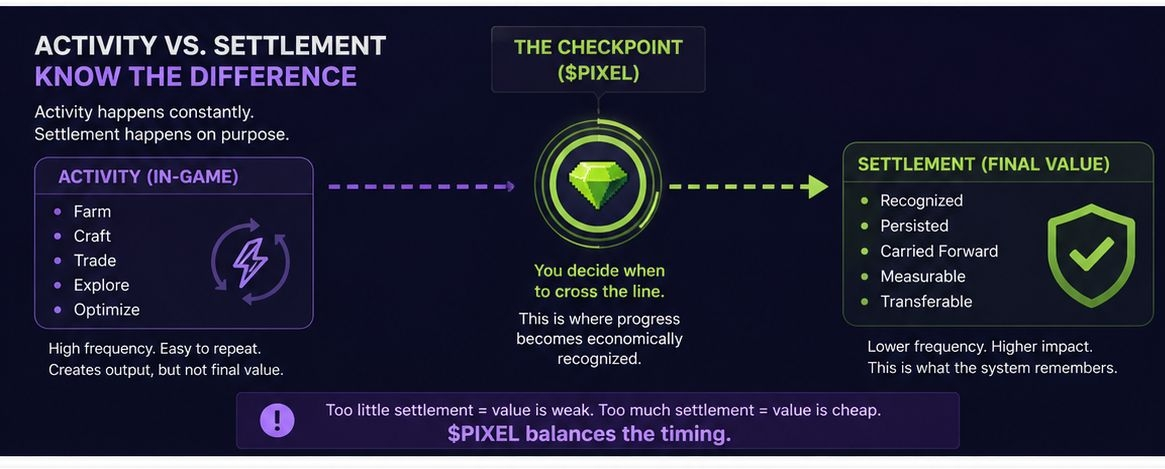
There’s a difference between doing work and having that work finalized.
In traditional finance, that final step is called settlement. It’s usually invisible. Just a backend confirmation that everything is complete. Most people never think about it. But that’s often where systems become fragile. Where delays happen. Where things don’t line up.
Pixels feels like it brings that layer closer, but without naming it.
You can spend hours building output in the game. Farming, crafting, optimizing routes, stacking resources. All of that creates progress. But not all of it becomes permanent immediately. There’s a point where that progress crosses into something the system treats as final. And PIXEL seems to sit right at that edge, almost like a quiet approval step.
I noticed it during a small decision.
I had enough progress to unlock an upgrade that actually mattered. Normally, that would be instant. Click and move on. But this time, I paused. I started thinking about whether it was the right moment to go through with it. Not because I couldn’t, but because I wasn’t sure if I should.
That hesitation felt different.
Most game economies don’t create that moment. They reward constant action. Here, it felt like timing mattered more than speed. Like value wasn’t just about what you did, but when you chose to make it count.
That small pause is more powerful than it looks.
If everything becomes final immediately, players stop separating effort from value. It all blends together. That’s what we’ve seen in many play-to-earn systems. High activity, but weak foundations. People optimize the loop, extract value quickly, and the system slowly loses balance.
Pixels doesn’t fully solve that problem, but it changes the flow.
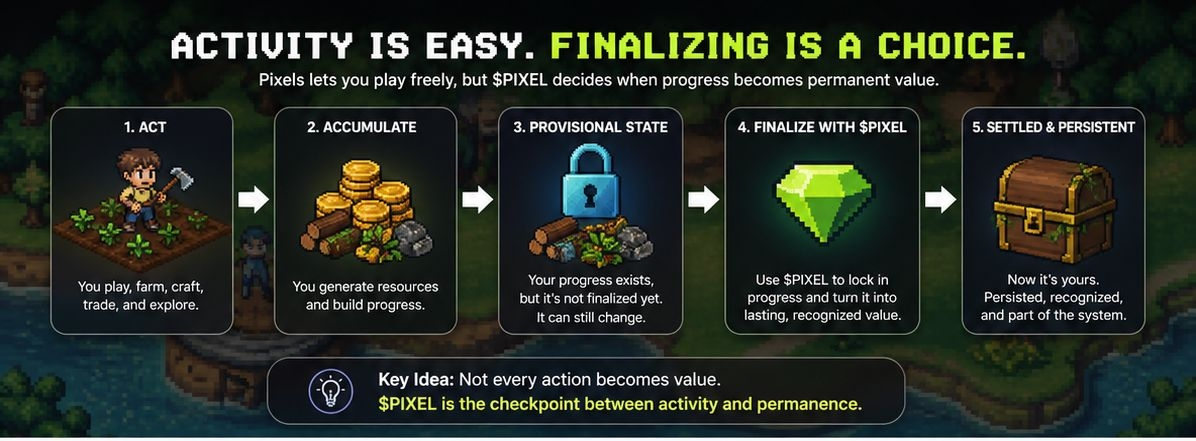
It introduces a thin layer where your activity can exist without instantly becoming permanent. You can keep producing, keep progressing, but stay in a kind of temporary state. To move beyond that, you have to engage with $PIXEL.
That’s why I keep coming back to the same idea.
Maybe PIXEL isn’t just pricing access or speed. Maybe it’s pricing timing.
It’s not asking how much you do. It’s asking when you decide it should become something lasting.
That’s a different role for a token.
It’s not driven by constant usage. It’s tied to decisions. Moments where players choose to finalize what they’ve built.
And those moments don’t happen evenly.
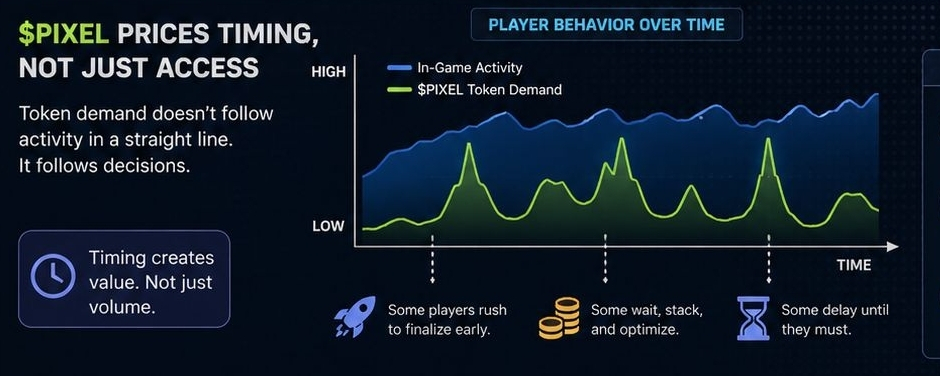
Some players commit early. Others wait and stack more before converting. Some delay as long as possible. That creates a pattern where token demand doesn’t move smoothly with activity. It comes in waves, depending on when people choose to cross that line.
From the outside, that can look confusing.
You can have a very active system, but low token usage. Or sudden spikes in demand without obvious changes in gameplay. It breaks the usual expectation that activity and demand move together.
And that’s where things get tricky.
If using PIXEL becomes too expensive or inconvenient, players might avoid finalizing altogether. They’ll stay in that temporary zone, producing but not committing. Over time, that weakens the part of the economy that actually holds value together. But if it becomes too easy, then everything settles too quickly, and the system risks overproduction again.
So the balance is tight.
Probably tighter than it looks.
I also wonder how many players actually notice this layer.
Most won’t describe it in technical terms. They won’t think about settlement or timing mechanics. They’ll just feel small decisions differently. A slight hesitation before committing. A sense that some actions are worth locking in, while others can wait.
That’s enough to shape behavior.
And that’s what makes this design interesting beyond just Pixels.
A lot of blockchain systems struggle with the same question: what should be recorded, and when? If everything is recorded instantly, systems get noisy and inflated. If everything is delayed, trust starts to weaken. Finding the middle ground usually requires strict rules or heavy coordination.
Here, that balance is being handled more indirectly, through a token.
I’m still not fully convinced it works under pressure. Designs like this often look clean until scale hits. Player behavior changes. Incentives get pushed. New strategies appear. The system can drift before anyone realizes it.
But the pattern is hard to ignore.
Pixels doesn’t feel like it’s just letting value flow freely. It feels like it’s controlling the pace. Letting activity happen first, then quietly asking if it deserves to become permanent.
And PIXEL sits right at that moment, not forcing the answer, but shaping when you decide to make it.
