
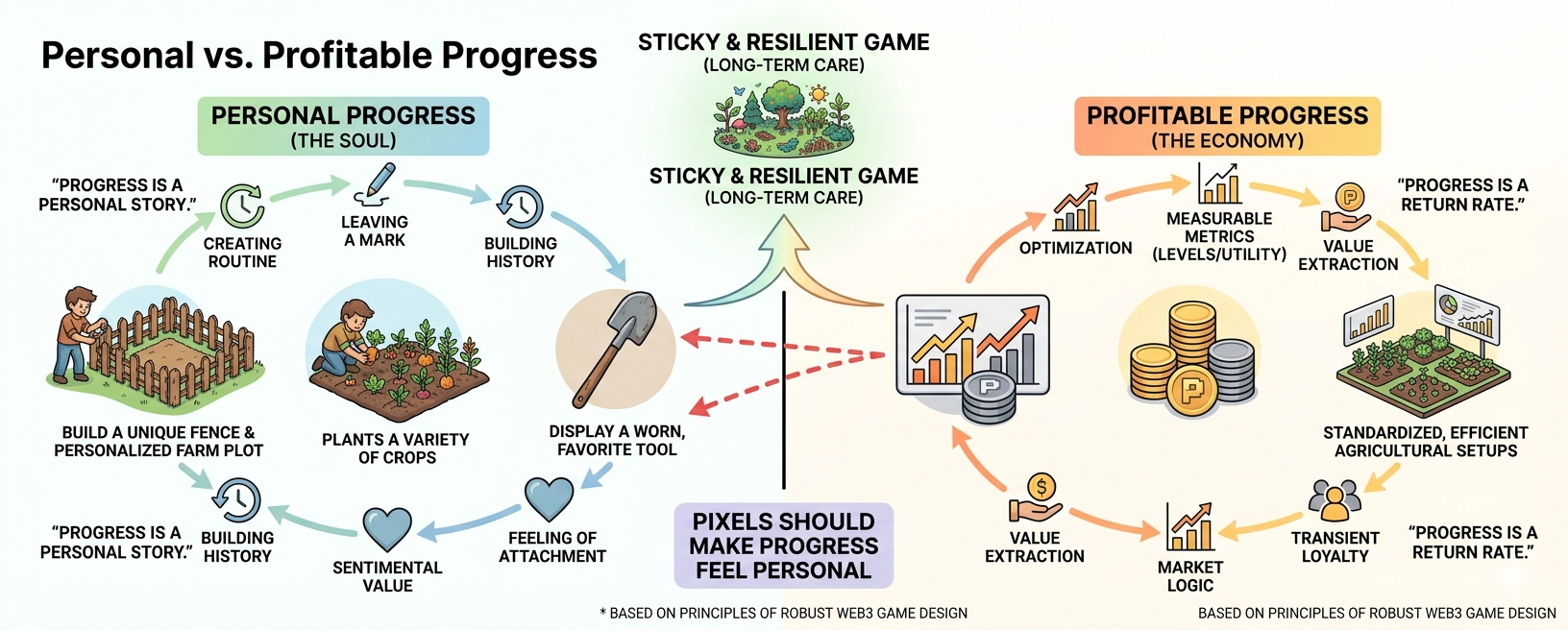
The thing that gets messy in Web3 games is progress. Not because progress is bad. Progress is the whole reason people keep playing half the time. You start small, do the work, unlock better tools, build better routines, reach places you could not reach before, and slowly feel like the game is opening up around you. That is good. That is basic game magic. But Web3 has a way of taking progress and making it feel weirdly financial before it feels personal.
That is where Pixels has to be careful.
Because Pixels is built on the kind of loop where progress should feel personal first. You farm. You gather. You craft. You explore. You build up your own rhythm over time. The reward is not only the item you earn or the value something might have. The reward is the feeling that your little corner of the world is different because you were there yesterday, and the day before that, and the day before that. That matters. A lot more than people in crypto usually admit.
A farming game lives or dies on that feeling.
If progress only feels like output, the game gets cold fast. If every action starts feeling like a calculation, then the whole loop turns into work with better graphics. Plant this because it pays better. Craft that because the economy favors it. Grind this because the rewards make sense. Fine, people will do it for a while. But that is not the same as caring. That is not the same as feeling attached to the world. That is just optimization.
And optimization is usually where fun starts dying quietly.
Pixels should not let the player feel like they are only moving through an economy. It should make them feel like they are leaving a mark. A small mark, sure. Nothing dramatic. But a mark. The farm should feel like it has history. The routine should feel like it belongs to the player. The items should matter because of use, memory, and timing, not only because someone can price them. When progress becomes personal, the player starts caring in a deeper way.
That is the kind of progress Web3 games struggle to understand.
They understand measurable progress. Level up. earn. unlock. hold. trade. stake. upgrade. Those are easy to show. Easy to chart. Easy to explain in a thread. But personal progress is harder. It is quieter. It is the moment when a player remembers how bad their first setup was. The place they used to visit every day. The crop they relied on when they were broke. The tool they kept using longer than they should have. The little system they built because it fit their style, not because it was perfect.
That stuff cannot always be turned into a clean metric.
But it is the glue.
Without it, a game becomes replaceable. If the only thing that matters is efficiency, players will leave the second another game offers better efficiency. Better rewards. Better numbers. Better hype. That is the risk with Web3 gaming. It trains players to compare systems instead of inhabit worlds. And once players think like that, loyalty becomes very thin.
Pixels has a chance to avoid some of that because the base loop is human. Farming is naturally slow. It rewards patience. It gives time a shape. You do something now and return later to see the result. That can create attachment if the game lets it. But if the Web3 layer keeps pushing everything toward value extraction, the softness disappears. The player stops seeing progress as a personal story and starts seeing it as a return rate.
That would be a waste.
Because the best part of a game like Pixels is not that you can explain its economy. It is that you can feel your routine forming. You start knowing what you want to do when you log in. You start having preferences. You start getting annoyed by little things because the world has become familiar enough to bother you. That is a sign of attachment. People only complain like that when they have started caring.
Web3 people sometimes miss this completely. They want clean praise. They want big excitement. They want players to talk about growth and utility and long-term potential. But a player saying, “I always do this first when I log in,” is more important than half the hype posts on the internet. That means the game has entered their day. That means progress has become routine. That means the world has started taking up space in their life.
That is real.
PIXEL as a token can support the experience, but it should not define the meaning of progress. If the token becomes the main reason to improve, then the game becomes fragile. Market mood changes. Reward expectations change. People get tired. But if progress feels personal, the player has more reasons to stay through quiet periods. They are not only protecting value. They are protecting a relationship with the world.
That is a stronger foundation.
Ronin helps by making the technical side smoother, and that matters. Nobody wants progress interrupted by clunky chain friction. But smooth tech is just the floor. It is not the soul. The soul comes from whether the game makes small effort feel worth remembering. Whether the player feels like yesterday mattered. Whether the world feels slightly more theirs after every session.
That is what Pixels should chase.
Not just profitable progress. Personal progress.
The kind that makes a player look back after a few weeks and think, yeah, this place has changed because I kept showing up. Not because the chart moved. Not because a campaign told them to care. Because their own small actions stacked into something they recognize.
That is how games become sticky in the right way.
Not through pressure. Not through hype. Not through constant market logic.
Through the quiet feeling that your time left a trace.
