

Pixels can look, at first, like the kind of open game economy Web3 has been promising for years. You farm, explore, craft, and build in a world that seems to reward activity in a natural way. On the surface, it feels alive in the best sense: players are always doing something, and that something appears to create value.
But there is another way to read it.
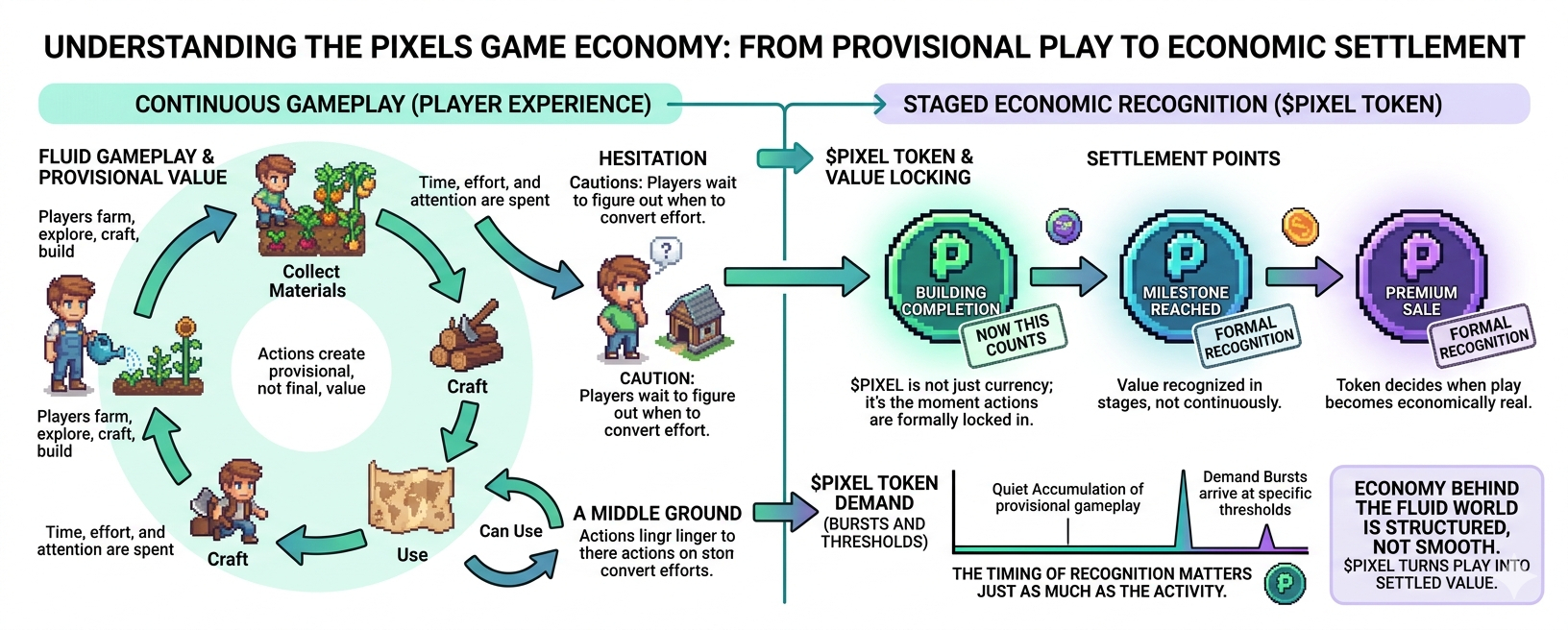
What $PIXEL seems to do is not simply reward play, but decide when play actually becomes economically real. A lot of what happens in the game feels productive before it feels final. Players may spend time, effort, and attention, but the value of that effort does not always feel fully settled right away. It sits in a kind of middle ground, where the action has happened, but the accounting has not quite caught up yet.
That is an important distinction. In a truly open economy, value would flow continuously. But Pixels seems closer to a system where value is recognized in stages. The game lets players act freely, but the token appears to be the moment when those actions are formally locked in as something lasting. In that sense, $PIXEL is not just a currency moving through the world. It is more like the point where the game says, “Now this counts.”
That changes how the economy feels from the player’s side. When not everything is immediately finalized, players naturally become a little cautious. They wait. They hold back. They try to figure out when it is worth converting effort into something the system will actually recognize. The result is a kind of hesitation built into the experience. Players are not only deciding what to do; they are deciding when it is worth making that action count.
This is where token demand becomes interesting. It may not show up as a constant, steady pressure. More likely, it appears in bursts. Players do not need the token every second in the same way they might need energy, tools, or raw materials. They need it when they reach a point where provisional gameplay has to become settled value. That means demand can gather quietly in the background and then arrive all at once when a threshold is crossed.
So even if the game looks open and fluid, the economy underneath may be more structured than it first appears. A lot of activity can happen before any of it is fully recognized. The world feels continuous, but the value may be arriving in moments of closure rather than in a smooth stream.
That is what makes Pixels feel economically interesting. It is not just a game where players create value. It is a game where the timing of recognition matters just as much as the activity itself. And pixel seems to sit right at that line, turning play into something that finally settles.
