
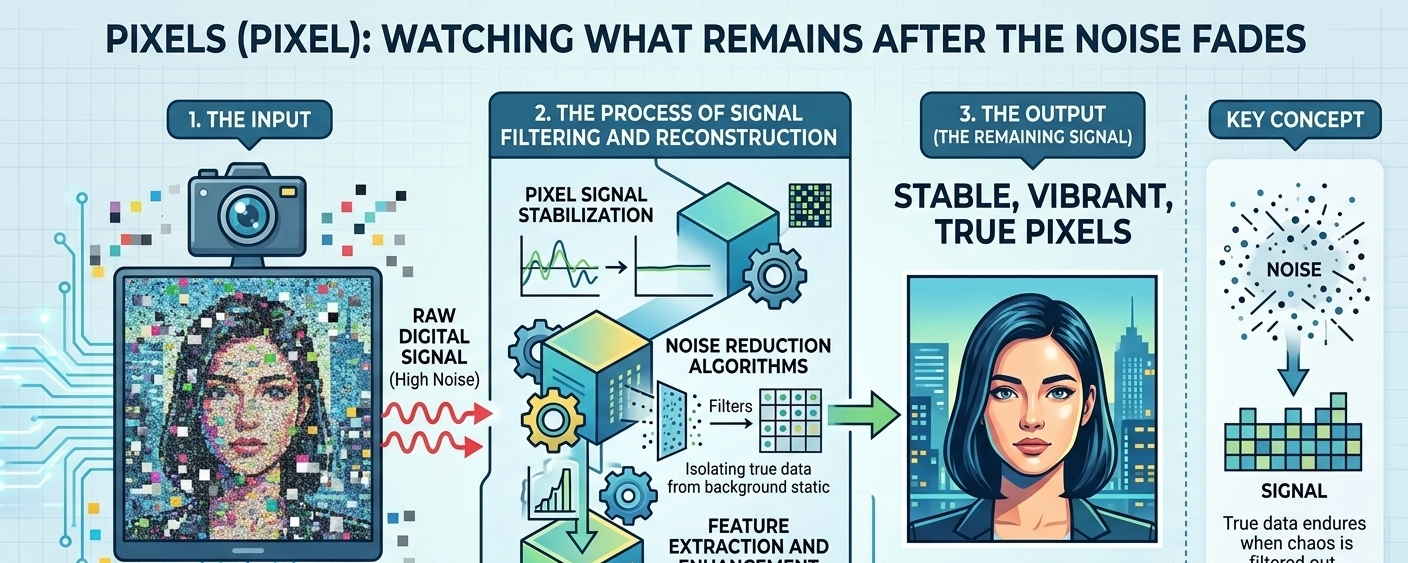
I’ve been noticing how the things that stay with me in crypto are rarely the ones that once felt important. It’s usually the quieter systems, the ones that keep running after attention leaves, that start to feel more honest over time. Pixels has slowly become one of those for me—not because it convinced me, but because it didn’t try very hard to.
There was a time when I would’ve looked at something like this and immediately framed it through growth, token demand, user numbers. That instinct is still there, but it doesn’t lead anymore. Now I find myself watching smaller details. The way a world feels when you enter it without expectation. The way people behave when there’s nothing urgent to chase.
Pixels doesn’t rush you. It doesn’t try to overwhelm you with opportunity or force a sense of progression. You move through it at your own pace, repeating small actions that slowly build into something resembling structure. Farming, collecting, adjusting, returning. It’s simple in a way that almost feels intentional, like it’s trying to lower the emotional cost of participation.
But simplicity in Web3 always carries a second layer.
Because even when the experience feels light, there’s still an underlying system shaping why people show up. The token doesn’t need to dominate the screen to influence behavior. It sits in the background, quietly defining value, even when no one is talking about it directly. And I’ve learned that this quiet influence can be more powerful than overt incentives, because it’s easier to ignore until it starts to matter again.
That’s where my hesitation comes in.
I don’t question whether people can spend time in Pixels. That part is obvious. The loops are easy to return to, the world doesn’t push back, and there’s a certain comfort in that predictability. But comfort and attachment aren’t the same thing. One keeps you present, the other keeps you invested. And I’m not sure where Pixels sits between those two.
Sometimes it feels like a place people inhabit casually, without needing a strong reason. Other times it feels like a system still waiting for that deeper reason to form. And maybe both are true at once.
I’ve seen enough projects try to manufacture that sense of meaning. They layer in mechanics, expand narratives, introduce new incentives—all in an attempt to keep attention from drifting. It works for a while, until it doesn’t. Because attention in this space is rarely lost all at once. It fades gradually, almost quietly, until one day the routine no longer feels necessary.
Pixels doesn’t seem to be fighting that process in an obvious way. It’s not constantly trying to pull you back in or remind you of what you might miss. If anything, it feels comfortable letting you step away. That’s unusual here. Most systems are designed around fear of absence. Pixels feels more neutral, almost indifferent.
And I can’t decide if that’s a strength or a risk.
There’s a version of this that works long-term, where the world becomes a kind of background presence in people’s lives. Not something they think about constantly, but something they return to without friction. That kind of retention is subtle, but it can be durable if it’s real.
But there’s also a version where that same softness leads to slow disengagement. Where nothing breaks, nothing fails, but nothing deepens either. The system continues, but the connection weakens over time. I’ve seen that happen more than once, especially in environments where incentives once carried more weight than the experience itself.
That history is hard to ignore.
So when I spend time around Pixels, I’m not trying to figure out if it’s good or bad, successful or failing. Those labels feel too immediate, too tied to moments that don’t last. I’m more interested in how it holds up in stillness. What remains when there’s no narrative pushing it forward.
Because that’s usually where the real shape of a project starts to appear.
Right now, it feels like Pixels is suspended in that kind of stillness. Not stagnant, but not accelerating either. Just moving at its own pace, shaped by the people who continue to show up without needing a clear reason.
And maybe that’s enough for now.
Or maybe it isn’t.
I don’t think that answer reveals itself quickly. It shows up over time, in small shifts that are easy to miss if you’re only looking for big signals. In the way routines either deepen into something meaningful or slowly dissolve into absence.
So I keep watching, not because I’m convinced there’s something here, but because I’m not ready to dismiss it either.
Some systems don’t reveal what they are until long after the noise is gone.
Pixels feels like one of those.