

I was reviewing my small $PIXEL position again this week, and honestly, I realized I’d been misunderstanding it for a while.
At first, I treated Pixels like most Web3 game economies I’ve seen before — active players grind, token gets used, demand should follow. Pretty standard. My early assumption was simple: more gameplay = more Pixel relevance. But after watching my own trades and hesitating more than once before adding, I started noticing something different.
What changed my view wasn’t price action alone — it was player behavior.
Pixels feels open when you first jump in. You can farm, craft, trade, optimize… the system moves constantly. That part is real. But the deeper I paid attention, the more it felt like not all value inside Pixels becomes equally “real” at the same time.
That’s where @Pixels started looking more important to me.
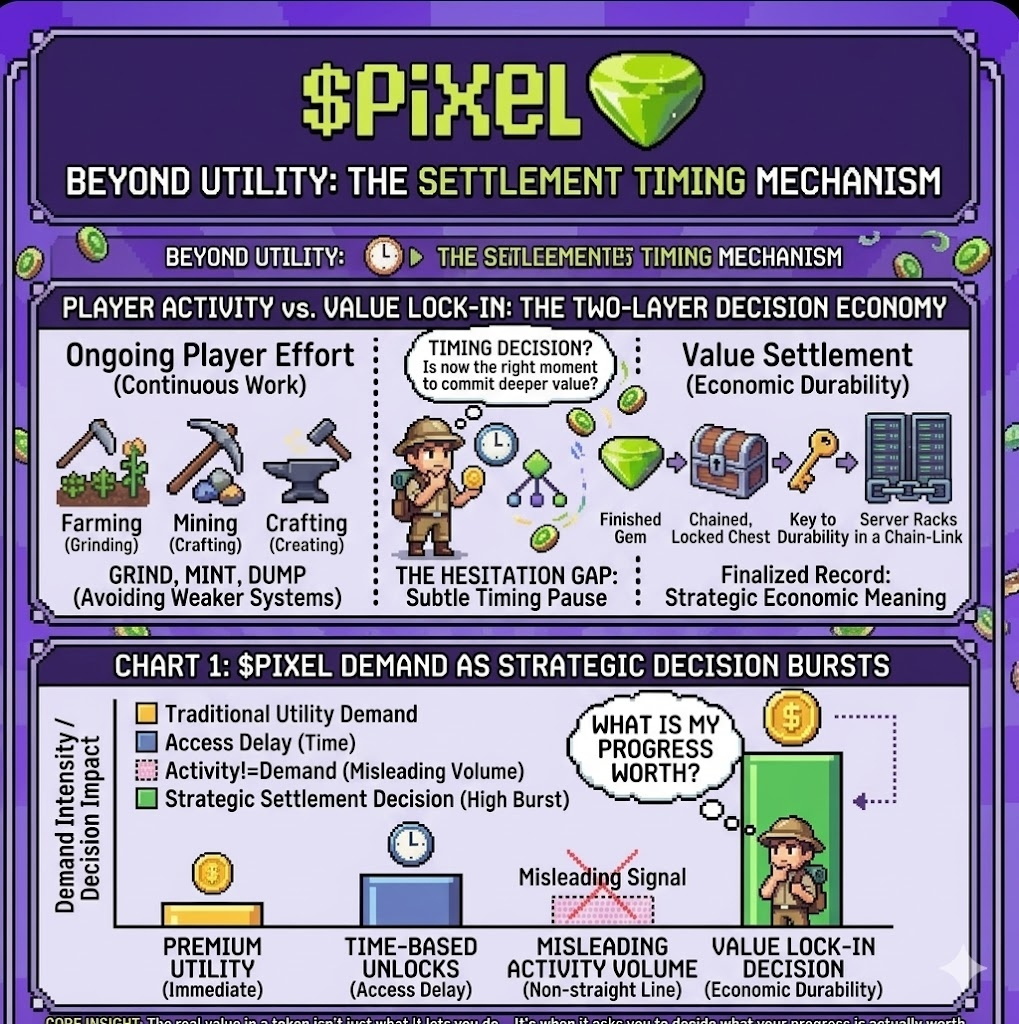
I don’t really see it as just a speed-up token anymore. It feels more like the layer that helps decide when your in-game effort actually becomes economically meaningful in a lasting way.
That distinction matters.
In a lot of weaker play-to-earn systems, everything gets extracted too quickly. Grind, mint, dump, repeat. Activity stays high for a while, but durability fades because too much value settles instantly. Pixels seems more thoughtful than that. From what I’ve experienced, there’s often this subtle pause between doing something productive and deciding when it’s worth committing deeper value.
I actually caught myself doing this recently during an upgrade decision. I had enough progress to move forward, but instead of instantly spending, I paused. Not because I lacked resources — I was thinking about timing. Was this the right moment to lock in value?
That hesitation surprised me.
Good systems change how you think, not just what you do. And Pixels, at least for me, seems designed around that principle.
This is why I think $PIXEL may be stronger than people assume during quieter periods. Token demand may not always move in a straight line with player activity because its role appears tied more to decision points than constant action. That creates bursts, pauses, and sometimes misleading market signals.
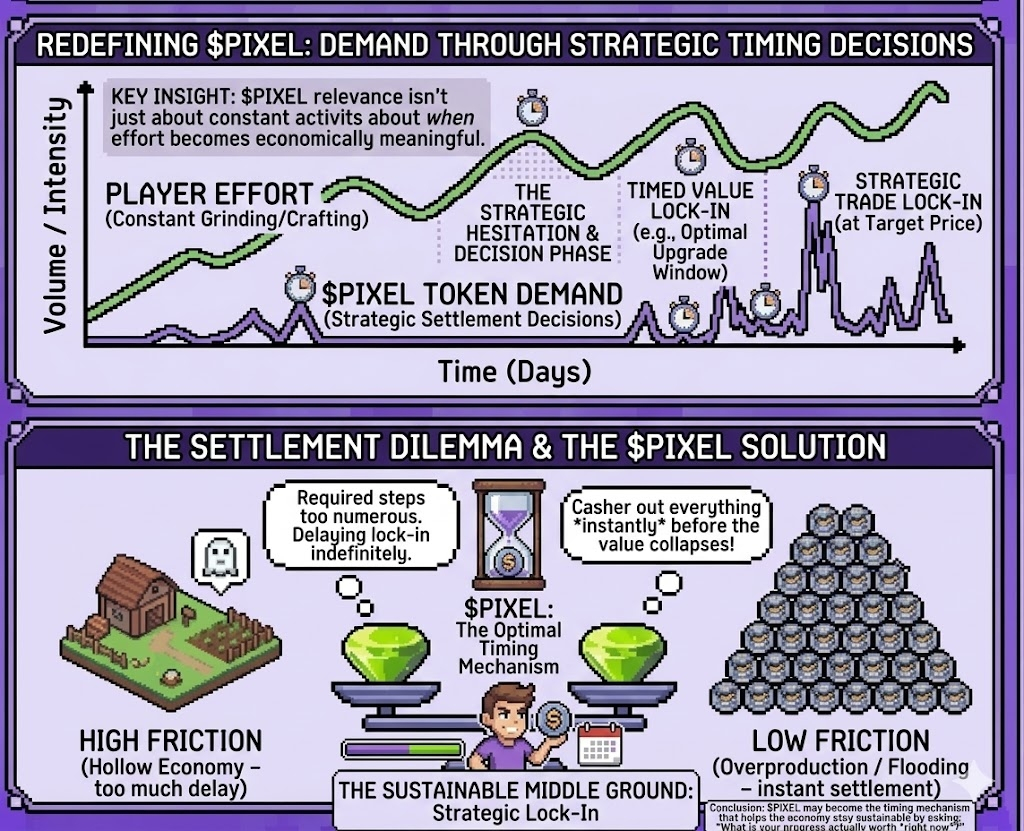
Of course, balance matters. Too much friction could delay settlement too long, while too little could flood the system. But if Pixels manages that middle ground well, $PIXEL could represent more than utility — it could become the timing mechanism that helps the economy stay sustainable.
I’m still watching closely, but right now, I’m leaning more bullish than I was months ago.
Sometimes the real value in a token isn’t just what it lets you do…
It’s when it asks you to decide what your progress is actually worth.