
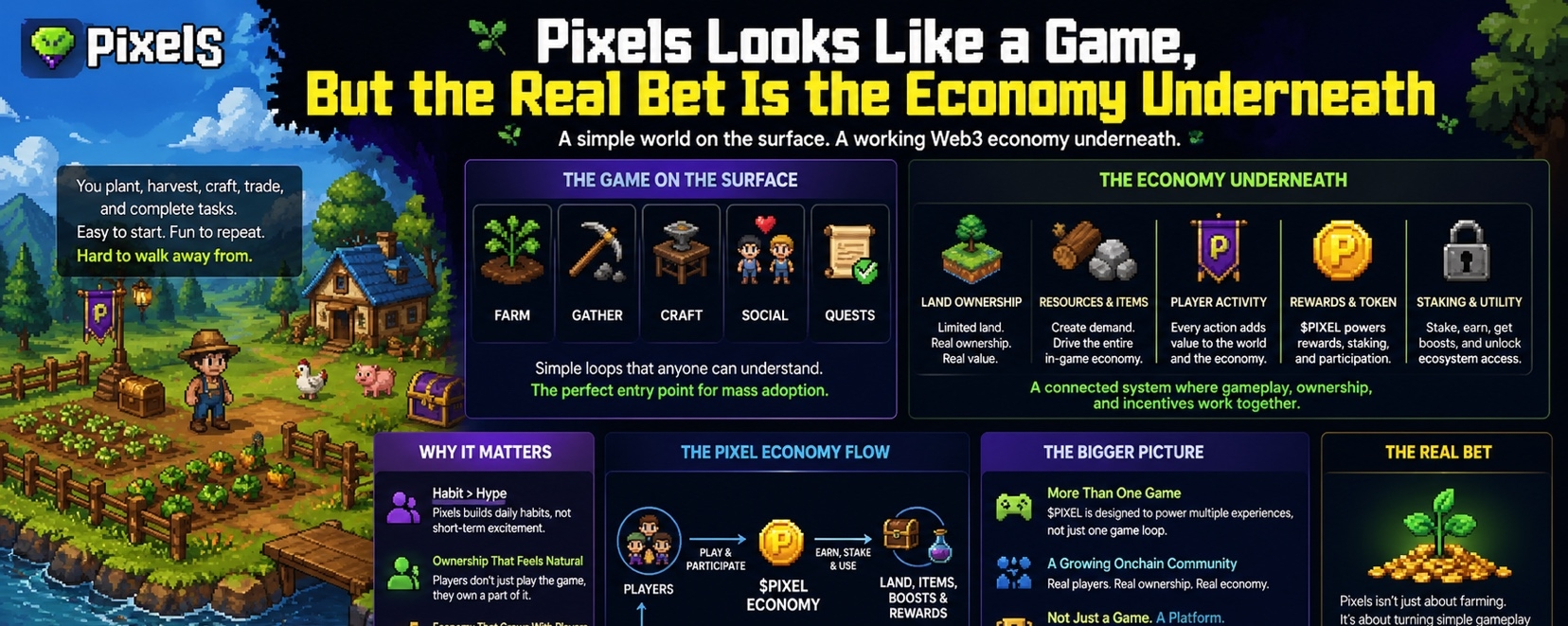
Most people still look at Pixels and call it a farming game.
I get why.
That is what it looks like from the outside. You plant, harvest, craft, move around, complete tasks, and repeat the same small loops again and again. Nothing about it screams serious economy at first glance.
But I’ve been around this market long enough to know the loudest projects are usually the first ones to disappear.
Pixels is not loud in that way.
That is why I keep watching it.
Web3 gaming has been recycling the same tired pitch for years. Big promises. Fancy trailers. Empty worlds. Tokens launched before the game had any real reason to exist. Then the rewards dry up, the players leave, and everyone pretends they never believed in it.
I’ve seen that movie too many times.
Pixels feels different because it starts with something basic. A world people can actually enter. A loop they can understand without reading a thread for twenty minutes. A game that does not immediately make the player feel like they walked into a trading terminal.
That matters.
Not because farming is exciting by itself.
It matters because simple behavior is easier to repeat. And repeated behavior is where an economy starts forming.
A player plants. A player harvests. A player crafts. A player trades. A player comes back tomorrow.
That sounds small.
It is not.
Most Web3 games never even reach that point. They get wallets. They get farmers. They get early noise. But they do not get habits. Pixels has at least shown it can create routine, and in this sector, routine is harder to fake than hype.
The farm is the clean part.
The economy underneath is where the friction starts.
Land has to matter without becoming only a whale game. Rewards have to feel worth chasing without turning the whole thing into an extraction machine. The token has to sit inside the system, not float above it like some useless market sticker. New players need a reason to enter, but old players need a reason not to leave.
That balance is ugly.
And this is where I stop being romantic about it.
Pixels still has to prove it can survive its own incentives. Every game economy gets tested eventually. Bots come in. Reward hunters squeeze the loop. Players optimize the fun out of the system. The market gets bored. The chart stops carrying the story.
That is when we find out what is real.
I’m not interested in the clean version of Pixels.
I’m interested in the stressed version.
What happens when rewards need adjusting?
What happens when landowners want more value?
What happens when casual players feel the grind but power users want deeper systems?
What happens when the token needs demand that does not come from short-term farming?
That is the real test.
Still, I keep coming back to one thing. Pixels has a playable identity. That is rare. It has a world people recognize, a loop that makes sense, and enough economic pieces around it to become more than a small farming title if the team keeps tightening the system.
Not perfect.
Just alive.
And alive matters.
Most crypto games are either too financial to feel like games, or too shallow to support an economy. Pixels sits somewhere in the uncomfortable middle. That is not a bad place to be. It is messy, but it gives the project room to grow.
The token side is where I’m careful.
A token inside a game needs real pressure from usage. Not just rewards. Not just staking banners. Not just people saying “utility” because they need something to post. It needs to be pulled into the daily life of the ecosystem until using it feels normal.
Pixels seems to be moving in that direction.
Slowly.
That is fine.
I would rather see slow structure than another fake explosion that ends in silence.
The bigger idea is not farming. It is participation. The game gives people something simple to do, then the economy starts building around those actions. Land, resources, rewards, identity, progression — all of it only matters if players keep showing up.
That is why I don’t dismiss Pixels.
I’ve watched enough projects fail to know that attention is cheap. Retention is expensive. It costs design, patience, balance, and a lot of painful adjustments nobody wants to talk about when the market is green.
Pixels will have to go through that grind.
Maybe it handles it.
Maybe it gets buried under its own reward design.
I don’t know yet.
But I do know this: calling it just a farming game feels lazy now. The farming is the visible layer. The more interesting part is the economy being tested underneath, where every small action either adds weight to the system or exposes another weak spot.
That is why I’m still watching.
Not with blind excitement.
More like tired curiosity.
Because sometimes the project that looks boring on the surface is the one quietly building the thing everyone else only pretended to build.