
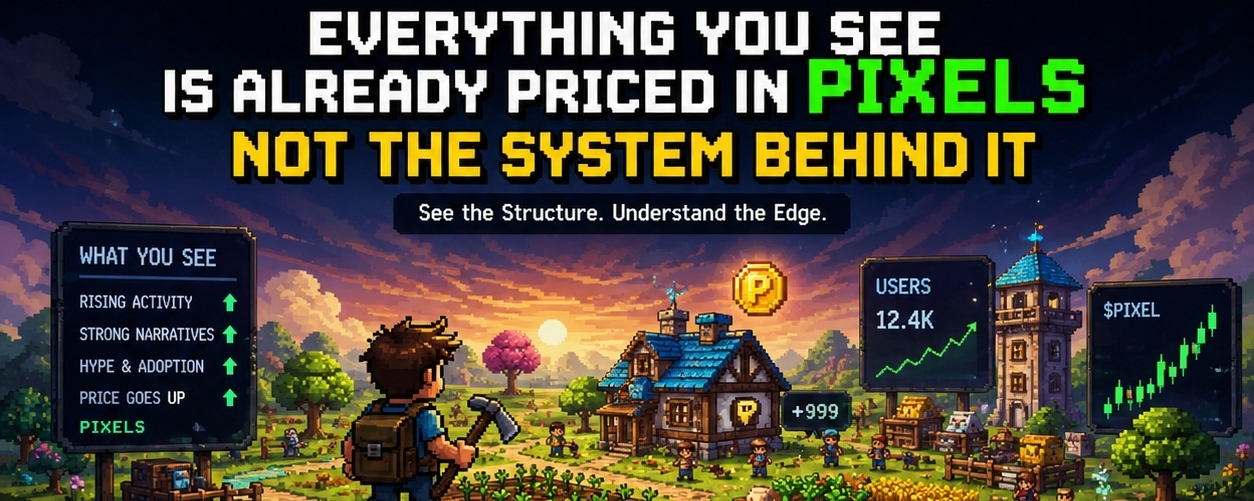
What looks obvious is usually where you’re already late.
A clean chart, rising activity, strong narratives — it all feels like confirmation. Like something real is unfolding right in front of you. But what you’re actually seeing isn’t the system. It’s just pixels — fragments of output that show results without revealing the machinery behind them.
Pixels are seductive because they simplify complexity. They give you something easy to react to. Price goes up, people call it strength. Users increase, people call it growth. Hype spreads, people call it adoption. But none of these are complete truths — they’re just surface-level signals disconnected from the deeper structure that actually drives outcomes.
Structure is where the real story lives. Incentives, ownership, capital flow, behavioral loops — these are the forces shaping what eventually becomes visible. By the time something looks strong on the surface, the underlying system has already been in motion for a while. Early capital has already positioned itself. Behavior has already adapted. Value has already started moving.
This is where most people misread digital systems. They anchor their decisions to visibility instead of design. They follow what’s trending instead of understanding what’s sustaining it. And in doing so, they end up reacting to effects instead of anticipating causes.
Smart money doesn’t operate like that. It doesn’t chase what’s visible. It studies what’s repeatable. It looks at who benefits from the system, how incentives are structured, where the pressure points are, and whether the entire loop can sustain itself over time. Because visibility is temporary, but structure compounds.
That’s what makes @Pixels more interesting than it appears at first glance.
On the surface, it looks like a simple farming game with land, tokens, and player activity. But underneath, it’s a structured economic system. Farming is not just gameplay — it’s production. Land is not cosmetic — it’s infrastructure that determines capacity and efficiency. The economy isn’t isolated — it’s interconnected, where every action feeds into another loop. And player behavior isn’t random — it evolves based on incentives, constraints, and optimization.
This creates a system where outcomes are not accidental. They’re designed.
Most people enter Pixels reacting to rewards. A smaller group studies how those rewards are generated, distributed, and sustained. One group chases yield. The other maps the source of yield. One focuses on what’s happening now. The other focuses on what must continue happening for the system to hold.
$PIXEL , in that sense, is not just a token moving with sentiment. It’s a reflection of how well the system underneath it is functioning. If the structure remains efficient and incentives stay aligned, value has something real to build on. If not, the surface can still look strong for a while — but eventually, the gap between pixels and reality closes.
Most people will keep reacting to what they can see.
The edge belongs to those who understand what generates it.



#pixel #TrendingTopic #StrategyBTCPurchase #Market_Update #meme板块关注热点