
The moment I started taking Pixels more seriously was when I stopped asking why BERRY existed, and started asking why it had to exist in the first place.
At a glance, most people assume a clean model: one main token, one unified economy, everything flows through it. In reality, that almost never works in live games.
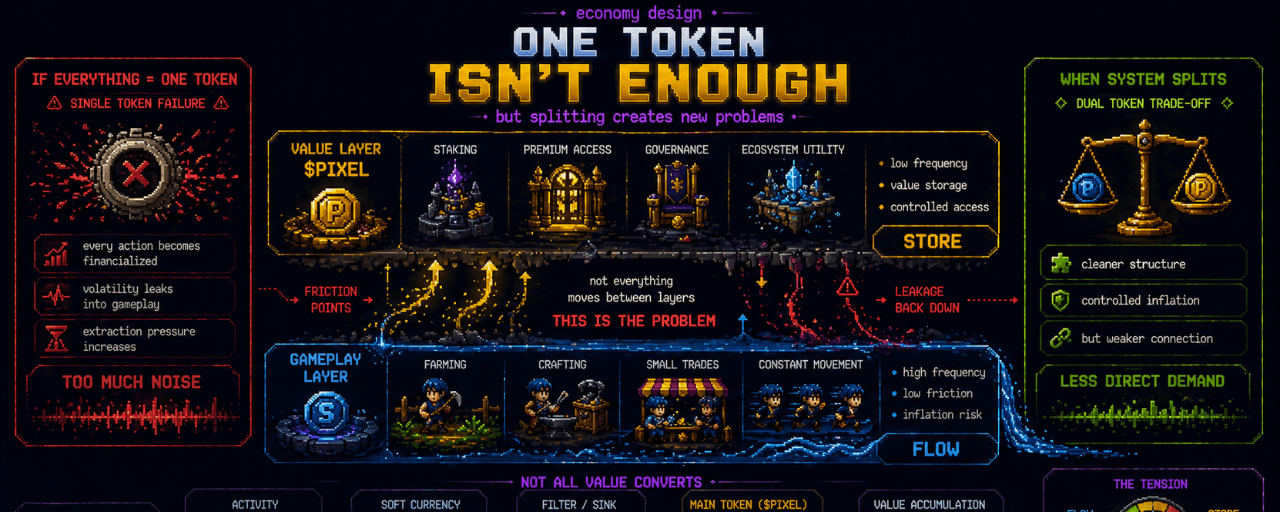
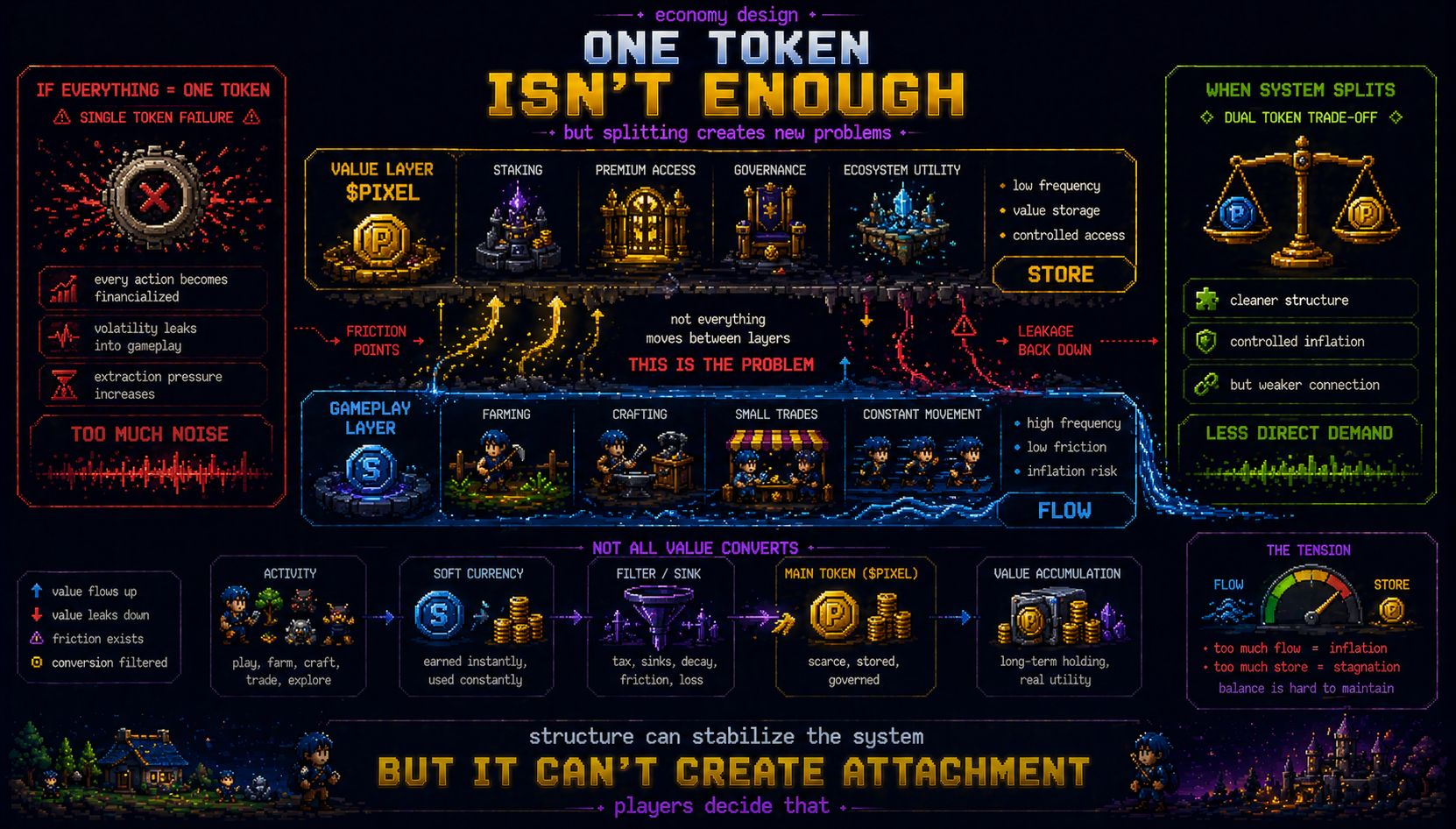
A system like Pixels needs two very different things at the same time. It needs a stable, low-friction medium for everyday actions, and it needs a higher-level asset that can carry value without being constantly diluted by gameplay.
Trying to force one token to do both usually breaks the economy.
That’s where BERRY came in. It wasn’t just an “old design mistake.” It was a functional layer that allowed players to farm, craft, and progress without turning every small action into something instantly tradable on the market. Without that buffer, even basic gameplay becomes tied to price volatility and extraction pressure.
But the problem showed up quickly. When a soft currency is too easy to farm and too easy to sell, it turns into a leak. Pixels itself acknowledged that BERRY was running with high daily inflation, which is exactly the kind of dynamic that pushes players toward farming behavior instead of long-term engagement.
The shift to move it off-chain wasn’t just a technical tweak. It was a reset of economic boundaries.
Now the system looks more segmented. Routine gameplay flows through internal coins, while PIXEL is positioned further up the stack closer to staking, premium access, ecosystem coordination, and higher-value interactions. On paper, that separation makes sense. It reduces noise around the main token and gives it a clearer role.
But design clarity doesn’t automatically translate into market confidence.
Even with active trading volume, PIXEL is still priced like a token that hasn’t proven its loop yet. The gap between current valuation and past highs tells you something simple: the market isn’t convinced that gameplay activity is turning into durable demand.
And that brings everything back to retention.
A dual-currency system can stabilize an economy, but it can’t create attachment on its own. If players only engage when rewards feel worthwhile, the structure just delays the same outcome. The soft currency handles daily flow, the main token captures value — but neither matters if users don’t stay.
That’s why BERRY still matters conceptually, even after being pushed into the background.
It represents the core tension every GameFi system faces. Players need freedom to act without friction. The economy needs limits to survive. Too much freedom leads to extraction. Too much control leads to disengagement.
Pixels is trying to sit in the middle of that.
My view is straightforward: the redesign shows the team understands the problem. Separating currencies, controlling inflation, and repositioning PIXEL are all rational moves. But none of them prove the outcome yet.
The real test isn’t whether the structure looks cleaner. It’s whether players keep participating once the system becomes more controlled, more selective, and less immediately rewarding.
So yes, it’s worth watching.
Not because the token looks cheap or active.
Because it’s still an open experiment in whether a game can split its economy into layers without losing the player in between.