
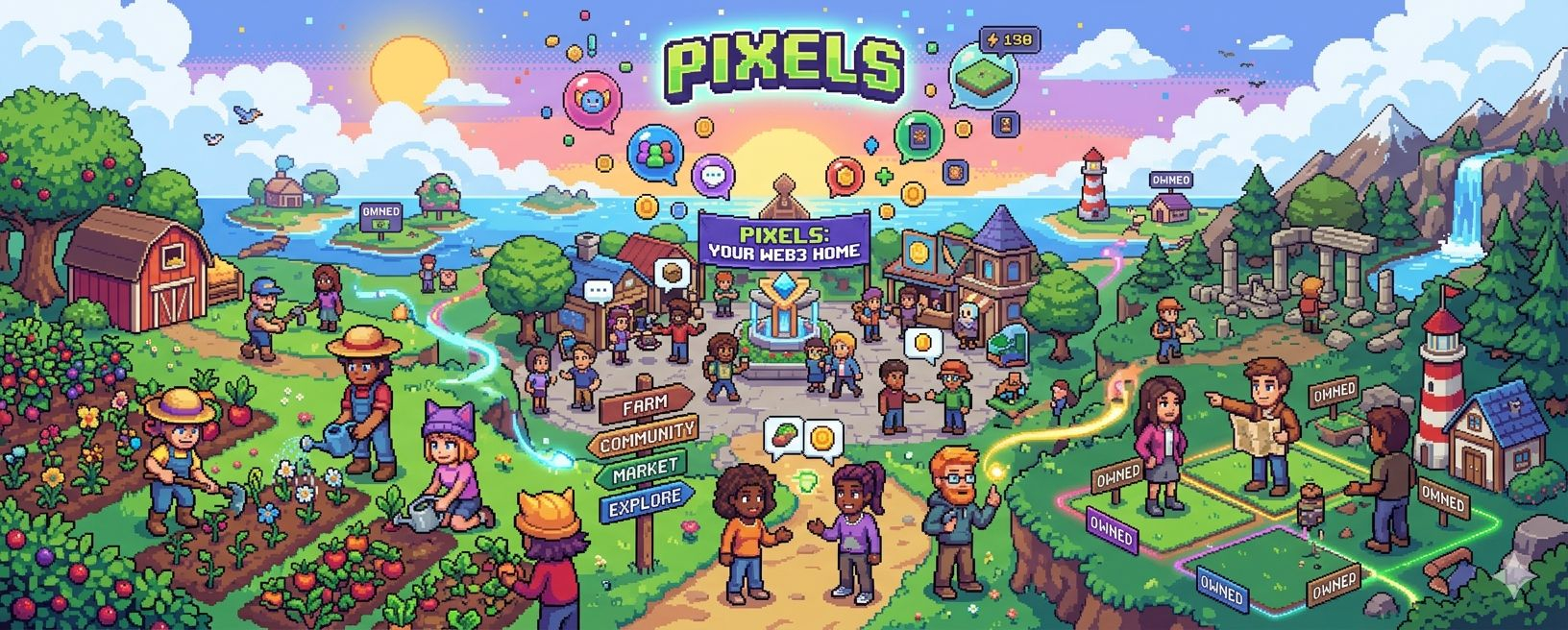

Pixels is not just a game; it feels more like a living Web3 space where farming, exploration, ownership, and community all connect with each other. When I look at it closely, I do not see only a casual farming game with colorful pixel-style visuals. I see a project trying to make digital participation feel more personal. That is what makes it interesting. It gives players something simple to do on the surface, but behind that simplicity, there is a bigger idea about progress, identity, and ownership in online worlds.
At first, most people notice the game side. They see crops, quests, land, resources, decorations, and daily activities. That part matters because no Web3 project can survive only on token hype. A game still has to feel enjoyable. Players need a reason to come back that is not only connected to money. Pixels understands this better than many blockchain games. It does not immediately feel like a complicated crypto product. It feels like a place where someone can enter, do small tasks, improve step by step, and slowly become part of the environment.
What stands out to me is the way Pixels uses simple gameplay to create attachment. Farming games have always worked because they give players a quiet sense of progress. You plant something. You wait. You collect. You upgrade. It sounds basic, but it creates a rhythm. That rhythm is powerful because people like visible improvement. They like seeing their effort turn into something. Pixels uses that same feeling, but adds a Web3 layer around it, which makes the progress feel a little more meaningful.
Still, the deeper value is not only in farming or earning. It is in the community. A game like Pixels becomes stronger when players feel they are not alone inside the world. They are part of a shared space where people interact, trade, build, and follow the same ecosystem. I pay attention to this because community is often the real engine behind Web3 projects. Technology can bring people in, but community keeps them around. Without that social energy, even the best-looking game can feel empty.
The ownership side also matters. In traditional games, players spend time, money, and energy building accounts, collecting items, and improving their characters, but most of that value remains locked inside the game company’s system. Web3 changes that idea. It gives players a stronger feeling that what they earn or hold has some kind of independent value. This is not only financial. It is psychological too. When people feel they own something, they naturally care about it more.
That is where Pixels becomes more than a surface-level farming game. It represents a shift in how players may start thinking about digital time. In the past, time spent in games was mostly entertainment. Now, with Web3 elements, that time can also become part of a player’s digital identity and personal progress. I am not saying every action inside a game must become an investment. That would ruin the fun. But I do think players are starting to expect more control over the things they build online.
There is also a practical reason Pixels feels important. It is easier to understand than many Web3 games. Some blockchain projects overwhelm users with wallets, token systems, marketplaces, and technical steps before they even explain why the game is fun. Pixels feels different because the experience comes first. The Web3 side supports the world instead of completely taking over it. That balance is important. If a casual player can enjoy the game without feeling lost in crypto terms, the project has a much better chance of reaching a wider audience.
But there is a risk too. Web3 games can lose their soul when the economy becomes louder than the gameplay. If players only enter for rewards, they may leave as soon as the rewards slow down. If speculation becomes the main attraction, the community can become unstable. This is why Pixels has to protect its core experience. The farming, the social world, the sense of progress, and the emotional connection must stay stronger than short-term financial excitement.
In my view, the real strength of Pixels is that it does not need to shout to prove its value. It works because it feels familiar and new at the same time. The farming side gives comfort. The community side gives life. The Web3 side gives ownership. When these parts work together, the game becomes more than a digital activity. It becomes a place where players can feel involved.
The long-term meaning of Pixels is bigger than one game. It shows where online worlds may be heading. Players do not only want to consume content anymore. They want to participate. They want to build. They want some kind of recognition for the time and effort they put into digital spaces. Pixels taps into that desire in a simple but effective way.
For me, Pixels matters because it shows a more human version of Web3 gaming. Not everything has to be aggressive, technical, or purely profit-driven. Sometimes the strongest idea is simple: give people a world they enjoy, let them grow inside it, and make their progress feel meaningful. If Pixels can keep that balance, it can become more than a successful game. It can become an example of how Web3 can feel natural, social, and genuinely useful.
