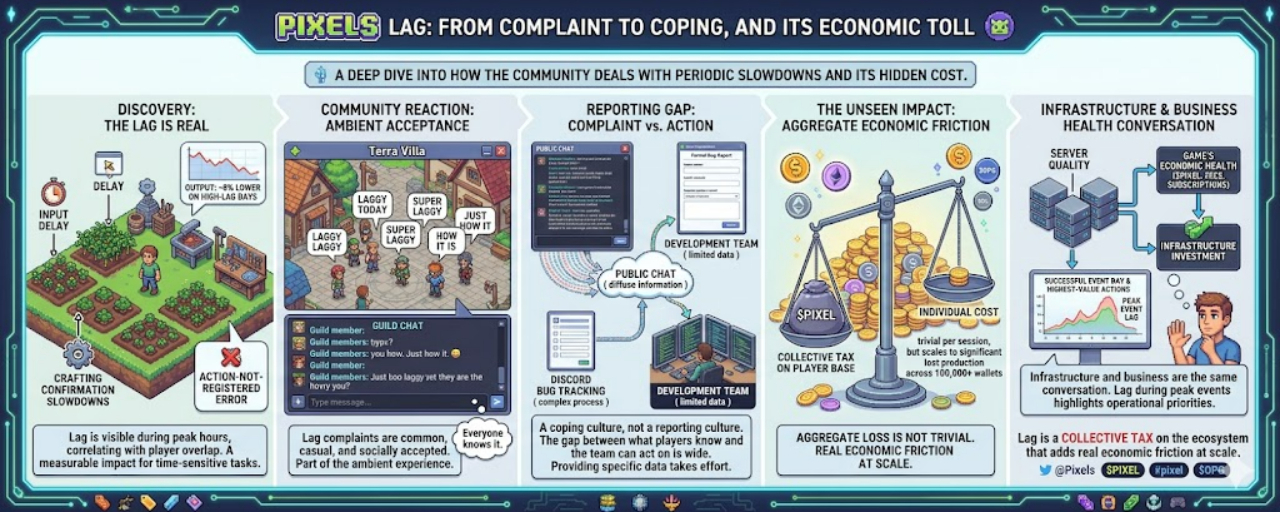
The lag in Pixels is real and periodic. Anyone who has played for more than a few weeks knows it. During peak hours, particularly in the evenings when North American and European player populations overlap with Asian ones, the game client can show input delays, slow response on crafting station confirmations, and occasional action-not-registered errors where an energy point is spent but the farming result doesn't appear in inventory.
For a casual player doing slow loops, the lag is annoying but inconsequential. For a player mid-session on a time-limited event quest, or running a tightly scheduled crafting chain, the lag has a real Coin cost.
I tracked this for about two weeks in month four, logging the approximate session time and whether I experienced notable lag, and checking the correlation with my actual output. On high-lag days, my output was roughly 8% lower than on clean-connection days running the same activity mix. Not catastrophic. Consistent enough to be real. 😅
Here's what I noticed about how the Pixels community handles this.
In guild chat and in Terra Villa public chat, lag complaints are common, casual, and socially accepted. Players mention it the way you mention traffic on a morning commute: an inconvenience everyone shares, worthy of a brief acknowledgment, not a cause for alarm or action. "Laggy today" is a sentence I have read approximately three hundred times across my Pixels play history. The community has absorbed lag into its ambient experience of the game.
What I notice less of: direct feedback to the development team documenting specific lag events, their timing, and their measurable impact. Players complain to each other. I see substantially less evidence of players systematically reporting lag to the bug tracking or feedback channels in the official Discord with the kind of specificity that would help a development team actually diagnose and fix the underlying issue. 🤔
This is a behavior pattern worth naming. The community has developed a coping culture around lag rather than a reporting culture. The lag is "just how it is," which functionally means the social pressure to fix it is diffuse and the actionable information available to the team is limited compared to what it would be if the community reported with the same energy it complains.
Pixels hasn't made high-quality lag reporting easy or visible. The main Discord server is large and active. Finding the correct channel to report a specific technical issue and providing the relevant information, client details, session timing, the specific actions that failed, requires more effort than typing "laggy today" in guild chat. The path of least resistance is the complaint that goes nowhere.
Whether Pixels' development team has alternative data sources for lag monitoring, server-side latency metrics, client telemetry, that don't depend on player reporting is something I can't verify from outside. Probably they do. But the gap between what the community knows about lag, which is extensive, and what the development team can act on, which requires structured data, is a communication gap that neither side is fully bridging.
The 8% output reduction on high-lag days is small enough per session to be dismissible. Across a player base of 100,000 daily active wallets, if even a fraction are experiencing similar impacts on the same high-lag days, the aggregate lost production in the Pixels economy is not trivial. It's a collective tax on a distributed player base that no individual player has enough incentive to campaign against, but that adds up to real economic friction at scale.
What I find most unresolved is the relationship between server infrastructure investment and token economics. Pixels runs on revenue generated partly through the $PIXEL ecosystem, NFT minting fees, marketplace fees, VIP subscription spend. If server quality is determined partly by the team's available resources, and those resources are partly determined by the game's economic health, then lag is a lagging indicator of something bigger than connection quality. It's a visibility window into operational priorities.
I'm not claiming lag is evidence of anything alarming. I'm noting that for a game generating real economic activity from real players, the infrastructure quality conversation is not separate from the business health conversation. They're the same conversation, and the community's adaptation to lag without demanding better has made it easier to not have it.
The lag on high-activity event days is consistently worse than baseline. This is the most predictable pattern in my two weeks of tracking: the game slows down when the most players are most engaged. The peak-event lag is also when missing a crafting confirmation or losing a farming action to an unregistered input hurts most, because those are the moments when individual actions have above-average economic value.
Pixels has built a game that creates its own most demanding load conditions during its most economically important moments. Whether the infrastructure is scaling to match that pattern is something the community notices and forgets by the time the event ends and the chat moves to something else.
I haven't stopped playing on high-lag days. I've just started saving my highest-value actions for mornings before the peak.