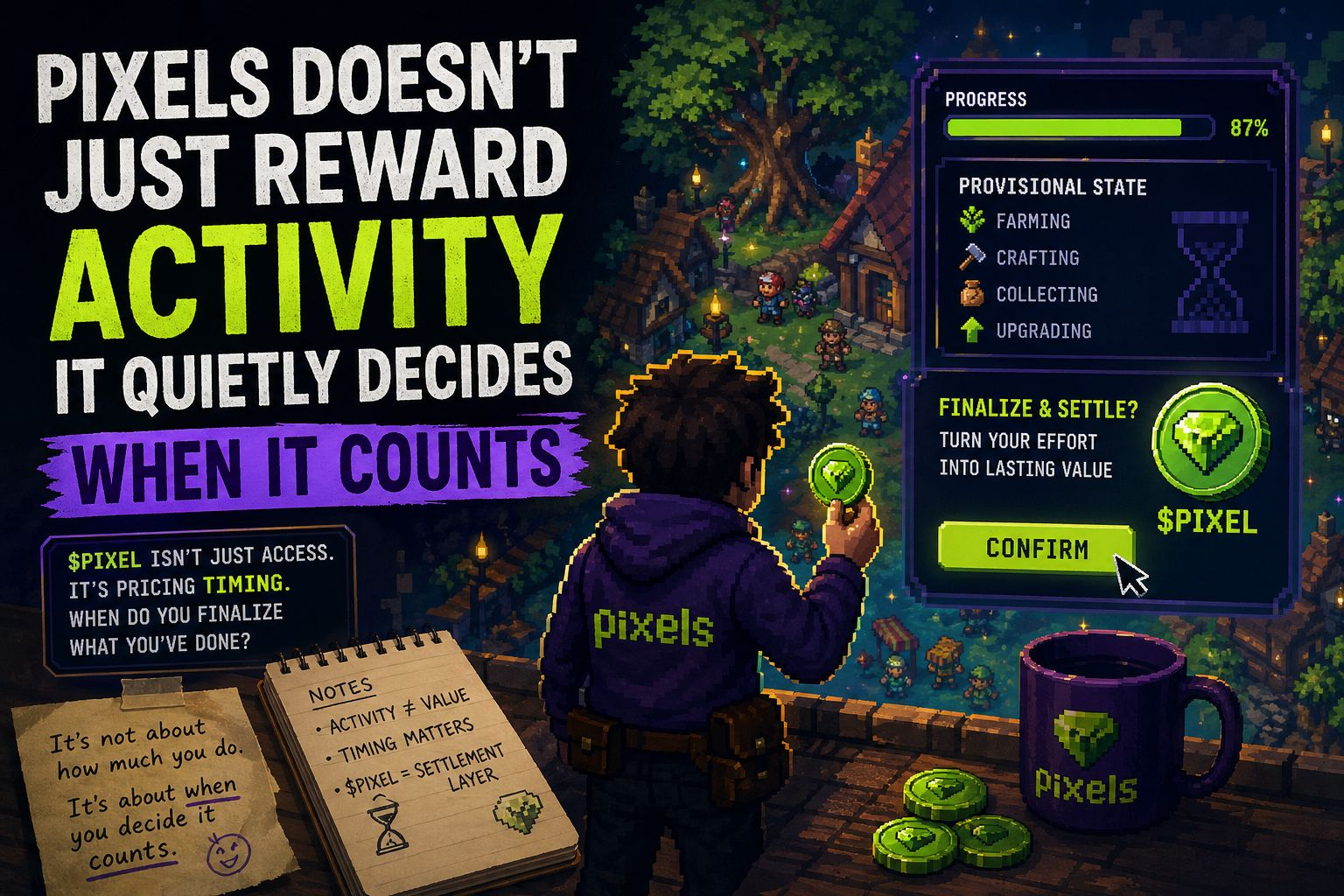
I almost hit confirm on a small $PIXEL spend yesterday… then just sat there staring at the screen.
It wasn’t a big move. Just converting some in-game progress into an upgrade I’d been working toward for a few days. Normally I wouldn’t think twice — grind, upgrade, move on. But this time I hesitated. Not because I didn’t have enough, but because I wasn’t sure if I should lock it in yet.
That pause caught me off guard more than the decision itself.
I’ve been spending time in Pixels on and off, nothing crazy — just a steady loop. Farming, crafting, stacking resources, figuring out small optimizations. The game feels open when you’re inside it. You can always do something productive. There’s no hard stop.
But the more I played, the more I started noticing this weird separation between doing things and those things actually becoming meaningful in a lasting way.
That’s where Pixel started feeling different to me.
At first, I treated it like any other premium token. Speed things up, unlock better loops, maybe smooth out progression. Standard stuff. But when I looked closer at when I was actually using it, it wasn’t at the start of actions — it was at the end.
Not when I was playing… but when I was deciding that what I did should count.
That distinction sounds small, but it changes how the whole system feels.
You can grind for hours in Pixels and stay in this kind of “in-progress” state. You’re producing, optimizing, stacking — but nothing is fully final yet. Then there’s this quiet moment where you decide to convert that effort into something persistent. Something the system will carry forward as real value.
And more often than not, pixel right at that moment.
I didn’t think much of it at first. But that hesitation I felt yesterday made it click.
This token isn’t just pricing access or speed — it’s pricing timing.
When do you finalize what you’ve done?
That’s a strange role for a token, especially in a game. Most systems reward constant activity. The more you play, the more you earn, simple correlation. But here, activity and value aren’t perfectly aligned. You can be highly active and still delay converting that into something “real.”
I actually tested this without realizing it.
A couple days ago, I built up enough resources for two upgrades. I only finalized one. The other just sat there. Not because I forgot — I just didn’t feel urgency. And that’s the thing: nothing forces you to settle immediately.
So token usage doesn’t scale cleanly with activity.
That matters more than it seems.
From a trading perspective, it breaks a common assumption — that more players automatically means more token demand. In Pixels, demand can show up in bursts. Players might grind for days without touching $PIXEL, then suddenly use it all at once when they decide to commit.
That creates a weird rhythm. The system can look quiet even when it’s active… or spike unexpectedly when people start finalizing.
I’ve seen similar behavior in markets, just framed differently. It reminds me of how liquidity sometimes sits idle until a key level breaks — then everything happens at once. Here, the “trigger” isn’t price, it’s player decision.
There’s also a balance problem hiding underneath.
If using $PIXEL$PIXEL s too expensive or feels inefficient, players might just stay in that provisional state longer. Keep grinding, keep producing, but avoid locking anything in. That slows down the part of the economy that actually anchors value.
On the flip side, if it’s too cheap or too easy, everything gets finalized instantly — and you risk flooding the system with too much settled value.
Neither extreme is good.
Right now, it feels like it’s somewhere in the middle, but I’m not fully convinced it holds under pressure. Players adapt fast. If there’s an edge in delaying or rushing settlement, people will find it.
As for me, I ended up only partially using my pixel. Small move, maybe a couple dollars worth — nothing significant PNL-wise. But the decision felt heavier than it should have.
That’s what stuck with me.
Most game economies don’t make you think about when your actions matter. Pixels does, even if it never says it out loud.
And now that I’ve noticed it, I can’t really go back to just “playing” without thinking about that layer.
It’s not just what you do in Pixels.
It’s when you decide it actually counts.
@Pixels $PIXEL #pixel