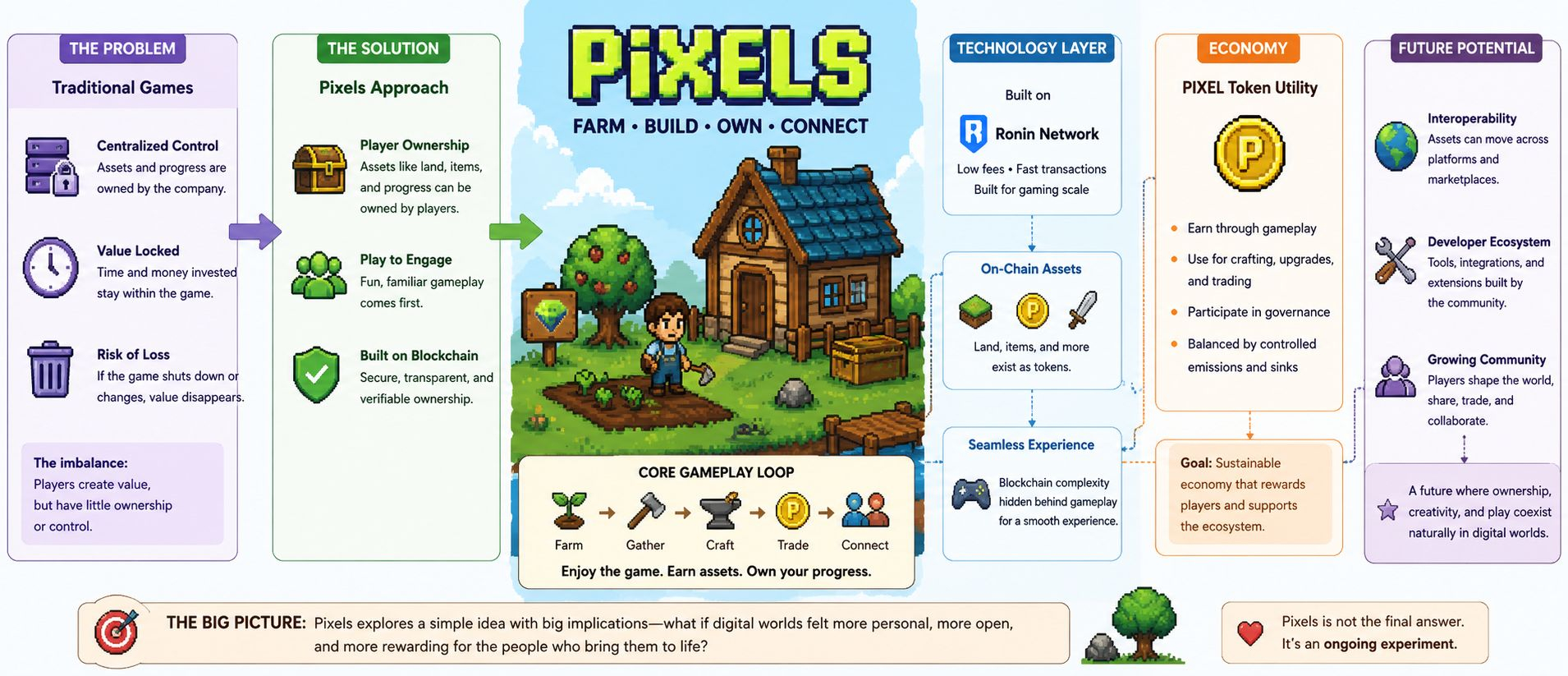
There is something quietly interesting about the way digital worlds are evolving. Not loudly, not through sudden breakthroughs, but through small, thoughtful experiments that try to understand how people actually want to spend their time online. Pixels is one of those experiments. On the surface, it looks simple a pixel-style farming game—but beneath that simplicity sits a deeper attempt to rethink ownership, work, and play in online environments.
At a high level, the idea behind Pixels connects to a broader shift in the internet often described as Web3. Instead of platforms fully controlling assets and data, users are gradually being given more direct ownership. In games, this means items, land, and progress can exist beyond the control of a single company. Pixels takes this concept and places it inside a familiar, low-pressure environment: farming, gathering, and social interaction. This choice is not accidental—it lowers the barrier for people who may not care about blockchain but do care about enjoyable experiences.
To understand why this matters, it helps to look at the underlying problems in traditional gaming systems. Most online games operate as closed economies. Players invest time, sometimes money, but the value they create remains locked within the game. If the game shuts down or changes direction, that value disappears. Over time, this has created a subtle imbalance: players contribute significantly to virtual worlds, yet have limited control or ownership. Pixels is part of a growing effort to explore whether this imbalance can be softened.
The solution it proposes is not aggressive or overly technical in appearance. Instead of pushing blockchain complexity to the forefront, Pixels hides much of that infrastructure behind gameplay. It runs on Ronin Network, a system designed to handle gaming transactions efficiently while keeping costs relatively low. This allows players to interact with digital assets—such as land or items—without constantly dealing with the friction that often comes with blockchain-based systems.
Inside the game, the mechanics feel intentionally familiar. Players farm crops, gather resources, craft items, and interact with others. But what is different is how these actions connect to ownership. Certain in-game assets can be represented as tokens, giving players a form of persistence and transferability. This does not automatically make the game better, but it changes the relationship between effort and reward. Time spent in the game can, in some cases, translate into assets that exist beyond a single session.
The architecture behind this experience reflects a careful balancing act. On one side, there is the need for scalability and smooth gameplay. On the other, there is the requirement for secure and verifiable ownership. By building on Ronin, Pixels avoids some of the congestion and high fees associated with larger networks. At the same time, it integrates blockchain elements in a way that does not overwhelm casual players. This layered design—game first, infrastructure second—is one of its more thoughtful choices.
Economically, Pixels introduces the PIXEL token, which plays a role in its ecosystem. Like many game tokens, it is tied to in-game activities, rewards, and governance elements. However, the challenge here is not just creating a token, but maintaining a balanced economy. If rewards are too high, the system risks becoming speculative. If they are too low, player motivation may decline. Pixels attempts to manage this through controlled emissions, gameplay-driven earning, and sinks that encourage spending within the game.
Interoperability is another area where Pixels hints at future possibilities. Because assets exist on a blockchain, they are not inherently limited to one environment. While practical interoperability is still developing across the industry, the foundation allows for potential integration with other platforms, marketplaces, or tools. For developers, this opens the door to building complementary experiences, analytics tools, or community-driven extensions around the game.
From a real-world perspective, Pixels sits at an intersection between entertainment and digital economies. For some players, it is simply a relaxing farming game with social elements. For others, it becomes a way to explore new forms of earning or ownership. This dual identity is both a strength and a challenge. It allows the game to appeal to different audiences, but also requires careful design to avoid leaning too heavily toward speculation.
There are clear strengths in this approach. The accessibility of the gameplay, the decision to simplify blockchain interactions, and the focus on community all contribute to a more welcoming experience. Unlike earlier Web3 games that emphasized earning over enjoyment, Pixels appears to prioritize engagement first. This shift, while subtle, reflects lessons learned across the industry.
At the same time, there are limitations that cannot be ignored. The long-term sustainability of token-based economies remains uncertain. Player retention in Web3 games often fluctuates with market conditions, which introduces instability. There is also the broader question of whether true ownership adds meaningful value for most players, or whether it remains a niche interest. Pixels does not fully solve these issues—it explores them.
Looking ahead, the future of Pixels will likely depend on how well it continues to balance these elements. Expanding gameplay depth, maintaining economic stability, and fostering a genuine community will be more important than any single feature. If it can evolve without losing its simplicity, it may offer a useful model for how Web3 concepts can blend into everyday digital experiences without overwhelming users.
In the end, what makes Pixels worth paying attention to is not that it claims to redefine gaming, but that it quietly experiments with how digital worlds can feel more personal and participatory. It does not present itself as a finished answer, but as an ongoing question: what happens when ownership, creativity, and play are allowed to coexist more naturally? That question, approached with patience and care, may be more important than any immediate result.