
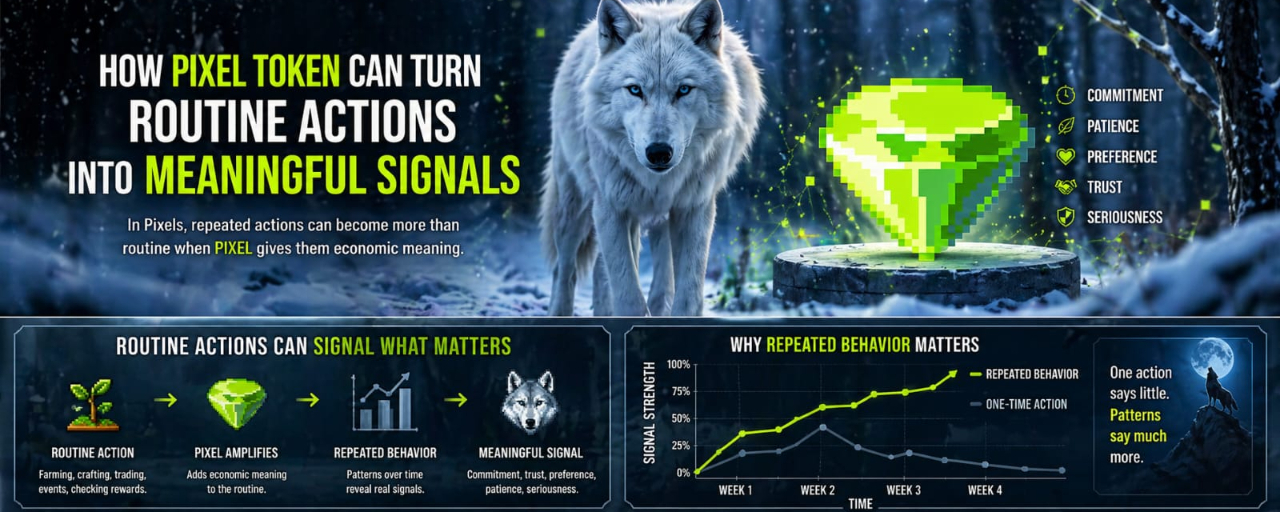

I used to think that adding a token to a game simply turns routine actions into incentives, like putting coins into a machine to keep it running. The common assumption is that tokens reward behavior, and that’s enough to make systems meaningful. What changed my view was realizing that most rewards don’t reveal anything new. They just inflate activity. My thesis is simpler and more uncomfortable: PIXEL matters not because it rewards actions, but because it exposes which actions people are willing to repeat when repetition has a cost.
When I first looked at routine gameplay loops like farming, crafting, checking rewards, joining events, or trading, they felt like background noise. These are the habits players fall into without thinking. On the surface, they look like engagement. Underneath, they’re often just friction dressed up as progress. Players repeat them because they are required, not because they are chosen.
Once a token like PIXEL connects to those loops, something subtle changes. The same farming action that used to feel automatic now has a visible economic footprint. You can see it in how often players return, how much they commit, and whether they continue when conditions worsen. What looks like “just playing” becomes a traceable signal. The system stops guessing and starts measuring.
This is what I mean by PIXEL acting as a signal amplifier. On the surface, it looks like a reward. Underneath, it is a filter. It forces players to reveal preference through repetition. If someone farms daily even when returns drop by 30 percent, that behavior carries more meaning than a one-time spike during a reward event. It shows persistence under weaker incentives, which is a stronger signal than participation under strong ones.
I’ve seen this dynamic show up clearly in broader crypto markets. When average transaction fees on major chains climbed above $15 during peak congestion periods, casual users disappeared almost overnight. That number matters because it represents a threshold. Below it, behavior feels routine. Above it, repetition becomes a choice. The users who stayed active under those conditions weren’t just engaged. They were committed in a measurable way.
The same logic applies inside PIXEL-driven systems. If a player continues to craft or trade when returns fluctuate or when token prices dip by 20 percent in a week, that repetition says something about their intent. It signals patience, or belief in long-term value, or simply a tolerance for volatility. Each of those interpretations is more useful than raw activity counts.
This is where repeated behavior starts to matter more than isolated actions. One action can be noise. Anyone can log in during a high-reward event or a temporary spike. But patterns over time reveal structure. If a player repeats a behavior 50 times over a month, even as conditions change, that’s not accidental. That’s preference under pressure.
We can see a similar pattern in exchange activity. During periods when daily trading volume drops by 40 percent across the market, the remaining trades carry more informational weight. They are not driven by hype cycles or sudden inflows. They reflect conviction, or necessity, or strategy. In the same way, repeated PIXEL-linked actions during quieter periods reveal more than activity during peak moments.
What this enables, if handled carefully, is a new layer of interpretation for designers and analysts. Instead of asking “what are players doing,” we can ask “what are players willing to keep doing when it’s no longer easy.” That distinction sounds small, but it changes how systems are understood.
On the surface, PIXEL creates visibility. Underneath, it creates comparability. Different routines can be measured against each other based on how consistently they are repeated under varying conditions. If crafting persists while trading drops off, that tells you something about perceived stability or trust in those mechanics. If event participation spikes but doesn’t sustain, that reveals dependency on short-term incentives.
I think this is where many systems fail. They treat all activity as equal. They count logins, clicks, or completed actions without asking what those actions cost the player in time, attention, or risk. PIXEL introduces cost into repetition, even if that cost is subtle. And once cost is present, behavior becomes more honest.
But there is a risk here that’s easy to overlook. If routines are over-incentivized, they stop being signals and start becoming chores. When rewards are too predictable or too generous, players optimize for extraction rather than expression. They repeat actions not because they value them, but because they are efficient.
We’ve seen this pattern in yield-driven environments across crypto. When returns spike above 50 percent annually, participation surges. But when yields normalize to 10 or 15 percent, activity often collapses. That drop is not just about lower returns. It reveals that the earlier behavior was not rooted in preference. It was driven by temporary opportunity.
In a PIXEL system, the same thing can happen. If rewards are structured in a way that encourages maximum repetition regardless of context, the signal gets distorted. What looks like commitment is actually optimization. What looks like trust is just short-term calculation.
This creates a design tension. On one side, you want enough incentive to make behavior visible. On the other, you want enough friction to ensure that repetition means something. Too little incentive and nothing happens. Too much and everything happens for the wrong reasons.
I think this is where broader market conditions start to matter. In periods of high liquidity, when capital flows easily and token prices trend upward, almost all behavior looks meaningful. Participation increases, repetition increases, and systems appear healthy. But this is often an illusion created by external conditions.
When liquidity tightens, the picture changes. ETF inflows slow, exchange volumes contract, and speculative capital becomes more selective. In those environments, only certain behaviors persist. Those are the ones that carry real informational value. They are less influenced by momentum and more by underlying preference.
If PIXEL is integrated into a system during both types of conditions, it can help separate these layers. It can show which routines survive when external support fades. That’s a powerful diagnostic tool, not just for game design but for understanding user behavior more broadly.
The challenge is to read these signals correctly. Not every repeated action is a sign of satisfaction. Sometimes it reflects habit, or lack of alternatives, or sunk cost. But over time, patterns emerge that are hard to fake. Consistency across changing conditions is one of them.
I’ve come to see PIXEL less as a reward mechanism and more as a measurement layer. It doesn’t create meaning on its own. It reveals where meaning already exists, or where it is being forced. That distinction is easy to miss if you only look at surface-level activity.
In the end, routine actions only become meaningful when repetition carries a cost and a choice. PIXEL doesn’t transform the action itself. It transforms what we can learn from it. And if we’re paying attention, it shows that the difference between a habit and a signal is not what people do once, but what they keep doing when it stops being easy.