
A small neighborhood grocery store near my home runs on a surprisingly delicate system. Every morning, fresh produce arrives from suppliers who trust they’ll be paid on time. The shopkeeper decides what to stock based on what sold yesterday, not what might become trendy tomorrow. Regular customers come back because prices feel fair and availability is reliable. When any one part slips—late deliveries, poor pricing decisions, or customers losing trust—the whole system starts to wobble. It’s not a complicated business on the surface, but it depends heavily on aligned incentives, predictable behavior, and a shared understanding of value.
When I look at Pixels (PIXEL), a social casual Web3 game built on the Ronin Network, I find myself thinking about systems like that grocery store. At a glance, Pixels presents itself as an open-world farming and exploration game where players can create, interact, and earn. But underneath that surface, it’s not just a game—it’s an economic system with moving parts that need to coordinate: players, developers, token incentives, digital assets, and infrastructure. The real question isn’t whether the game is engaging in the short term, but whether this system can sustain itself when subjected to real-world pressures.
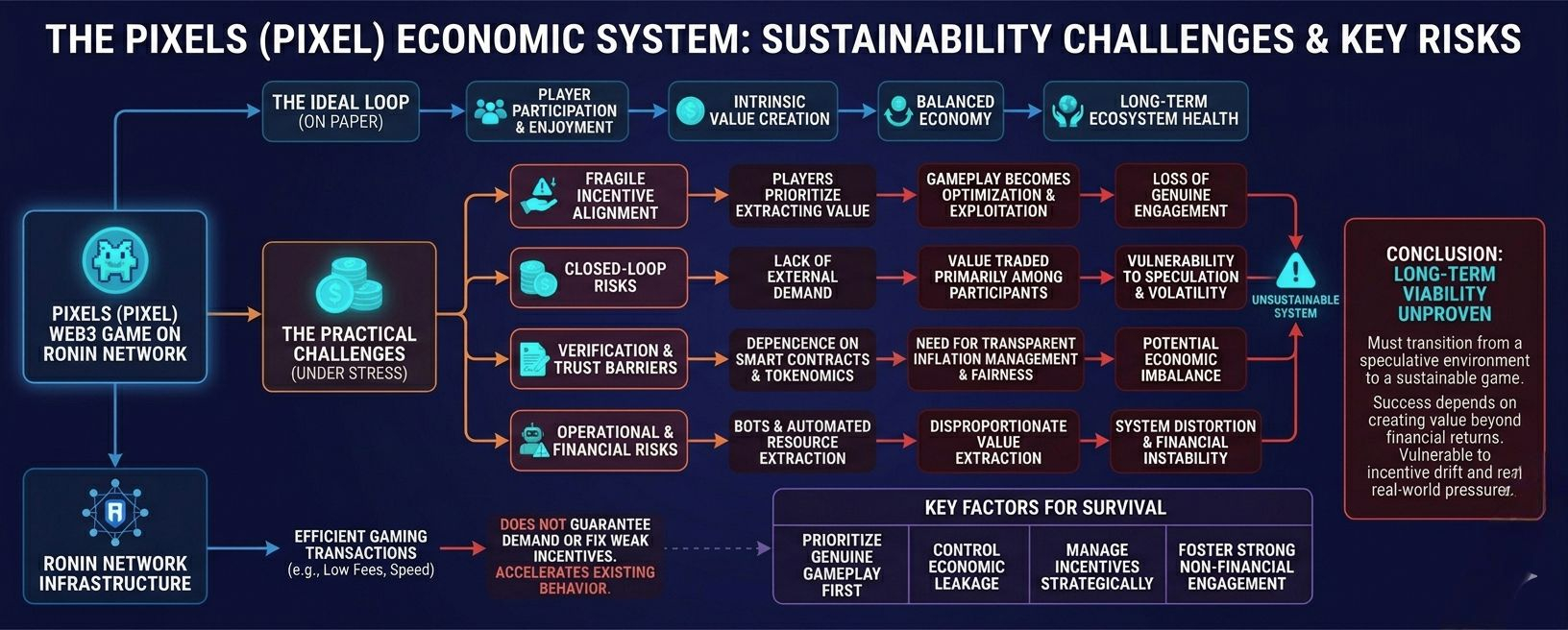
The idea of combining gameplay with ownership and tokenized rewards is appealing. In theory, giving players control over assets and the ability to earn from their activity aligns incentives. Players are not just consuming content; they’re participating in an economy. But in practice, incentive alignment is fragile. If players are primarily motivated by extracting value rather than enjoying the game, behavior starts to shift. Farming becomes less about gameplay and more about optimization. Exploration turns into resource exploitation. The system begins to resemble a production line rather than a world people want to spend time in.
This is where I start to question the durability of such a model. In traditional games, value flows in one direction: players pay, and developers maintain the system. In Web3 games like Pixels, value is expected to circulate within the ecosystem. Tokens are earned, traded, and reinvested. But for this loop to work, there needs to be consistent demand from outside the system or genuine intrinsic value inside it. Otherwise, it risks becoming a closed loop where participants are mostly trading value among themselves.
The Ronin Network adds another layer to this. It’s designed to handle gaming transactions efficiently, which solves a real infrastructure problem—high fees and slow speeds on general-purpose blockchains. That’s a meaningful improvement, similar to how a logistics company might invest in better roads or warehouses to reduce delivery times. But infrastructure alone doesn’t guarantee demand. A faster system doesn’t fix weak incentives; it just accelerates whatever behavior already exists.
I also think about verification and trust. In a grocery store, trust is built through repeated interactions—you know the quality of the produce, and the shopkeeper knows your preferences. In Pixels, trust is more abstract. It depends on smart contracts, tokenomics, and developer decisions. Players have to trust that rewards won’t be arbitrarily changed, that inflation will be managed, and that the game won’t tilt too heavily in favor of early adopters or large holders. These are not trivial concerns. Economic imbalance can quietly erode participation long before it becomes obvious.
Operational risk is another area that often gets overlooked. Running a persistent online world is already complex. Adding a real-money economy on top increases the stakes. Exploits, botting, and resource imbalances are not just gameplay issues—they become financial ones. If a small group can extract disproportionate value through automation or coordination, it can distort the entire system. This is similar to how, in real industries, a single inefficiency in supply chains can ripple outward and affect pricing, availability, and trust.
Adoption is perhaps the most telling factor. For Pixels to function as more than a speculative environment, it needs a steady base of players who engage because they enjoy the experience, not just because they expect returns. This is harder than it sounds. Most successful games build retention through design, storytelling, and community—not financial incentives. If the economic layer becomes the primary reason to participate, it introduces volatility. When returns drop, so does engagement.
What I find myself coming back to is the distinction between a system that works under ideal conditions and one that survives under stress. It’s easy to design a model where everything balances on paper. It’s much harder to maintain that balance when players act strategically, when markets fluctuate, and when attention shifts elsewhere. The test for Pixels isn’t whether it can attract users during periods of excitement, but whether it can retain them when incentives tighten and novelty fades.
In my view, Pixels is an interesting experiment that sits at the intersection of gaming and economic design. It shows how far infrastructure has come and how creative these systems can be. But I remain cautious. The long-term success of such a project depends less on its concept and more on its ability to manage incentives, control economic leakage, and create genuine, non-financial reasons for people to stay. Without that, it risks becoming another system that functions well briefly but struggles to sustain itself once real-world behavior sets in.
My opinion, after thinking through all this, is that Pixels has potential as a game, but its economic layer needs to prove itself under pressure. If it can prioritize gameplay first and treat the economy as a supporting structure rather than the main attraction, it might find stability. If not, it may end up repeating patterns we’ve already seen—where the system looks promising early on but gradually loses balance as incentives drift apart.
Because in the end, the difference between a game and an economy is simple: one survives on enjoyment, the other survives on pressure—and very few can handle both for long.
