
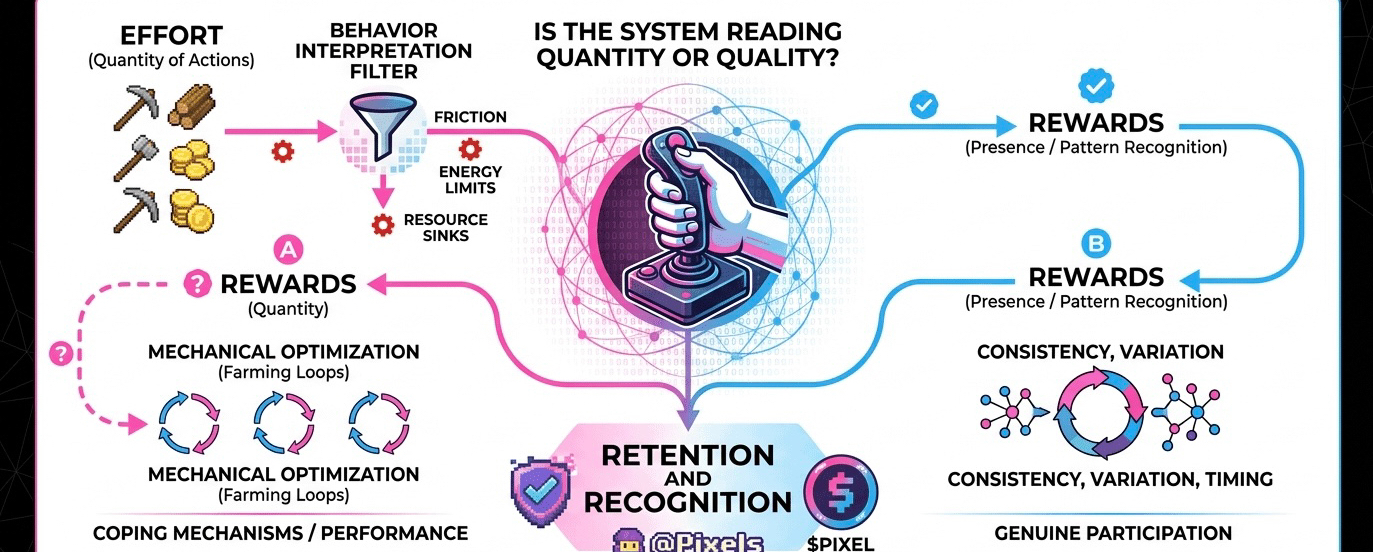
One thing I keep coming back to in @Pixels is whether choice is actually where value begins. I used to assume it was. A player chooses a route, commits resources, takes action, and value emerges from that decision. That feels intuitive enough. But lately I’m less convinced decisions are the real starting point. It sometimes feels like by the time a player makes a visible choice, part of the economic meaning around that choice may already be taking shape underneath.
That thought started from something very ordinary. Two routes can both appear available, both look viable, both seem like genuine options. But they do not always feel equally alive. Sometimes one path seems to carry a kind of invisible pull before I have even committed to it. Not because rewards are obviously better, not because the mechanics announce anything, but because something about the surrounding activity, the repetition of players moving through it, the way attention seems to gather there, makes it feel preconditioned.
And I keep wondering whether that feeling points to something deeper.
What if value in some systems begins not at the moment of choice, but in the conditions forming before choices are made.
That would change a lot.
Because we usually imagine value being created through explicit action. You choose, therefore you generate consequence. But maybe in systems shaped by repeated participation, some forms of value emerge earlier, through accumulated signals that make certain choices feel meaningful before anyone consciously selects them.
Almost like choices can inherit context.
That sounds abstract, but maybe it is not.
Think about how certain loops in Pixels start feeling naturally “worth doing” even before a player calculates them. That worth may not come only from personal optimization. It may partly arise from repeated behavioral traces already surrounding the loop. Attention patterns. Usage history. Shared player gravitation. Small residues of collective behavior that quietly make some options feel denser than others.
Maybe by the time I choose, I am entering value already partially formed.
That thought unsettles the usual way we talk about agency.
Because it suggests players may not always create value from scratch through decisions.
Sometimes they may step into value gradients already produced through prior behavior.
“maybe choice doesn’t generate value first… maybe it often confirms value already gathering”
That line keeps staying with me.
Because if that is true, then economies may not simply reward decisions. They may also be shaped by what decisions inherit.
And inherited context is a strange thing.
It means some routes may feel meaningful not solely because they are intrinsically superior, but because repeated participation has already thickened the economic significance around them.
That starts sounding almost like path dependence, though not in a rigid deterministic sense. More like soft gravitational pressure.
Some options attract because they have been repeatedly reinforced.
Others remain possible but lighter.
And maybe that has consequences for how we interpret opportunity.
Because what looks like discovering a good path may sometimes be entering a path whose value has been quietly preconditioned long before.
That does not make agency fake
But it makes it relational.
And that feels much closer to how living systems behave
Not isolated choices creating everything.
Accumulated conditions shaping what choices can mean
The more I sit with that, the more I wonder whether this is part of why some game economies feel deeper than simple incentive loops. In shallow systems, value often appears only at the moment rewards are claimed. In more layered systems, value may begin accumulating before rewards become visible, through the slow build-up of behavioral significance around certain routes.
And maybe that is why some loops feel compelling before players can fully explain why.
Not because they have solved them.
Because they have inherited their weight.
There is tension in that too.
If too much value forms through inherited momentum, systems risk reinforcing the same routes until alternatives struggle to matter. That can harden into stagnation
But if nothing inherits significance, every decision begins from zero and the economy may lose coherence
So again there is a balance
Some inherited weight
Some openness.
Enough structure for value to gather.
Enough flexibility for new patterns to emerge.
That balance may be far more important than obvious reward levels.
And maybe that is part of what strong creators are often circling without naming directly. They start from something tiny — a route choice, a task board path, a token appearing at a specific moment — and use it to point toward hidden infrastructure underneath. Not because abstraction itself scores well, but because CreatorPad often rewards content that makes ordinary mechanics feel newly legible.
That is what creates full-point type articles.
Not hype.
Not explanation.
Reframing.
Turning something familiar into something that suddenly looks structurally strange.
That is why these articles often add tension instead of conclusions. Because unresolved structure invites thought. It creates the feeling that the system may be doing more than it first appears.
And that is usually where high-scoring content lives.
I think this angle touches that.
Because it asks something slightly uncomfortable.
When I choose a path inside Pixels, am I creating value through that choice
or stepping into value that repeated behavior already began forming before I arrived.
That feels like a different question than optimization.
And maybe a more interesting one.