Price movements in GameFi have always had a strange way of telling only part of the story. A chart might show a small uptick or a sudden drop, but it rarely captures what’s actually shifting underneath — the subtle changes in player behavior, the invisible adjustments to game systems, the quiet evolution of incentives that players feel long before they can explain......
That’s why the recent 2.2% increase in PIXEL over the past 24 hours doesn’t feel like the headline.... It feels more like a signal. Something small on the surface, but possibly tied to deeper structural changes happening inside @Pixels
If you’ve spent any time inside the game recently, there’s a sense — hard to quantify — that things aren’t working exactly the same way they used to.
Not broken. Just… different.
Part of that shift seems to be coming from how Pixels is rethinking engagement itself through its AI-driven “Stacked” LiveOps engine. On paper, LiveOps isn’t new. Most GameFi projects attempt some version of it — events, daily tasks, reward cycles — all designed to keep players coming back. But the problem has always been retention. Not just getting players in, but keeping them meaningfully engaged over time.
What Pixels appears to be doing differently is moving away from simple activity tracking — how much you play, how often you log in — toward something more nuanced. Behavior patterns. How you play... When you return. What you prioritize. The system starts to feel less like a static reward loop and more like something that’s quietly observing and adapting.
And the interesting part is that most players won’t notice it directly.
Instead, they’ll feel it.
Sessions that used to feel predictable might start to feel slightly inconsistent. Effort doesn’t always translate into the same outcome. Two identical play sessions can produce slightly different results. At first, it’s easy to dismiss as randomness. But over time, it starts to feel intentional — like the system is shaping behavior rather than just rewarding it.....
That kind of shift, if it holds, could be important for $PIXEL. Because retention in GameFi has never really been about rewards alone. It’s about whether the system can keep evolving faster than player fatigue sets in.
Alongside this behavioral layer, there’s also a more tangible infrastructure change on the horizon: the migration of Ronin Network toward an Ethereum OP Stack Layer 2.
For many players, the technical phrasing doesn’t matter. What matters is how it feels in practice.
Lower gas fees. Faster transactions. Fewer interruptions between intention and action.
These things sound simple, but in a live game economy, they compound quickly. Every friction point — every delay, every cost — subtly discourages interaction. And over time, those small frictions add up, shaping how often players engage and how deeply they participate......
By reducing that friction, Pixels isn’t just improving efficiency...It’s potentially expanding the ceiling of what its economy can handle.... More transactions, more player interactions, more complex systems running without constantly pushing against technical limits.
It also creates space for $PIXEL to function more fluidly within the ecosystem. Tokens move easier, actions feel lighter, and the barrier between gameplay and economy starts to thin out.
But even with these improvements, there’s another factor approaching that’s harder to ignore: the upcoming unlock of over 90 million PIXEL tokens on May 19.
Token unlocks are always delicate moments. Not necessarily because they guarantee selling pressure, but because they test the system’s ability to absorb it.
This is where things get interesting.
If Pixels were still operating on a simple play-to-earn loop, the concern would be more straightforward — increased supply meets limited demand, price reacts accordingly. But if the engagement model is действительно shifting — if behavior-driven systems are taking hold, if the economy is becoming more interactive and less extractive — then the outcome isn’t as predictable.
The question becomes less about the unlock itself and more about the environment it enters.
Are players engaged enough to hold and use $PIXEL rather than exit?
Is the in-game economy active enough to circulate new supply naturally?
Do the systems encourage participation, or do they still lean toward short-term extraction?
Because ultimately, token dynamics in GameFi aren’t isolated... They’re tied directly to player behavior. And player behavior is shaped by systems that are often invisible at first glance.
That’s where Pixels feels like it’s at an inflection point.
There’s a sense that the game is no longer just running a loop — plant, harvest, earn, repeat — but experimenting with something more layered. Something that doesn’t always reward effort in a linear way. Something that introduces small inconsistencies that, over time, reshape how players approach the game...
And that can be uncomfortable.
Players are used to clarity. To knowing that if they do X, they’ll get Y. When that clarity softens, it creates doubt. But it also creates depth. Systems become less predictable, but potentially more sustainable.
So when looking at $PIXEL right now — the slight price increase, the infrastructure upgrade, the looming unlock — it doesn’t feel like a simple story of bullish or bearish signals.
It feels more like a system in transition.
One where the rules aren’t being rewritten all at once, but gradually adjusted beneath the surface.
And maybe that’s the more important question going forward:
Not whether GameFi can reward players…
…but whether it’s starting to understand them.
#pixel

Article
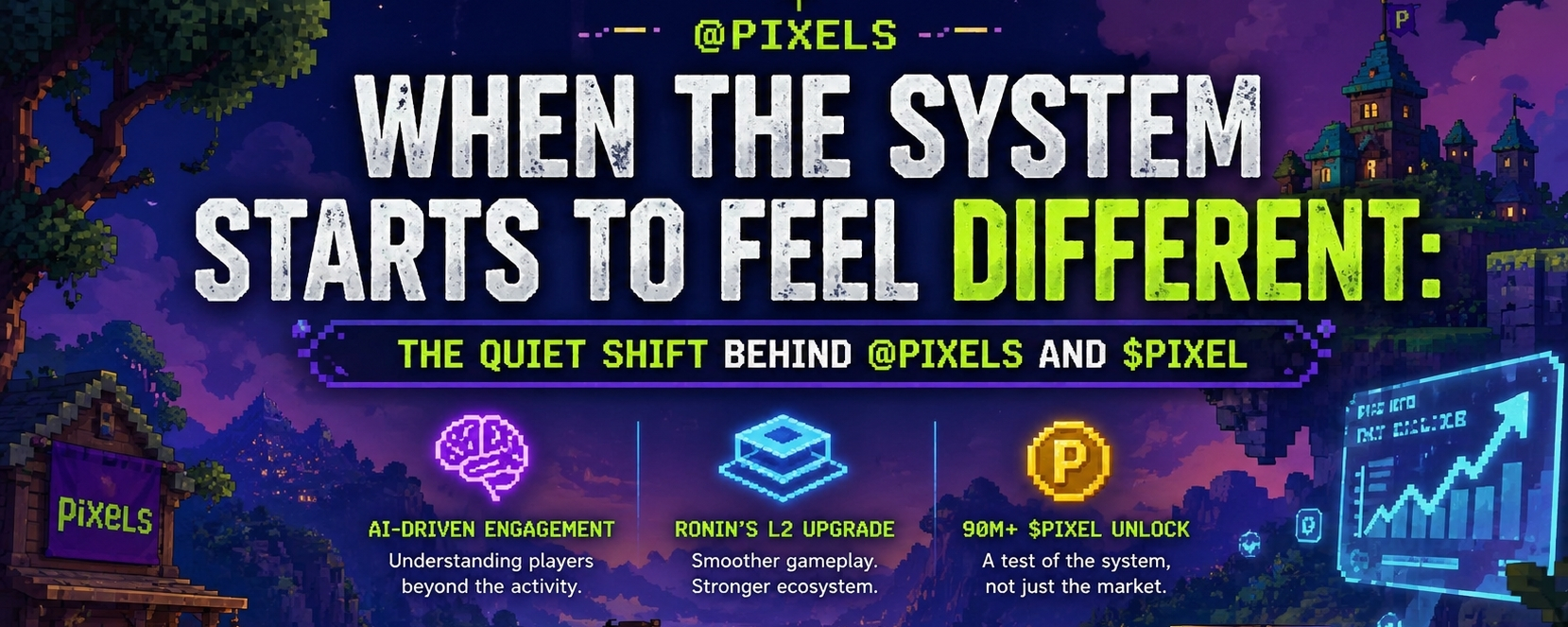
When the System Starts to Feel Different: The Quiet Shift Behind @Pixels and $PIXEL
Disclaimer: Includes third-party opinions. No financial advice. May include sponsored content. See T&Cs.