

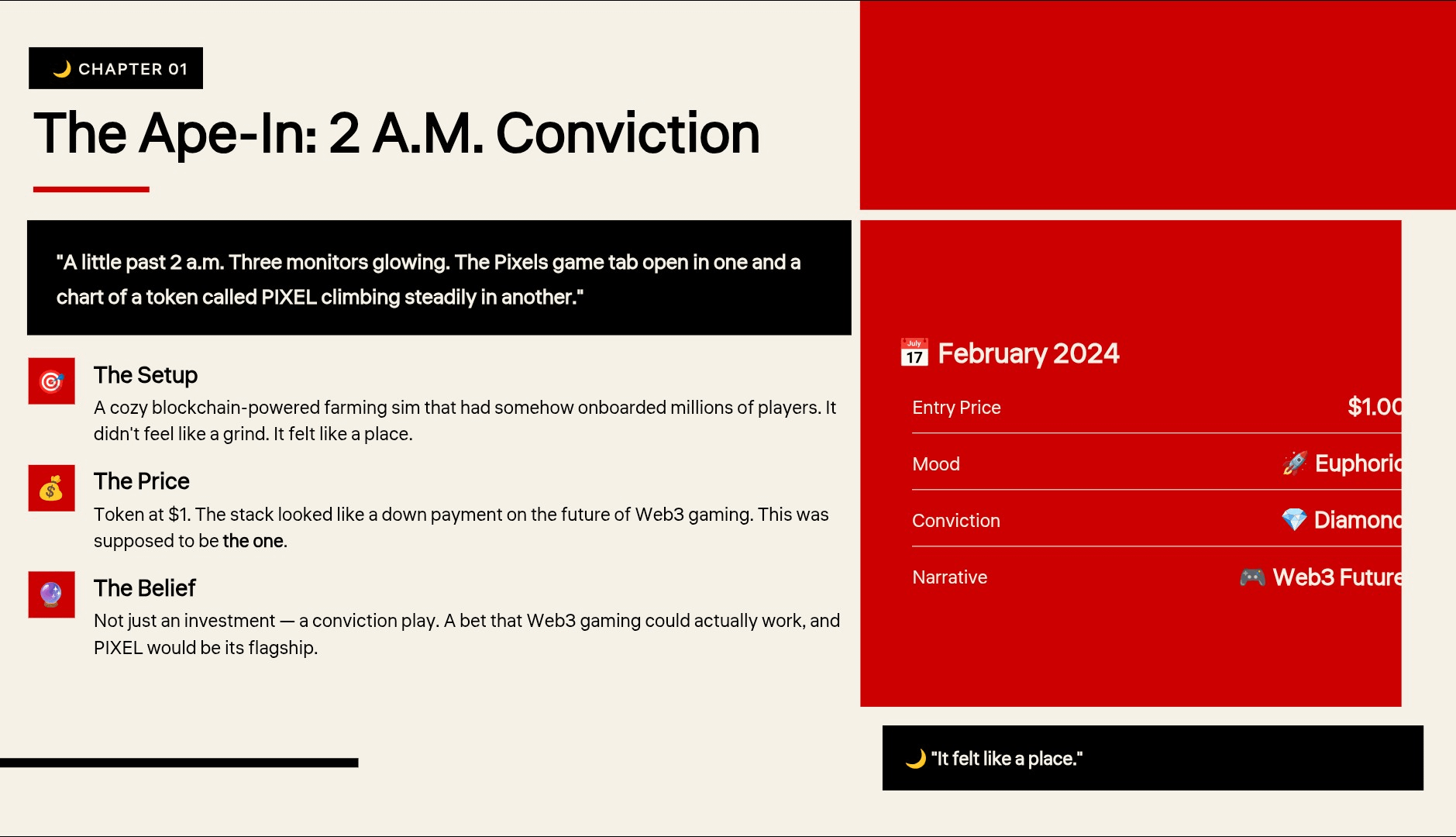
I still remember the exact night I aped in. A little past 2 a.m. three monitors glowing the Pixels game tab open in one and a chart of a token called PIXEL climbing steadily in another. This was supposed to be the one a cozy, blockchain powered farming sim that had somehow onboarded millions of players. It didn’t feel like a grind. It felt like a place. And with the token at a dollar, my stack looked like a down payment on the future of Web3 gaming.
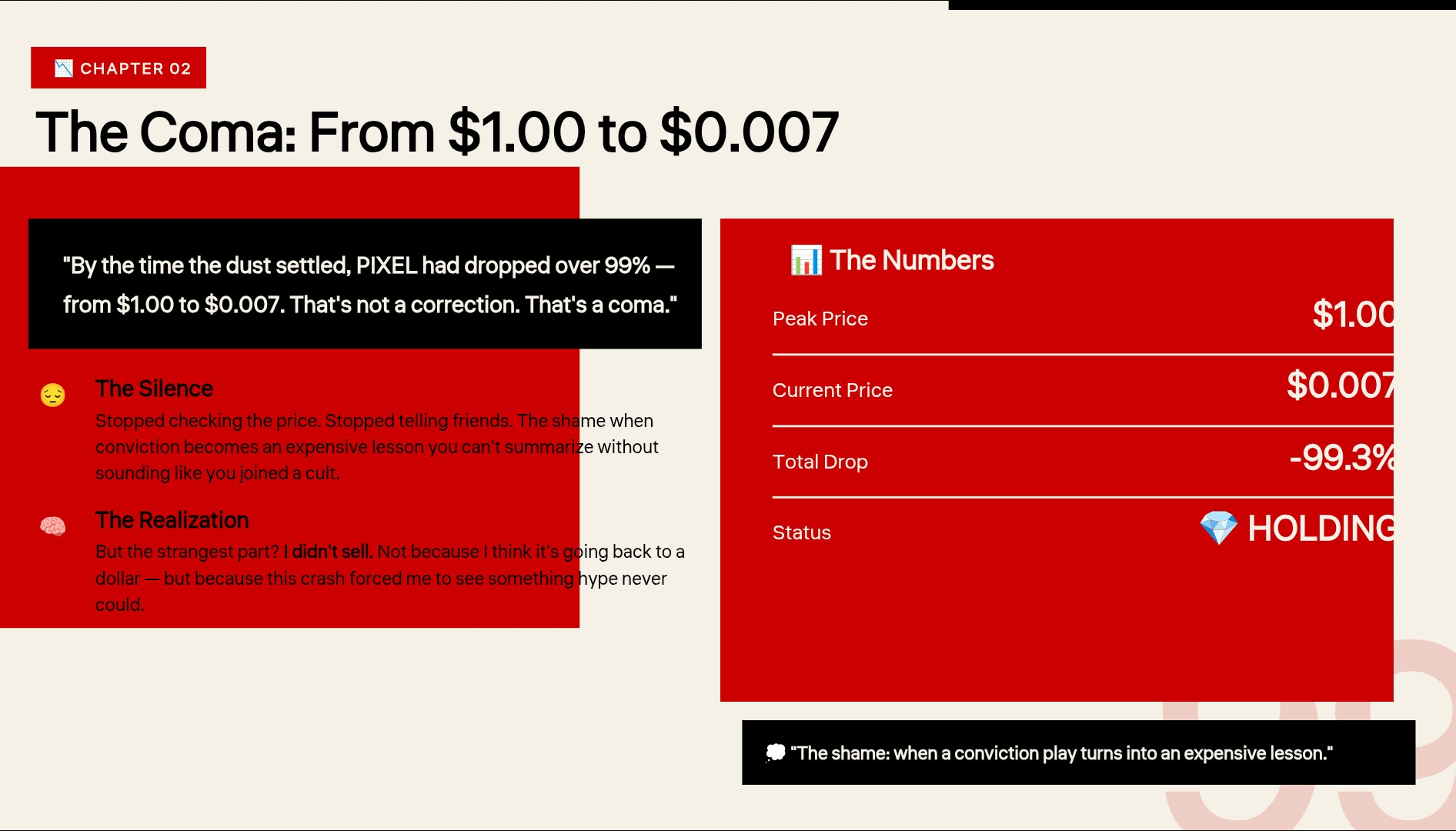
That was February 2024. By the time the dust settled, PIXEL had dropped over 99%_from $1.00 to $0.007. That’s not a correction. That’s a coma. Somewhere in the descent, I stopped checking the price. I also stopped telling friends I held it. You know the shame: when a conviction play turns into an expensive lesson you can’t even summarize without sounding like you joined a cult. But the strangest part? I didn’t sell. And I still haven’t. Not because I think it’s going back to a dollar, but because this token crash forced me to see something that hype never could.
Let me walk you through the wreckage, because there’s a piece of technology inside the Pixels ecosystem that genuinely deserves a spotlight—and a piece of tokenomics that all but guaranteed the floor would fall out. The tension between the two is a parable for every Web3 game out there, and it’s why I’m still holding.
The diamond in the rubble is something called Stacked. Most people hear “AI rewards engine” and their eyes glaze over, picturing another buzzword-laced whitepaper. But Stacked is different. It’s not a chatbot grafted onto a quest system or a cheap personalization gimmick. It’s an infrastructure layer that observes how actual players behave—where they spend their time, what loops they get stuck in, which incentives nudge them to convert—and then dynamically tailors rewards on an almost individual level. In plain language, it’s behavioral economics, automated. It studies you like a good bartender studies a regular: noticing you light up when offered a cosmetic rather than a token reward, or that you tend to log in more after a collaborative goal rather than a competitive one, and then quietly rearranges your experience to keep you around. The conversion boosts haven’t been marginal; the team has shared numbers privately that would make any free-to-play studio blush.$RIVER
This isn’t mindless gamification. It’s genuine economic architecture that acknowledges human beings aren’t rational calculators. We’re emotional, pattern-seeking creatures, and Stacked treats those patterns as signals rather than noise. In a different timeline, this engine alone would have made PIXEL the kind of token you brag about at conferences—a case study in how Web3 could finally understand player attention in a way Web2 never bothered to.
But here’s the gut punch: brilliant tech cannot fix broken tokenomics. And PIXEL’s tokenomics were, to put it gently, a ticking clock strapped to a dump truck.
From day one, the total supply was enormous—billions of tokens. A significant chunk was earmarked for monthly unlocks: team, investors, advisors, ecosystem funds. Every thirty days, a new wave of liquid tokens hit the market, regardless of game health, regardless of price, regardless of whether there was enough demand to absorb them. It was a momentum killer built into the foundation. In traditional markets, a company can buy back stock or invest earnings to counteract dilution. Here, the unlock schedule just kept printing sell pressure into an already thinning order book.
And then there’s vPixel. In the game, you earn a currency called vPixel through farming, questing, engaging. It’s the lifeblood of the in-game economy, yet it has a critical design constraint: it’s a spending-only mechanism. You can use it to buy items, upgrades, and passes, but you cannot sell it, trade it, or convert it back into the PIXEL token. The token sits outside, walled off, a distant governance and speculation asset with no real circulatory role inside the player experience. The very place where tokens should find organic demand essentially quarantined them. vPixel gave players a reason to stay, sure—but zero structural reason to hold PIXEL. So the unlocks kept coming, the sinks were elsewhere, and the chart became a slow-motion avalanche.
I’m not writing this to bash the team. They built something beautiful and peculiar: a living world that felt warm, with a machine-learning brain under the hood that could someday redefine how rewards work everywhere. But they also handed out an asset whose supply overwhelmed its narrative, and whose value proposition was severed from the heart of the game itself. That’s not a rug pull—it’s a design contradiction. And it’s one that I suspect many of us in this space feel but don’t have the vocabulary for.
This dissonance has become a microcosm of where we are in Web3 gaming. We talk about player ownership, but what we’re really engineering are systems that securitize attention and behavior into tradable data. Every click every idle session, every micro preference gets logged, analyzed, and folded back into the reward layer. Stacked is the honest version of this a machine that learns what you want before you can articulate it. It’s not sci fi; it’s already here. And in this new world, the algorithm may end up knowing us better than we know ourselves curating our desires so precisely that genuine choice feels like a warm memory from an earlier internet.
If that sounds dystopian, I’m not sure it is. It’s just structural. The question is who gets to define value inside those structures. Is it the market, which priced PIXEL down 99.2%? Is it the unlock schedule, which treated attention as an infinite resource to be extracted? Or is it something more emergent—something that the Stacked engine itself could one day quantify, like the liquidity of a loyal player’s habits, or the reputational weight of someone who consistently strengthens a guild’s social fabric?$ENSO
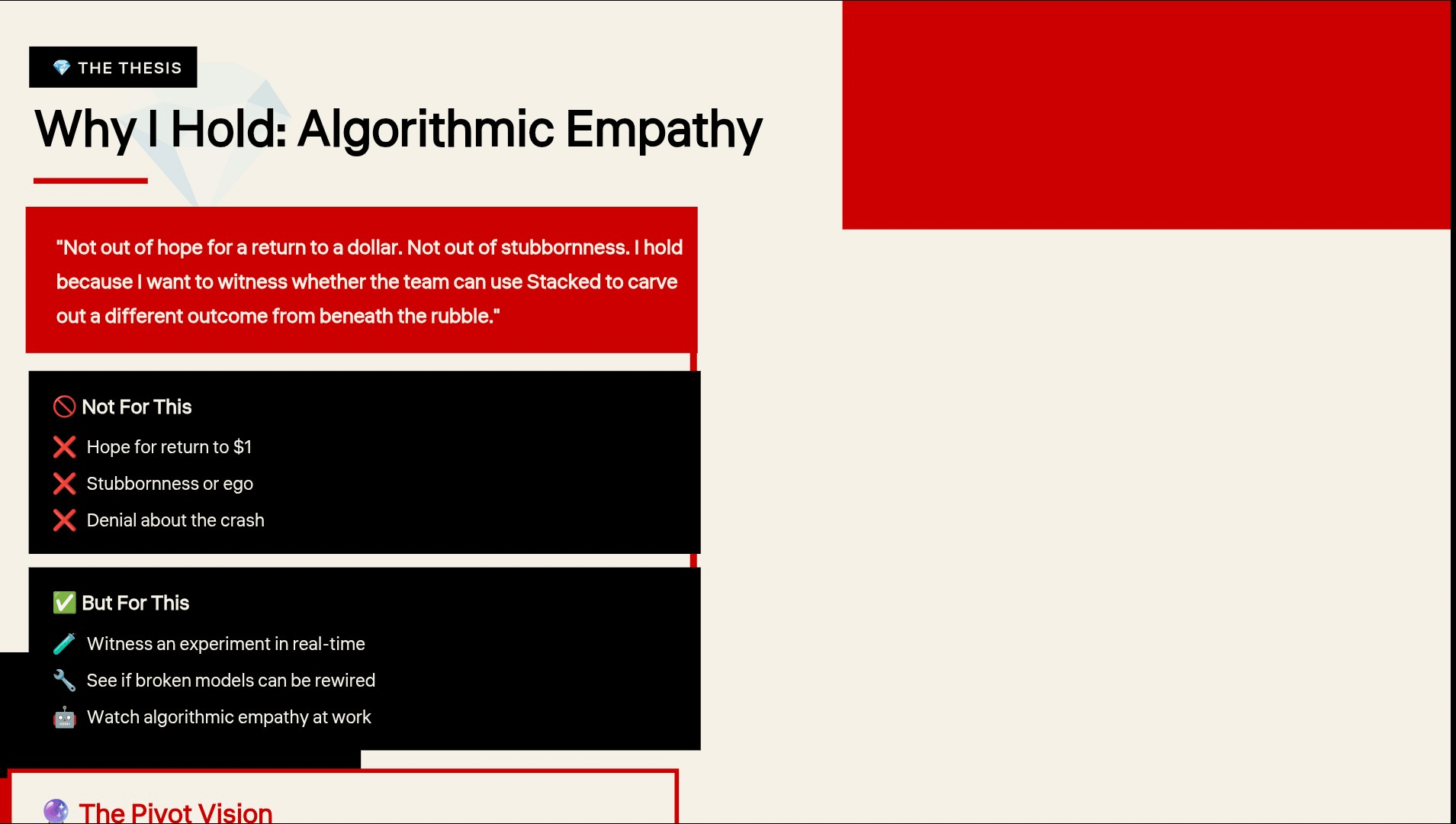
This is why I hold. Not out of hope for a return to a dollar. Not out of stubbornness. I hold because I want to witness whether the team can use Stacked to carve out a different outcome from beneath the rubble of their own design flaws. If they can pivot the token’s role—not as an external speculative instrument, but as a credibility layer, a data-signaling tool, an in-game value capture that’s actually linked to behavioral contribution—then PIXEL might become the first project to retroactively justify its own collapse by proving that broken models can be rewired. Not by market forces, but by algorithmic empathy.
I don’t know if they’ll pull it off. The sell pressure isn’t going anywhere soon, and the wall between vPixel and PIXEL remains an engineering and ideological hurdle. But if any team has the raw, adaptive intelligence to force a rethink of what this token even means, it’s the one that built a reward engine that actually sees players as individuals rather than wallets.
There’s a quiet, stubborn lesson in staring at a position down 99.2% and not flinching. It’s not about diamond hands. It’s about recognizing that the price has already said everything it can say about the past, while the value—the real, unsettled, behaviorally-driven value—is still being written. I’m staying to read the next chapter, even if it takes years. And maybe in the process, I’ll learn a little more about what own eyes were drawn to in the first place.