
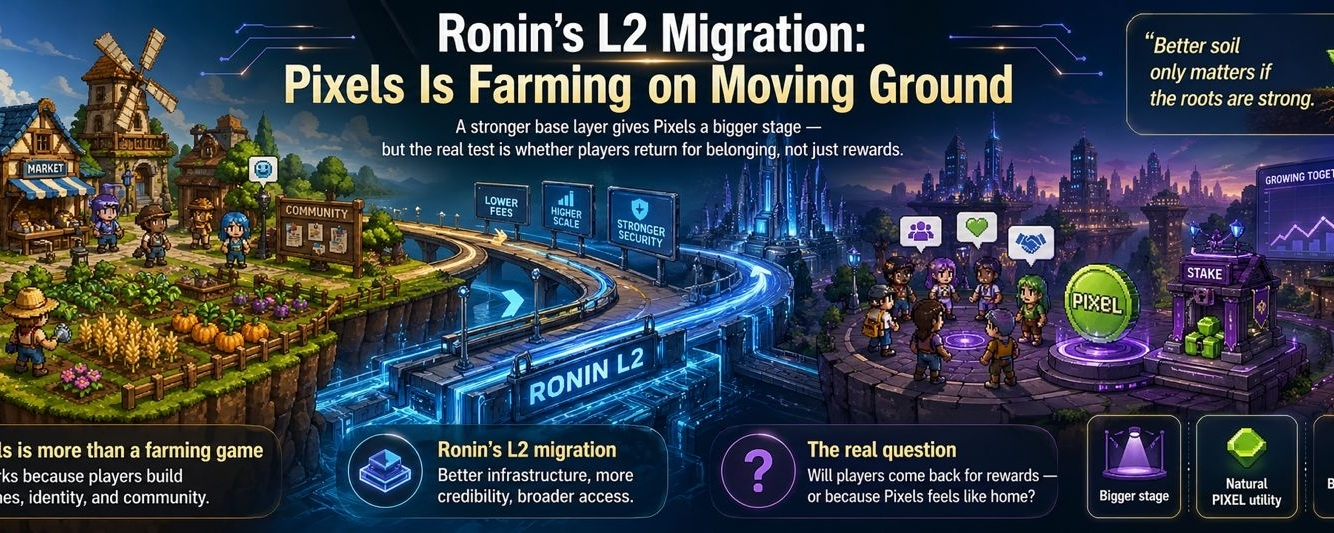
I do not look at Pixels as just a farming game anymore.
At first, that is the easiest way to describe it. You plant, harvest, craft, decorate, complete tasks, and move around a bright social world with other players. But the more I look at Pixels, the more it feels like a small digital town pretending to be a game.
The crops are not the whole story. They are the excuse.
The real story is habit. People return because something is waiting for them. A task. A crop. A friend. A piece of land. A group goal. A small reason to log in again.
That is why Ronin’s move toward a Layer 2 future matters so much. For Pixels, Ronin is not just infrastructure sitting quietly in the background. Ronin is the ground under the town.
And now that ground is being rebuilt.
Pixels Did Not Need Any Chain. It Needed the Right Culture.
A lot of Web3 games talk as if the chain is only a technical choice. Faster transactions, cheaper fees, better tooling — these things matter, but they are not enough.
A game also needs the right crowd.
Pixels found that on Ronin.
Ronin already had a player base that understood blockchain gaming. These were not just wallets looking for the next farm. They were people familiar with game assets, NFTs, marketplaces, and digital ownership. That gave Pixels a better starting point than it would have had on a more general chain.
To me, this is one of the most overlooked parts of the Pixels story.
Pixels did not simply migrate to Ronin. It moved into a neighborhood where its language made sense.
That is important because games are not built only with code. They are built with shared behavior. If the players understand the culture, the game has a better chance to breathe.
Ronin’s L2 Migration Feels Like a New Road Into Town
The way I see it, Ronin’s Layer 2 migration is not just a chain upgrade. It is like building a larger road into a small town.
Before, the town could survive with its own local roads. The people who knew it could find it. The regulars understood how to move around. The economy worked within its own boundaries.
But a bigger road changes things.
More people can arrive. More builders can notice it. More capital can move through it. More outside attention can enter. The town becomes easier to access, but also harder to hide.
That is the part that interests me.
Ronin becoming more Ethereum-aligned may give Pixels more credibility, but it also puts Pixels under a brighter light. The game will not only be judged as a cozy Web3 farming title. It may be judged as one of the leading consumer applications on a gaming-focused Ethereum Layer 2.
That is a much bigger stage.
The Migration Does Not Make Pixels Stronger by Itself
This is where I think people should be careful.
A better base layer does not automatically make a better game.
If a restaurant moves to a better street, the food still has to be good. If a farm gets better soil, the farmer still has to know what to grow. If a town gets a new road, people still need a reason to stay after they arrive.
That is the same with Pixels.
Ronin’s L2 migration may improve the foundation. It may bring more trust, better connectivity, stronger infrastructure, and more attention. But Pixels still has to prove that its world is worth returning to.
That is the real test.
Not whether people visit.
Whether they stay.
PIXEL Has to Become Part of the Lifestyle, Not Just the Reward System
The PIXEL token is one of the most delicate parts of the project.
In many Web3 games, the token becomes the center too quickly. When that happens, the game stops feeling like a world and starts feeling like a job. Players calculate earnings, compare rewards, sell tokens, and leave when the numbers no longer make sense.
Pixels has to avoid that path.
For PIXEL to work long term, it needs to feel like part of the lifestyle of the game. Not something forced into every corner. Not something players use only because the system demands it. It has to connect naturally to progress, access, identity, competition, and social status.
That is why features like staking, land activity, Unions, events, and ecosystem participation matter. They can help PIXEL become more than an output. They can turn it into a tool players use because they care about their place in the world.
The strongest token utility does not feel like a toll booth.
It feels like a key.
Pixels’ Real Product Is Belonging
If I had to describe Pixels in one sentence, I would not say, “It is a farming game on Ronin.”
I would say, “It is a game trying to turn ownership into belonging.”
That is a much harder thing to build.
Ownership alone is not enough. Crypto has already proven that. People can own tokens, NFTs, land, and assets without feeling connected to any of them. Real value begins when ownership becomes personal.
Pixels has a chance because land, farming, customization, and social activity all push players toward attachment. A player does not just hold an asset. They build around it. They decorate it. They return to it. They use it as part of their identity.
That is the difference between an item in a wallet and a place in a world.
If Pixels can keep strengthening that feeling, then Ronin’s upgraded base layer becomes much more meaningful. The infrastructure will not be carrying empty speculation. It will be supporting real digital attachment.
The Risk Is That Web3 Can Make Everything Too Financial
My biggest concern for Pixels is not Ronin.
It is financial gravity.
Web3 has a habit of pulling every experience toward price. A game launches, and people ask about token charts. A feature arrives, and people ask about rewards. A community grows, and people ask how to monetize attention.
That pressure can damage a game if it becomes too loud.
Pixels needs money mechanics because it is a Web3 game. But those mechanics should support the world, not swallow it. If players start seeing every crop, task, item, and event only through the lens of profit, the magic disappears.
The healthiest version of Pixels is one where ownership adds weight to the experience without turning every moment into a trade.
That balance is difficult, but it is also where the project’s future sits.
Ronin Needs Pixels as Much as Pixels Needs Ronin
Another reason this migration matters is that Ronin and Pixels are now tied together in a very visible way.
Pixels needs Ronin for infrastructure, users, liquidity, and ecosystem identity.
But Ronin also needs Pixels for proof.
A chain can announce upgrades, partnerships, and technical improvements all day. But in gaming, the real proof is simple: are people actually playing something?
Pixels gives Ronin that proof.
It shows that Ronin can support a casual social world, not only high-intensity crypto gaming. It gives the ecosystem a softer, more accessible face. It shows that blockchain games do not always need to look like speculation wrapped in combat mechanics.
That makes Pixels important to Ronin’s story after the L2 migration. Ronin can build the road, but Pixels helps show why anyone would travel there.
My Personal View
I see Ronin’s L2 migration as a moment of exposure for Pixels.
Not exposure in a bad way — exposure in the sense that the project may now be seen more clearly.
If Pixels is only strong because of rewards, the market will eventually notice.
If Pixels is strong because people genuinely enjoy returning, coordinating, building, and owning parts of the world, the migration could amplify that strength.
That is why I do not think the key question is, “Will Ronin’s L2 migration pump Pixels?”
That is too small.
The better question is:
Can Pixels become one of the first Web3 games where the chain upgrade improves the world without becoming the whole story?
That is the version I find interesting.
Because the best outcome is not players logging in because Ronin upgraded.
The best outcome is players logging in because their land matters, their group matters, their progress matters, and the upgraded chain simply makes that world stronger underneath.
Final Thoughts
Pixels is farming on moving ground, but that is not necessarily a bad thing.
Sometimes better soil requires disruption. Sometimes a town needs new roads before it can grow. Sometimes a game has to pass through a technical transition before people understand what it really is.
Ronin’s L2 migration gives Pixels a stronger foundation and a larger stage. But it also removes some of the fog. The project will have to prove that its player economy has depth, not just activity. It will have to show that PIXEL has purpose, not just distribution. It will have to show that its world creates attachment, not just transactions.
From my perspective, Pixels’ future depends on one simple thing:
Can it make people feel like they are coming home, not just logging in?
If it can, then Ronin’s changing base layer may become more than an upgrade.
It may become the ground where Pixels grows from a popular Web3 game into a real digital community.
