

I was scrolling late at night, half awake, half annoyed, and Pixels showed up again. Not in a flashy way, not with some dramatic announcement—just… there. And honestly, that’s kind of how I feel about most of crypto right now. Nothing feels fully alive, nothing feels fully dead. Just a constant stream of “new” things that all somehow feel familiar.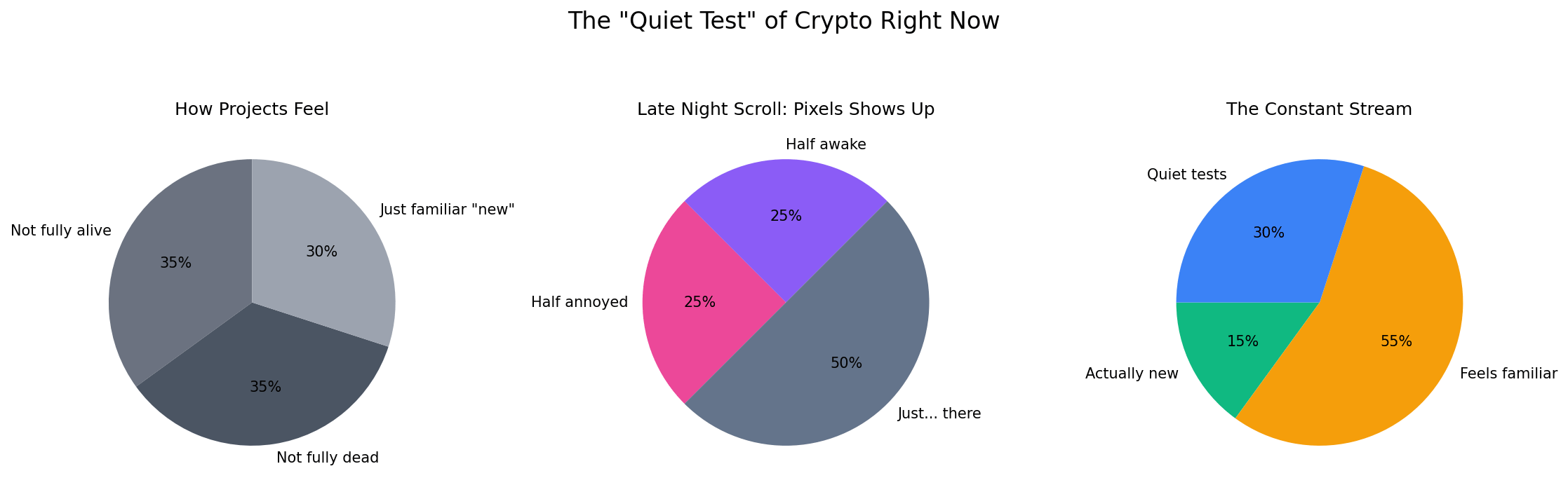
Every project claims it’s building the future. Every thread sounds the same. AI this, infrastructure that, “next generation,” “redefining everything.” I’ve read so much of it that it all blends together now. And then in the middle of that noise, there’s Pixels—a simple farming game. No big promises. No revolutionary slogans. Just planting crops, walking around, doing small tasks.
At first, I almost ignored it. Farming? In 2026? That’s what we’re doing now?
But then I looked closer, and it made me pause a bit.
Because while everyone else is trying to sound important, Pixels is doing something quieter. It’s not trying to impress you with complexity. It’s just trying to see if people will actually show up and play something… simple.
And weirdly, people did.
The numbers went up fast at one point—hundreds of thousands of daily users jumping in. Not all at once, not clean growth, more like waves. People came, left, came back again. It didn’t feel stable, but it definitely wasn’t empty. That alone says something in a space where most “active users” are just wallets moving tokens around.
But here’s the thing no one likes to admit: most of those users weren’t there for the game.
They were there for the rewards.
That pattern never changes. I’ve seen it too many times. You build a game, add a token, and suddenly it’s not a game anymore—it’s an opportunity. People optimize everything. They don’t ask “is this fun?” they ask “is this worth it?”
Pixels didn’t escape that. It leaned into it a bit, but it also tried to keep the game itself simple enough that maybe some people would stay even after the rewards slow down.
That’s the real test, and I don’t think we’ve seen the answer yet.
Because crypto users are… impatient. Including me. We’re always looking for the next thing. The next spike. The next opportunity. Loyalty is rare here unless there’s constant incentive.
And that ties into a bigger problem nobody really solves: infrastructure doesn’t break because it’s bad—it breaks because people behave unpredictably.
When too many users show up at once, things get messy. When rewards drop, they disappear just as fast. It’s not always a tech issue. It’s a human issue. Systems are built for steady use, but crypto brings chaos. Sudden traffic, sudden exits, sudden shifts in attention.
Pixels runs on Ronin, which is actually pretty solid for gaming. Fast, relatively cheap, smoother than a lot of chains. But even then, it’s not just about whether the chain works. It’s about whether the ecosystem can hold attention.
Because attention is everything.
If people stop caring, it doesn’t matter how good the tech is.
That’s why I don’t really compare Pixels to other Web3 games. I think that’s the wrong comparison. The real competition is everything else people could be doing instead. Mobile games, console games, social media, even just doing nothing.
Against that, Pixels does something interesting. It’s slow. It’s repetitive. It doesn’t demand too much from you. You can just log in, do a few things, and leave. There’s something almost calming about that.
And maybe that’s the point.
Not everything has to be intense or groundbreaking. Sometimes people just want something easy.
But then the token comes in and complicates everything again.
The PIXEL token isn’t just a reward—it changes how people behave. When the price goes up, everyone suddenly “loves” the game. When it drops, people disappear or start complaining. It’s the same cycle every time, and it’s exhausting to watch.
I don’t think Pixels has solved that. I’m not sure any project has.
The team keeps updating things—adding features, adjusting rewards, trying to balance the economy. You can tell they’re trying to make it sustainable. But that’s one of the hardest things in crypto. If you give too much, people abuse it. If you give too little, they leave.
There’s no perfect balance.
And onboarding is still a challenge, even if it’s improved. Pixels is easier to get into than a lot of Web3 stuff, but it’s still not as simple as a normal game. Wallets, assets, tokens—it’s always a bit more complicated than it should be.
Most people don’t want to think about that. They just want to play.
That’s something the entire space still struggles with. We keep building for ourselves instead of for normal users.
And then there’s the bigger picture. The market itself feels unstable. Liquidity moves around too fast. Narratives change every few months. Right now it’s AI again, even when half the projects barely use it. Everything is fighting for attention at the same time.
Pixels isn’t loud enough to dominate that conversation. It kind of just sits there, doing its thing.
That could be good. Or it could mean people forget about it.
I keep going back and forth in my head. Part of me respects it for not overhyping itself. It feels more real than most projects. But another part of me wonders if being “real” is even enough in this space.
Because I’ve seen good ideas fail before. Not because they were bad, but because people moved on.
That’s the risk here too.
If Pixels can turn even a small percentage of its users into actual players—not just reward hunters—it might have a chance to last. Not explode, not dominate, just… survive. And honestly, that would already be impressive in Web3 gaming.
But if it stays dependent on incentives, it’ll probably follow the same path as everything else. A big wave of attention, then a slow fade.
Right now, it feels like it’s somewhere in between.
Not a failure. Not a breakthrough. Just existing, trying to figure itself out while the rest of the space keeps chasing the next big story.
And maybe that’s why I keep paying attention to it, even when I don’t mean to.
It’s not trying too hard.
Still, I don’t know if that’s enough.
Maybe it quietly builds something lasting in the background while everyone else burns out chasing hype. Or maybe one day people just stop logging in, and it slowly disappears without much noise.
Both outcomes feel equally possible.
And that’s the honest part no one really likes to say.
It might actually work.
Or nobody shows up tomorrow.