
When most people first open @Pixels it looks simple.
You plant crops.
You complete tasks.
You explore.
You craft items.
You upgrade slowly over time.
At first glance, it feels like another casual farming game with Web3 elements attached to it.
That’s exactly why a lot of people underestimate what’s happening inside the ecosystem right now.
Because the deeper you go into Pixels, the more obvious it becomes that this project is no longer designing around short-term farming mechanics. It’s designing around economic behavior.
And honestly, that changes everything.
Most GameFi projects spent the last cycle trying to answer one question:
“How do we attract users fast?”
Pixels feels like one of the few projects now trying to answer a much harder question:
“How do we keep an economy alive long term without destroying the token?”
That difference matters more than people realize.
Pixels is quietly moving away from the old play-to-earn formula that failed across the industry and replacing it with something much more controlled, layered, and sustainable.
And the interesting part is that they’re not doing it through hype.
They’re doing it through systems.
The old Web3 gaming model was broken from the beginning.
Most games rewarded activity equally.
The more you clicked, the more you earned.
The more accounts you ran, the more tokens you extracted.
The faster you farmed, the faster you dumped.
That created temporary growth, but eventually every economy reached the same outcome.
Inflation exploded.
Real players lost motivation.
Bots became dominant.
Token prices collapsed.
Communities disappeared.
The problem was never just the token itself.
The real problem was that the entire economy rewarded extraction instead of participation.
And this is where Pixels starts separating itself from most GameFi projects.
Inside Pixels, not every action is treated equally anymore.
That’s an important shift.
The game is slowly introducing systems where progression depends more on positioning, access, planning, efficiency, and strategic ownership rather than pure grinding volume.
That completely changes player incentives.
Instead of asking:
“How fast can I farm rewards?”
Players are increasingly asking:
“How do I position myself better inside the ecosystem?”
That mindset shift is a massive difference.
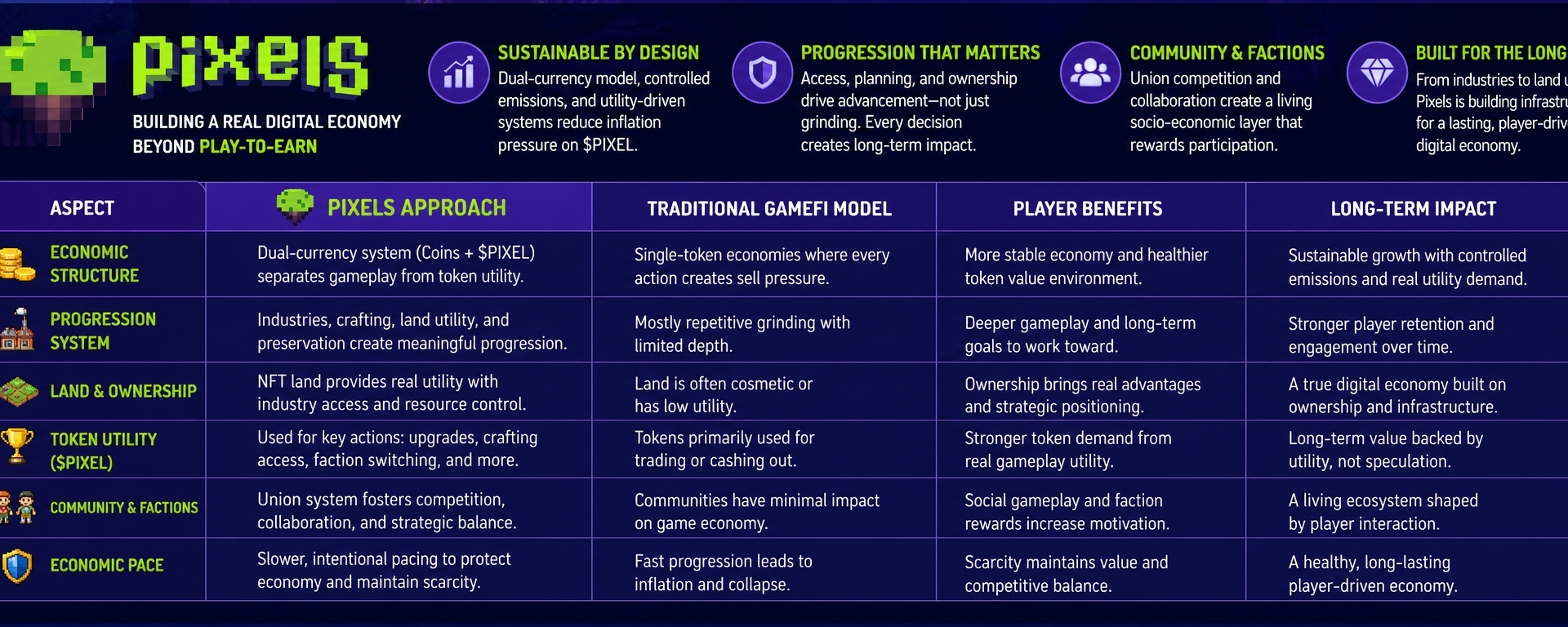
One of the smartest things Pixels introduced is the separation between off-chain Coins and $PIXEL itself.
A lot of people overlook this mechanic, but I honestly think it’s one of the most important economic decisions in the game.
In most Web3 games, every action directly creates token emissions.
That creates nonstop sell pressure.
Pixels approaches things differently.
Basic gameplay activity can still happen through off-chain Coins, while pixel increasingly becomes tied to higher-level progression, upgrades, crafting access, ecosystem participation, industries, and long-term utility.
That creates friction between gameplay and extraction.
And surprisingly, friction is healthy for economies.
Because when every single action immediately becomes liquid value, players stop thinking like participants and start thinking like farmers.
Pixels is clearly trying to slow that cycle down.
The project seems much more focused on controlling how value enters the economy instead of simply maximizing reward output.
That’s a much more mature design philosophy than most people realize.
And honestly, it feels closer to how real economies function.
Not every activity in a real economy creates direct monetary output instantly.
Some actions create infrastructure.
Some create positioning.
Some create ownership advantages.
Some create long-term leverage.
Pixels is slowly introducing similar ideas into gameplay.
The Tier 5 expansion made this direction even more obvious.
This wasn’t just another content update.
It fundamentally changed how players think about land, industries, and progression.
Before T5, a lot of players approached Pixels casually.
Farm resources.
Complete loops.
Sell rewards.
Repeat.
But Tier 5 added something much more strategic.
Now industry access matters.
Capacity matters.
Land utility matters.
Timing matters.
Access matters.
And suddenly, not every player can participate equally anymore.
That’s where economies become interesting.
T5 industries being tied to NFT lands created a much stronger relationship between ownership and production.
Now land isn’t just cosmetic.
It’s infrastructure.
And infrastructure changes how value flows inside a system.
The slot system also introduced something very important:
Scarcity.
Most Web3 games are terrified of limiting access because they think players only care about instant rewards.
Pixels is doing the opposite.
Limited T5 slots force players to think carefully about allocation, optimization, and long-term planning.
That creates meaningful decision-making instead of endless inflationary loops.
The Preservation Rune mechanic adds another layer to this.
Instead of permanent passive ownership, players now have to actively maintain access to advanced infrastructure.
That creates recurring engagement while also slowing uncontrolled expansion.
Again, this is economic design.
Not just gameplay design.
And the more you look at Pixels through that lens, the more interesting the project becomes.
Another thing I find fascinating is how Pixels is slowly turning social coordination into economic leverage.
Most players still think Unions are mainly cosmetic faction systems.
I don’t think that’s true anymore.
The seasonal reward structure already creates strategic behavior between factions.
First place capturing the majority of rewards changes how players think about participation.
But the interesting part is that Union size itself becomes an economic variable.
If a faction becomes too crowded, rewards get diluted.
If it’s too small, it struggles to compete.
That creates natural balancing behavior inside the ecosystem without the game needing to constantly interfere manually.
That’s clever design.
The switching cost also matters more than people think.
Charging pixel for faction movement turns social decisions into economic decisions.
Again, the project is constantly introducing systems that reduce random movement and encourage intentional participation.
That’s the opposite of how most GameFi economies operate.
Most Web3 games optimize for instant onboarding.
Pixels increasingly seems focused on retention quality instead.
And honestly, that may be the only path that actually works long term.
One thing I’ve noticed recently is that Pixels no longer feels like a game trying to maximize token hype.
It feels like a project trying to stabilize player behavior.
That’s a huge distinction.
A lot of crypto games only look healthy when token prices are pumping.
But systems built entirely around speculation eventually become unstable because the economy depends more on external buyers than internal utility.
Pixels seems to understand this problem very clearly.
That’s why the ecosystem keeps adding utility layers instead of simply increasing emissions.
Crafting systems.
Industry systems.
Land systems.
Preservation systems.
Progression systems.
Faction systems.
Economic gating systems.
All of these mechanics create reasons for players to remain involved beyond pure token farming.
And that’s probably one of the hardest problems in Web3 gaming.
Retention.
Real retention does not come from rewards alone.
It comes from attachment.
From ownership.
From positioning.
From identity.
From progression that feels meaningful.
Pixels is quietly building those layers over time.
And I think that’s why the ecosystem continues surviving while so many other GameFi projects disappeared after the first hype cycle.
Another thing worth paying attention to is how the project approaches economic pacing.
Most games scale rewards aggressively early to attract users fast.
But that usually destroys sustainability later.
Pixels increasingly seems willing to slow progression intentionally.
Some players complain about that.
But honestly, slower progression often creates healthier economies.
When progression becomes too fast, value collapses because nobody needs specialization anymore.
Everything becomes abundant.
Scarcity disappears.
Ownership loses meaning.
Pixels appears to understand that progression itself can be part of the economy.
Not everyone reaches advanced infrastructure instantly.
Not everyone gains equal access at the same speed.
That naturally creates market layers between players.
And market layers create trade, specialization, and economic interaction.
Again, that starts looking much closer to a functioning economy rather than a reward faucet.
The really interesting part is that most casual players probably don’t even notice these systems consciously.
They simply feel the gameplay changing over time.
But underneath the surface, player incentives are being reshaped constantly.
And honestly, that’s probably the smartest way to do it.
Because sustainable economies usually don’t feel obvious while they’re forming.
They evolve gradually.
What also stands out to me is how Pixels continues treating gameplay as the center instead of purely financial speculation.
That sounds simple, but it’s actually rare in Web3 gaming.
Many projects start with tokenomics first and gameplay second.
Pixels increasingly feels gameplay-first with economic systems layered underneath.
That order matters.
Because without enjoyable loops, no economy survives long term.
Players eventually leave if the experience itself is weak.
And despite all the economic experimentation happening inside Pixels, the game still remains approachable.
That balance is difficult to maintain.
Too much complexity kills accessibility.
Too little complexity kills long-term depth.
Pixels is trying to operate somewhere in the middle.
And honestly, I think that’s one reason why the ecosystem continues attracting attention even during quieter market periods.
The project feels alive.
Not because of marketing alone.
But because systems continue evolving.
That creates curiosity.
And in online economies, curiosity is valuable.
Especially when players start realizing there may actually be long-term positioning advantages inside the ecosystem.
I also think the broader market is slowly underestimating how important digital ownership could become over the next few years.
Most people still think NFTs only matter for speculation.
But infrastructure ownership inside functioning digital economies may eventually become much more meaningful than simple collectibles.
Pixels is experimenting with that idea directly through land utility, production systems, and controlled progression access.
That makes the ecosystem far more interesting than the average farming simulator narrative people still attach to it.
At this point, I honestly don’t even view Pixels as just a Web3 game anymore.
It increasingly feels like a live experiment in digital economic design.
Some systems will work.
Some will probably fail.
Some mechanics will need balancing.
Some reward structures will evolve.
But that experimentation itself is valuable.
Because most projects never move beyond simple emission loops.
Pixels at least seems willing to iterate toward sustainability instead of endlessly repeating the same broken GameFi formula.
And that’s why I’m still paying attention to pixel while many older Web3 games quietly fade away.
The ecosystem still feels early.
But for the first time in a long time, it feels like a GameFi project is thinking beyond short-term token extraction and actually trying to build a functioning digital economy around player behavior, ownership, and long-term participation.
That’s a much harder path.
But it’s probably the only one that survives.