

I didn’t enter Pixels thinking about ownership models or economic structures. I joined like most players curious, early, and focused on one thing: how to play smart and get ahead.
At first, land looked like the obvious upgrade. If grinding is step one, then owning land felt like step two — a move from participant to controller. More efficiency, more output, more control.
But after actually spending time inside the system, observing how land behaves over weeks — not just days — my perspective shifted.
What I thought was ownership started to feel more like participation under conditions.
And that distinction matters more than most players realize.
From the outside, NFT land in Pixels looks simple. You own it. You use it. You benefit from it.
But once you’re inside, you start noticing the layers.
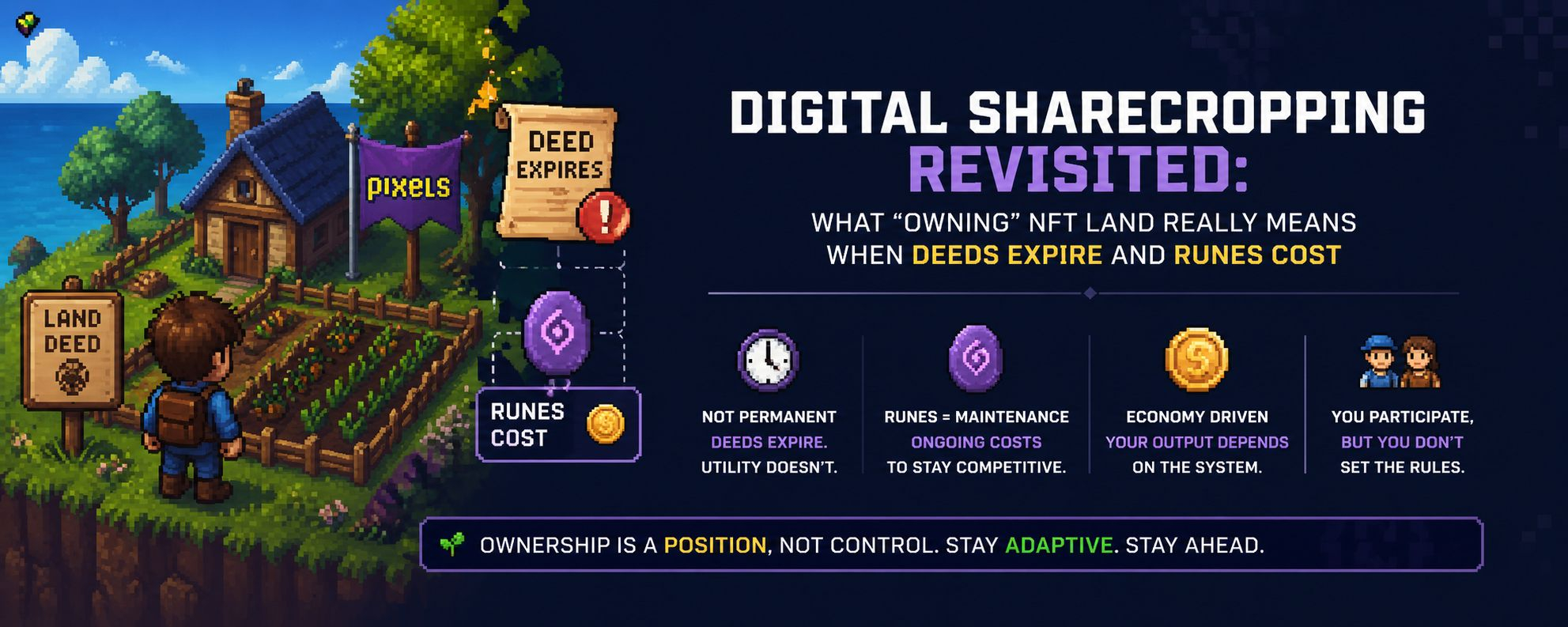
Land doesn’t operate in isolation. It depends on player activity, resource cycles, and ongoing system incentives. And more importantly, it comes with maintenance mechanics — especially when you factor in runes.
Runes aren’t just a feature. They’re a cost layer that sits quietly underneath everything.
From what I’ve seen, they shape behavior more than people admit.
You don’t just earn — you reinvest to sustain your position.
And that creates a loop that feels very different from traditional ownership.
When I first started interacting with land setups — either mine or others — I assumed the advantage was passive. Own land, optimize once, and let it run.
That assumption didn’t last long.
Land requires attention. It requires adjustments. It requires awareness of what other players are doing.
Because if activity drops, output drops. If competition increases, margins tighten.
There’s no fixed demand protecting your position.
What you actually “own” is exposure to a live, changing system.
The moment that really changed how I see things was when I started tracking my own efficiency against costs.
Let’s say you’re earning steadily. On paper, everything looks fine.
But then:
Rune costs increase
Resource prices shift
More players enter the same loop
Suddenly, your margin compresses.
And you realize something important:
You’re not just playing the game — you’re managing a balance between input costs and output value.
That’s not passive ownership. That’s active positioning.
Pixels has grown fast. At one point, it crossed over a million daily active users, making it one of the most active Web3 games in the space.
On the surface, that sounds like strength — and in many ways, it is.
But from inside the game, high activity doesn’t always feel like stability.
It often feels like pressure.
Because more players mean:
More competition for the same resources
Faster shifts in pricing
Shorter windows of advantage
I’ve personally seen how quickly strategies stop working. What was profitable one week becomes average the next.
So the idea that growth alone secures your position doesn’t really hold up in practice.
This is where the idea of “digital sharecropping” started to make sense to me.
In traditional sharecropping, you work land that you don’t fully control. Your output depends on conditions you didn’t create.
In Pixels, you technically own land. But:
The mechanics can evolve
The cost structures can shift
The reward systems depend on broader player behavior
So while ownership exists, control is limited.
You operate within a system — not above it.
What I’ve noticed is that many players misunderstand where the real edge comes from.
It’s not just owning land.
It’s understanding flow.
The best players I’ve observed don’t rely on one setup. They adapt constantly.
They:
Shift production based on demand
Exit loops when margins shrink
Reallocate time and resources quickly
Meanwhile, players who treat land like a fixed asset often struggle when conditions change.
Because the system doesn’t reward static strategies.
It rewards awareness.
Another thing I’ve learned the hard way is that time is a hidden cost.
Grinding more doesn’t always mean earning more.
Sometimes it just means maintaining your position.
And that’s a big difference.
If your effort is going toward sustaining output rather than expanding it, then your “ownership” is behaving more like a responsibility than an advantage.
So what does owning land in Pixels actually mean?
From my perspective as a player, it means you have access to a higher layer of the economy.
But that access comes with exposure.
Exposure to:
Cost fluctuations
Player behavior
System adjustments
You’re not just benefiting from the system — you’re tied to it.
I’m still playing. Still testing. Still learning.
Because despite everything, Pixels is one of the most interesting live experiments in Web3 gaming right now.
It’s not static. It evolves fast. And that’s exactly why it reveals these dynamics so clearly.
But I don’t look at land the same way anymore.
I don’t see it as something I simply “own.”
I see it as a position I hold inside a system that keeps moving.
And once you understand that…
You stop chasing the idea of ownership and start focusing on how to stay ahead inside the flow.
