

I’ve spent enough time inside Pixels to recognize the point where something that feels light and easy starts carrying a kind of quiet weight.
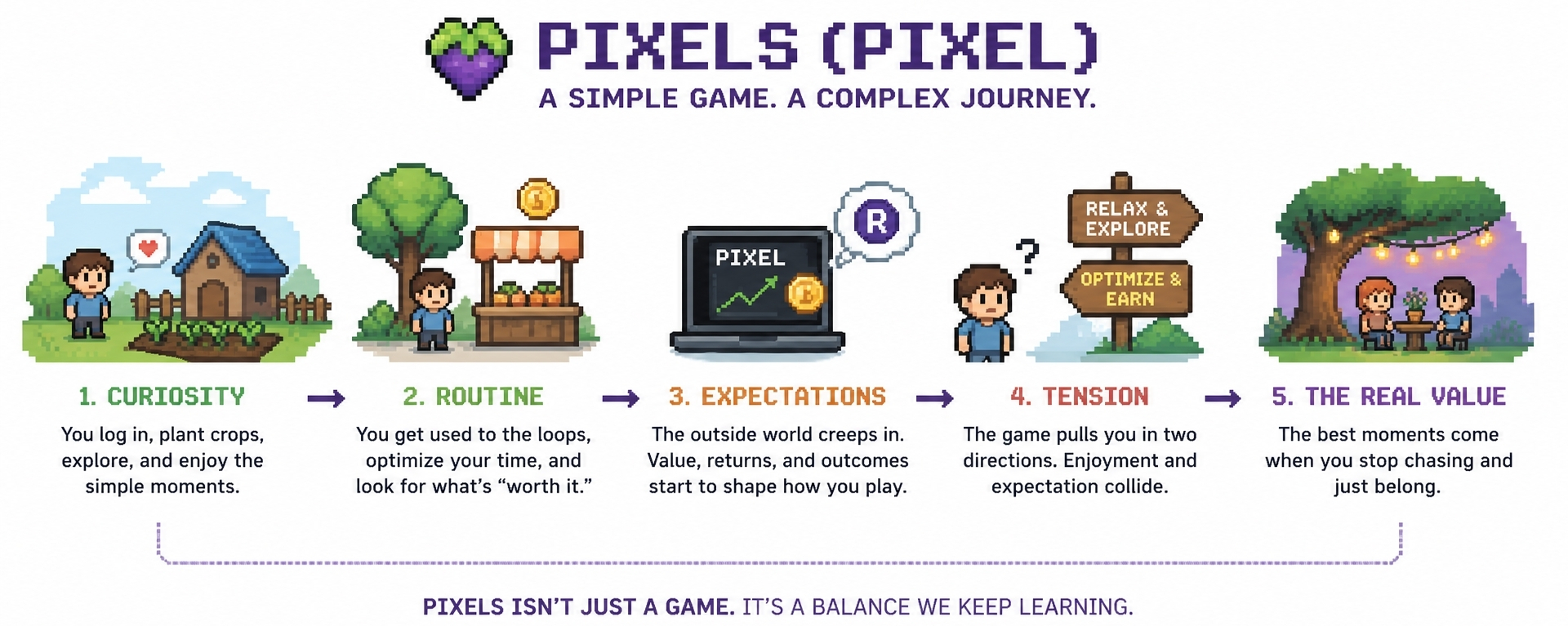
In the beginning, it’s simple in the best way. You log in, plant a few crops, walk around, maybe bump into someone doing the same thing. Nothing feels urgent. You’re not chasing anything big. It’s just small actions that feel complete on their own. That’s what makes it work early on—it doesn’t ask much from you, and it doesn’t pretend to be more than it is.
And then there’s Ronin Network sitting underneath it all, but at first it feels distant, almost irrelevant. You know it’s there, but it doesn’t interfere with how the game feels. If anything, it just adds a quiet sense that maybe this time spent could matter in some other way later.
That idea stays in the background for a while.
But it doesn’t stay there forever.
After some time, the way you play starts to change, even if the game itself doesn’t. You begin to notice how often people talk about what’s efficient, what’s optimal, what’s “worth doing.” Not aggressively, not in a way that ruins the mood instantly—it just slowly replaces the earlier feeling of wandering without a goal.
You catch yourself thinking the same way. Not because you want to, but because it starts to feel natural.
And once that happens, the experience shifts.
The same farming loop that once felt calming starts to feel like something you’re repeating on purpose. The exploration becomes less about curiosity and more about knowing where to go. The world doesn’t shrink, but it starts to feel smaller.
Nothing is technically wrong. That’s the strange part. The systems are still working. The game still looks and sounds the same. But the reason you’re there starts to drift, and that changes everything without changing anything obvious.
There’s a version of Pixels that feels honest—a small, social game where people show up, do a few things, and leave when they’re done. That version doesn’t need to justify itself. It doesn’t need to scale into something bigger.
But there’s also this constant pressure, even if it’s subtle, for it to become more than that. For time spent inside the game to connect to something outside it. To mean something beyond the moment.
And that’s where things start to stretch.
Because the game itself feels built for something slower, more relaxed, more contained. But the expectations around it keep nudging it toward something more structured, more calculated. You can feel that tension in how people behave, in how the rhythm of the game changes over time.
It’s not dramatic. It’s gradual.
There are still moments where everything feels right. You forget about outcomes and just exist in the game for a bit. You interact with someone without thinking about why. You do something small that feels satisfying for no real reason. Those moments are real, and they’re probably the strongest part of the whole experience.
But they don’t hold the same way they did at the start.
They feel temporary, like something you slip into rather than something the game naturally keeps you in.
And over time, you start to realize that the game isn’t just competing with other games—it’s competing with the expectations built around it. Expectations that don’t always fit the kind of experience it’s actually good at delivering.
So it keeps moving forward in this in-between state.
Still enjoyable in parts. Still easy to return to. Still capable of creating moments that feel genuine. But also carrying this underlying sense that it’s being pulled in directions that don’t fully match its core.
It doesn’t fall apart. It just never fully settles.
And maybe that’s the part that sticks with me the most—not that it fails, but that it almost finds its balance and then drifts away from it again. Like something that works best when no one is trying too hard to make it work at all.