
There was a moment when I was checking a simple onchain update and something felt slightly delayed my not broken, not failed, just not as immediate as I subconsciously expected. The action had clearly gone through, but the confirmation of “ownership” didn’t land at the same speed as the interaction itself. I remember just sitting with that gap for a few seconds, realizing how much I’ve started expecting instant finality from systems that are actually doing a lot more underneath.
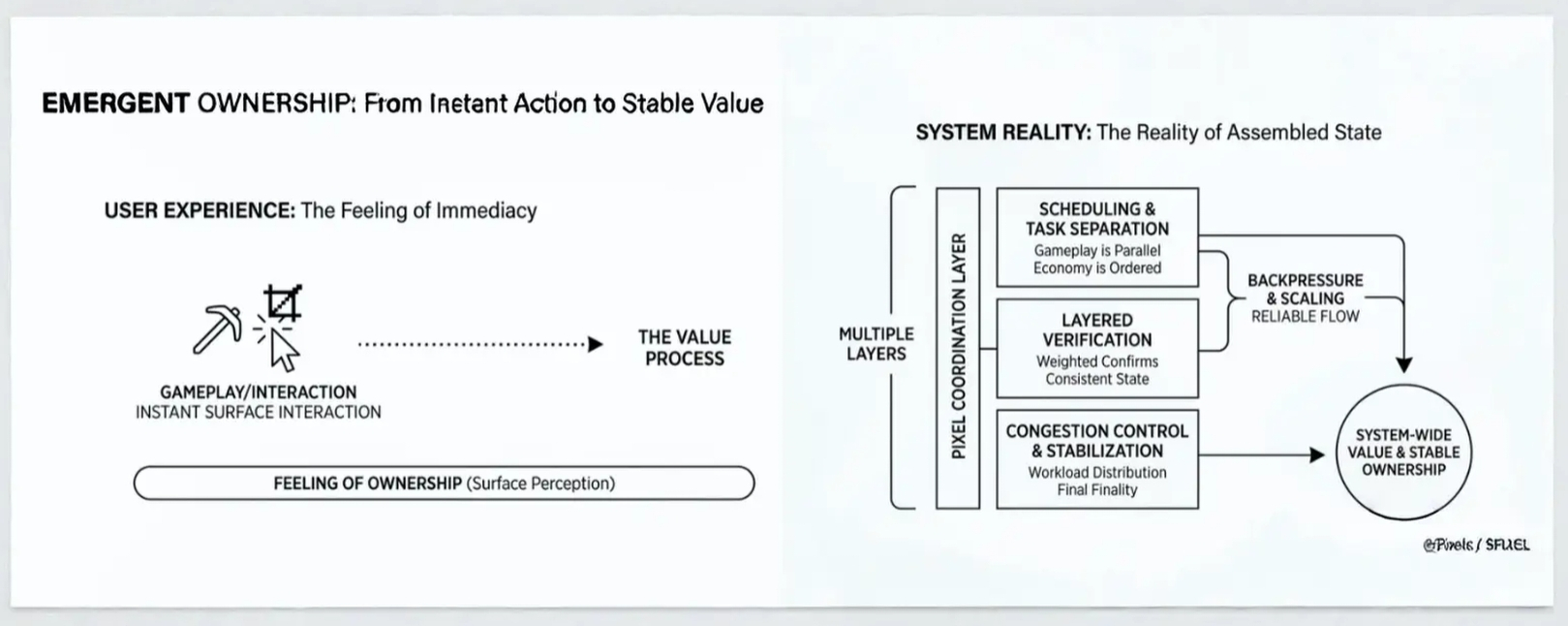
After seeing this kind of behavior across different Web3 experiences, what I noticed is that “ownership” is not a single moment. It is a process that gets assembled across multiple steps execution, verification, synchronization, and final state alignment. And when usage increases, that process doesn’t disappear; it just becomes more visible through timing differences. Some things feel instant, others feel slightly deferred, even though the final outcome is the same.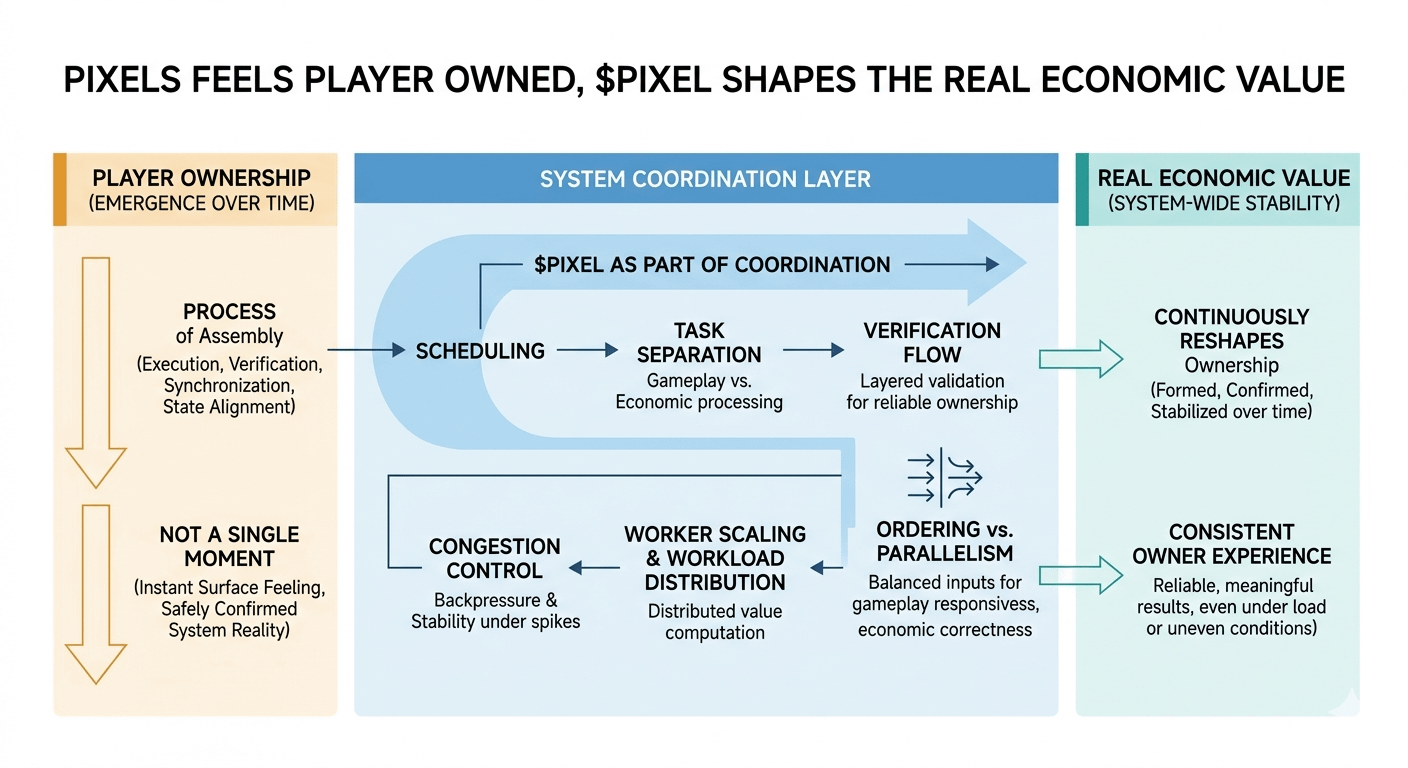
From a system perspective, this creates an interesting separation between what users feel and what systems actually do. The feeling of ownership is immediate at the surface, but the reality of ownership depends on how quickly a system can safely confirm and distribute that state across all its internal layers. When demand rises, that confirmation layer becomes the real pressure point.
I often think about it like a shared ledger being updated by thousands of hands at once. Everyone believes they are updating the same “truth,” but the system has to decide the order, validate consistency, and ensure that no conflict exists before anything becomes final. Ownership exists, but its recognition depends on system coordination.
When I look at how @Pixels approaches this, what caught my attention is that it doesn’t present ownership as a single flat outcome of gameplay. It feels more like ownership is something that emerges from how the system processes participation over time, rather than just from momentary activity.
What interests me more is how $PIXEL sits within that structure.
It doesn’t feel like it simply “rewards” behavior in a direct way. Instead, it feels like it interacts with how value flows through different layers of the system.
Scheduling plays a subtle role in that flow. Some actions that contribute to value appear to resolve quickly, while others are processed with more spacing. That difference doesn’t feel accidental it feels like timing is part of how the system avoids concentrating too much activity at once.
Task separation is another layer that stands out. Gameplay remains responsive and lightweight, even when activity increases. But economic processing value updates, progression states, ownership related logicfeels like it operates in a separate lane. From experience, this kind of separation is often what prevents systems from becoming unstable under load.
Verification flow adds another dimension. Not every action is treated with the same depth of validation. Some are lightweight, others require stronger confirmation before they affect state. That layered verification structure often determines how reliable “ownership” feels when the system is under pressure.
Then there is congestion control. What matters in practice is not just handling activity, but preserving consistency when activity spikes. Backpressure becomes important here it slows certain pathways just enough so the system doesn’t overload while still allowing flow to continue.
Worker scaling and workload distribution only work effectively when value related computation is actually spread across the system. If everything is concentrated in one processing path, ownership updates become delayed or inconsistent. Distribution is what keeps economic state stable when participation grows.
And then there is ordering versus parallelism. Gameplay depends on parallel responsiveness it needs to feel immediate. But economic finality often requires ordered processing to maintain correctness. Balancing both is where system behavior becomes meaningful rather than just functional.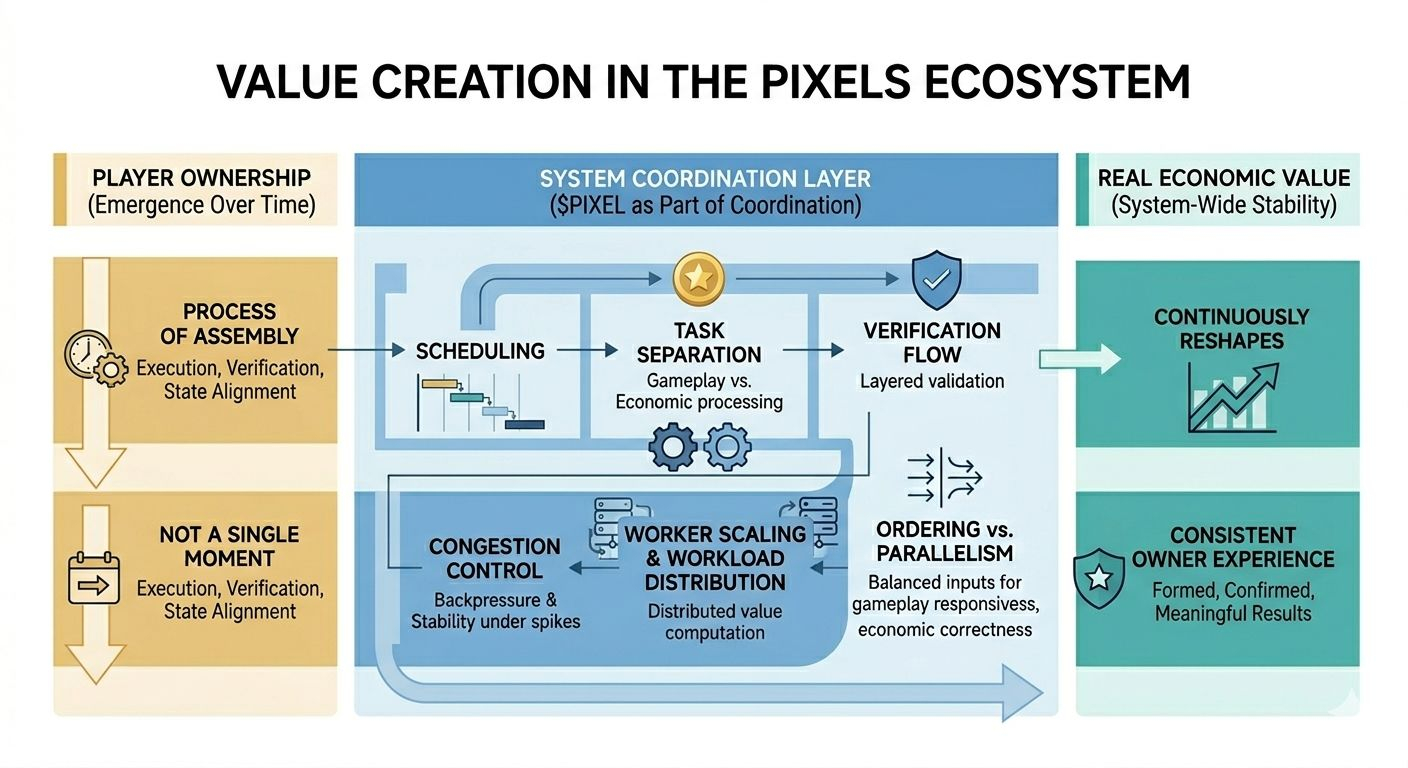
What stands out to me is that Pixel doesn’t treat player activity as the final expression of value. Instead, it feels like activity is only one input into a larger system that continuously reshapes how ownership is formed, confirmed, and stabilized over time. And in that structure, $PIXEL feels more like part of the coordination layer than just a reward unit.
From a broader perspective, this is where Web3 systems become more interesting not when they simply allow participation, but when they define how participation turns into stable, system wide value under changing conditions.
A reliable system is not the one that makes ownership feel instant in every moment, but the one that ensures ownership remains consistent when conditions are uneven. Good infrastructure doesn’t rush to show results. It makes sure the results still make sense when everything else is under pressure.