


Waiting is no longer free in Pixels.
It's just unpaid.
That's the quiet shift most people miss.
PIXEL doesn't measure play. It measures how much you're willing to pay to stop waiting.
And in a system that never pauses, waiting is a position you take not a default.
I didn't think much of it at first.
Open the app. A carrot timer shows 1:58.
Close it. Nothing lost.
Or spend PIXEL, and the timer hits zero. The crop is identical; only the moment you receive it changes.
I've done it without thinking.
The wait wasn't painful just heavy. PIXEL was there, and waiting felt slightly heavier than spending.
That's not calculation. That's a reflex PIXEL quietly installs.
You harvest blueberries.
12 this time. Next time, same action 8. No explanation.
You open the app, stare at a grown carrot, close it without harvesting.
You didn't want the carrot.
You just wanted to see if it was ready.
That's the surface. Underneath, PIXEL is tightening somethingthough never in a straight line.
Every skip burns PIXEL as a fee permanently removed from circulation.
New tokens enter on a fixed, declining emission schedule. Supply inflates predictably at first, then slows.
PIXEL's fee sink scales with usage, but usage shifts with mood, habit, and whether the token feels cheap or expensive that week.
The mismatch is the core dynamic. Emissions are known; PIXEL fee outflows are behavioral.
The gap, weekly PIXEL net flow is the directional signal, not a hard rule.
It suggests whether the economy is tightening or loosening. It rarely shouts. It usually hints.
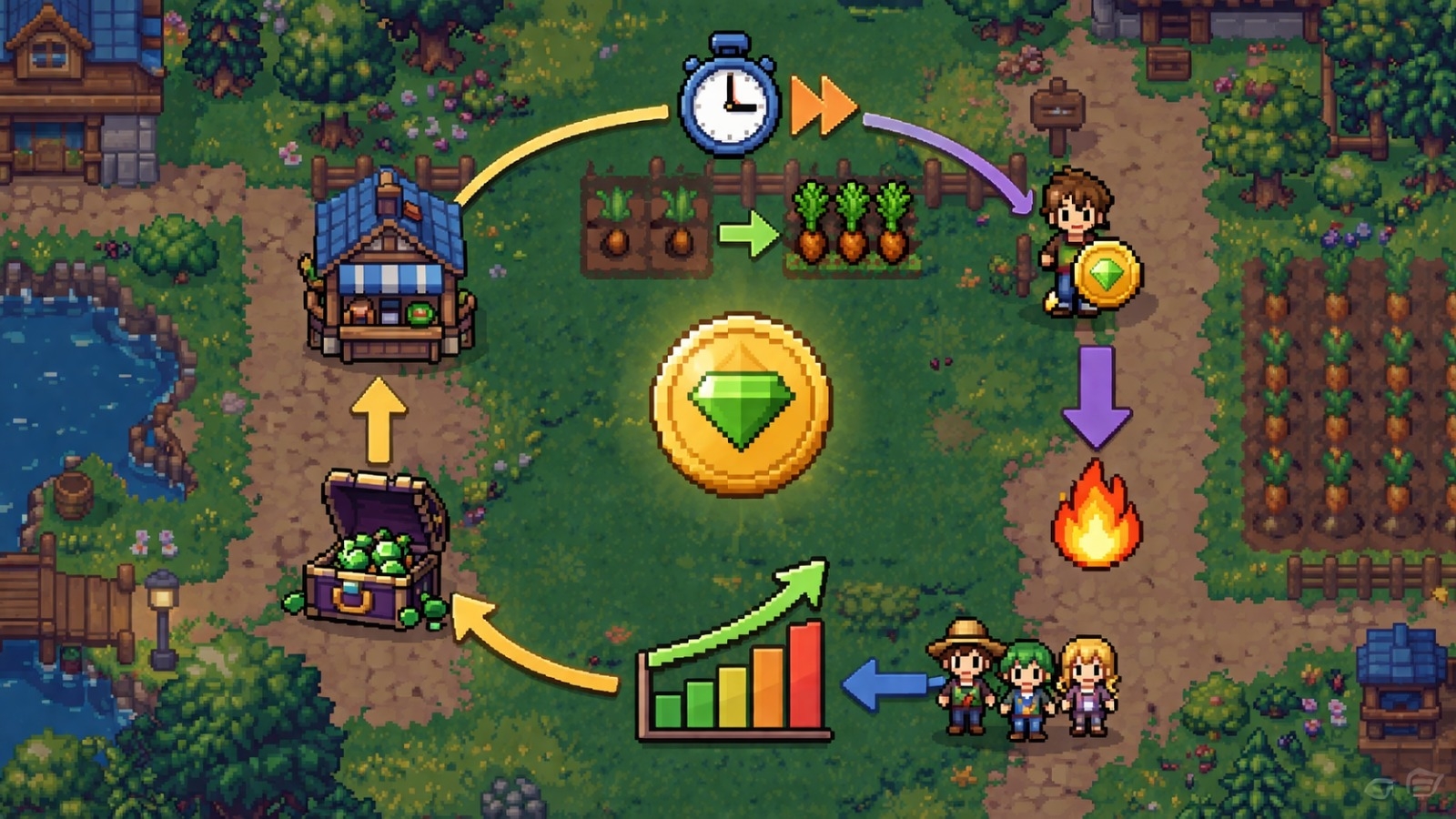
Two speeds coexist without pushing. Base: free, natural clock. Accelerated: costs PIXEL, contracts PIXEL's supply.
No mandatory PIXEL gate. No penalty for patience.
You can stay away; the farm keeps producing. You return; everything is exactly where it should be.
Yet PIXEL demand persists not forced, but because the economy generates a soft compulsion.
Skipping with PIXEL doesn't just save a few minutes; it increases your share of total system throughput.
In a persistent‑output world, relative speed tends to determine relative accumulation.
Waiting isn't punished, but it frequently costs you the cycles someone else is already using PIXEL to pull ahead.
That pressure isn't fabricated; it's emergent, and it shifts as participation shifts.
Here's the loop most analyses miss.
As more people use PIXEL to skip, the perceived cost of waiting rises.
That perception feeds back into behavior more PIXEL spending, higher fee outflows, tighter PIXEL supply.
If PIXEL's price rises in response, the cost of skipping increases, which can dampen demand, which shifts perception again.
The system breathes. It oscillates around thresholds, pushed and pulled by the very PIXEL behavior it's measuring.
Some people use PIXEL because they've calculated the cycle.
Earlier harvest means earlier planting. Each saved minute nudges the whole sequence forward.
Over weeks, identical starting points diverge powered by PIXEL.
Others spend PIXEL without knowing they've decided. Impatience, reflex, the quiet satisfaction of not waiting.
The thumb taps before the brain catches up.
Both patterns feed PIXEL's sink. And behind them, the system holds its shape through four kinds of users.
High‑frequency optimizers are the core PIXEL demand engine. They skip consistently, view time through an efficiency lens, and generate the bulk of steady PIXEL fees.
Their behavior is rational, repeatable, and resilient until the PIXEL cost equation shifts, and then they recalculate.
Casuals keep things steady without trying to. They skip when they feel like it sometimes impatience, sometimes boredom, sometimes no reason at all.
Their spending comes and goes, but because there are so many of them, the lows never get too low. They're the background hum the system runs on.
Whales are trickier. A handful of big wallets can make the numbers look healthy while hiding how thin the real support actually is.
If one of them stops spending, the sink weakens overnight. You can't ignore them, but you can't trust the headline figures they create either.
Non‑spenders anchor the base progression. They never use PIXEL, yet they absorb the emission pressure that would otherwise concentrate among spenders.
They're the counterweight that keeps the PIXEL acceleration path from becoming mandatory.
A healthy economy tends to need all four but it only works if optimizers and casuals together sustain enough distributed $PIXEL fee outflow to keep PIXEL net flow directionally positive, even without whales.
That's not a guarantee; it's a condition that can fail.
And that's where the thresholds sit. Not as tripwires, but as warning bands.
The first is PIXEL net flow: total weekly fees minus emissions. If it leans negative over a rolling four‑week window, the economy is likely shifting from sink‑dominant to inflation‑dominant.
It's not a switch; it's a trend. PIXEL supply grows faster than it's burned, and the scarcity argument erodes gradually.
The second is concentration. If the top three wallets consistently account for more than roughly 40% of weekly PIXEL skip volume, demand is probably more fragile than the aggregate suggests. This isn't a cliff; it's a zone where PIXEL risk concentrates.
The third is PIXEL acceleration frequency decline among the top 20% of users. If that metric drops substantially from its peak and stays down for two weeks, the core PIXEL optimizers may be losing conviction.
That's the earliest leading signal, the one that often precedes the PIXEL net‑flow shift.
When all three point the same direction PIXEL net flow leaning negative, concentration elevated, PIXEL optimizer frequency declining the economy isn't collapsing.
The base game continues. Crops still grow. Timers still tick. But PIXEL's role likely shrinks from a universal accelerator to a niche tool kept alive by habit alone.
There's a hard ceiling anyway. Crops can only grow so fast. Queues can only shorten to zero. At peak optimization, further PIXEL skips yield nothing.
The player who uses PIXEL on everything ends up at the same output as the player who spends PIXEL smart.
Some stop. Others continue using PIXEL out of rhythm, out of the quiet satisfaction of not waiting. PIXEL demand fragments.
Here's the quiet tension most analyses never touch: $PIXEL derives value from the desire to eliminate waiting, but the value of elimination decays as waiting becomes negligible.
Too much friction tends to drive players away and away from $PIXEL. Too little tends to make PIXEL irrelevant. The equilibrium is a moving band, not a fixed point. Restraint is the entire $PIXEL economic foundation.
Scenarios are useful, but PIXEL thresholds matter moreand they overlap, drift, and interact with the very PIXEL behavior they're measuring.
A serious analyst tracks the direction and the interplay, not the line itself.
The numbers either lean toward PIXEL sustainability or they don't. And what they're measuring is constantly being reshaped by the people watching them.
The metric is PIXEL acceleration frequency per wallet per day, segmented by cohort.
It's measured against the rolling weekly PIXEL net flow, stripped of the top wallets to check for distributed PIXEL demand.
If the remaining trend still supports directionally positive PIXEL net flow, demand is probably real. If it doesn't, the headline PIXEL number is likely noise.
Pixels built an economy that doesn't need you.
PIXEL is the gap between natural time and optimized time.
PIXEL's real product isn't speed, it's the gradual recognition that waiting was never neutral. It was just a cost you hadn't learned to measure yet.
And waiting is no longer free in Pixels.
It's just unpaid.
PIXEL doesn't reward play.
It prices impatience.
