

Honestly, I’ve been around this market long enough to stop getting impressed by shiny narratives.
Every cycle it’s the same thing. New coins, new buzzwords, new “revolutions.” First it was DeFi saving finance. Then NFTs were going to reinvent ownership. Then everything became AI overnight because apparently adding “intelligence” to a landing page is enough to mint another billion-dollar story.
And every time, the same people show up pretending this cycle is different.
It usually isn’t.
Crypto has become very good at manufacturing excitement. It’s much worse at building things people still care about once the rewards slow down and the hype moves on. Most projects aren’t really products. They’re temporary narratives with liquidity attached.
That’s why looking at anything in this market now comes with a built-in level of exhaustion. You stop asking what sounds exciting. You start asking what survives when nobody is paying attention.
That’s more or less where Pixels sits for me.
Not as some breakthrough. Not as the future of gaming. Just as one of the few projects in the Web3 gaming pile that at least seems aware of why most of this sector keeps failing.
And that already makes it more interesting than most.
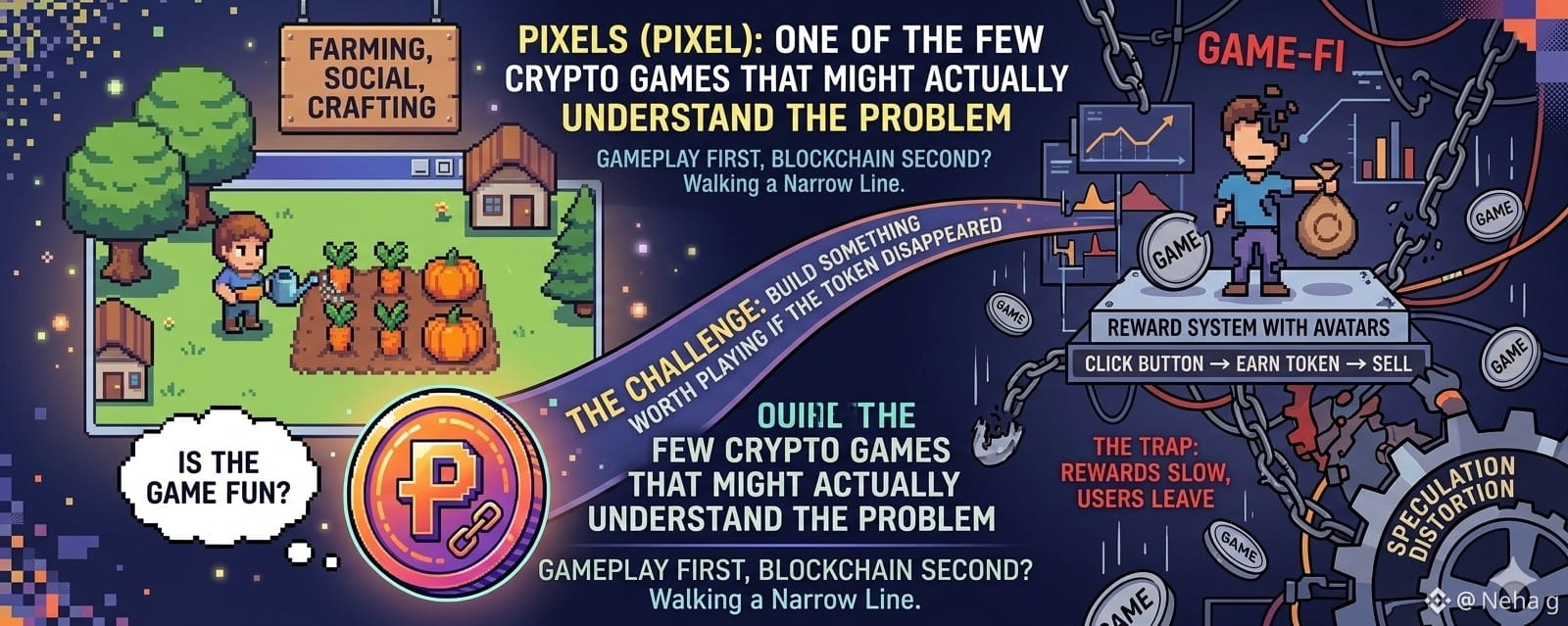
Pixels is, on paper, pretty simple. Farming, exploration, social gameplay, crafting, a light open-world loop, pixel art, low-pressure progression. It’s clearly borrowing from the same kind of casual, sticky design that made people sink absurd amounts of time into games like Stardew Valley, old browser MMOs, and social sims that had no business being that addictive.
That part makes sense.
What makes it different, at least a little, is that Pixels doesn’t immediately feel like a token economy pretending to be a game. And if you’ve spent enough time watching GameFi stumble through the last few years, that distinction matters more than people admit.
Because let’s be real, most crypto games were never games.
They were reward systems with avatars.
Click button, complete task, earn token, repeat. Maybe there was a marketplace. Maybe there were NFTs. Maybe someone called it an economy. But most of the time it was just a farm with extra steps, built for extraction first and entertainment second.
And that model has already been tested to death.
People came for rewards, not gameplay. Then rewards got weaker, and users disappeared. Every time.
That’s the part Pixels seems to understand better than most.
The real challenge in Web3 gaming was never putting assets on-chain. That was always the easy part. The hard part was building something people would actually want to spend time with if the token disappeared tomorrow.
That’s the real test.
And Pixels, to its credit, at least seems to be trying to answer that question instead of avoiding it.
That doesn’t mean it has solved anything.
It just means it’s asking the right question, which is more than most projects ever did.
Because the actual problem here is real. Crypto gaming has spent years trying to convince people they wanted “ownership,” when what most players actually wanted was a game that didn’t feel like unpaid labor. That mismatch killed a lot of projects before they even had a chance to matter.
Ownership is nice in theory. Most players do not care in practice unless the game itself is already worth playing.
That’s the uncomfortable truth this sector keeps relearning.
Pixels at least seems to understand that gameplay has to come first, and the blockchain part has to stay mostly invisible. That’s probably the only way this category has any chance of becoming something more than a niche loop for crypto natives.
But that’s also where the real risk starts.
Because being better than most crypto games is not the same thing as being good enough.
That’s the part that worries me.
Pixels is not competing with failed Web3 experiments. It’s competing with normal games. And normal games are better. They’re smoother, simpler, cheaper in cognitive load, and they don’t ask users to think about wallets, tokens, gas, or digital property rights.
They just work.
That’s the standard.
And Web3 gaming still tends to underestimate how brutal that comparison is.
Crypto-native users will tolerate a lot of friction if there’s upside attached. Normal players won’t. They do not care about ownership mechanics unless those mechanics improve the experience in a way they can actually feel. Most of the time, they don’t.
That means Pixels has to walk a very narrow line.
The blockchain layer needs to matter enough to justify existing, but not so much that it becomes annoying. It has to be useful without becoming the point. If users notice the monetization layer more than the gameplay loop, the whole thing starts to collapse into the same old GameFi pattern.
And we’ve seen how that ends.
Then there’s the token.
And honestly, this is where the usual skepticism comes back fast.
PIXEL, like most game tokens, raises the same question almost every crypto gaming token does: does this actually need to exist, or is it just here because every crypto product still feels obligated to attach a tradable asset to itself?
That’s not cynicism. That’s pattern recognition.
Game tokens always sound reasonable in theory. Premium currency, upgrades, access, utility, ecosystem incentives. Fine. On paper, all of that makes sense.
In reality, most game tokens end up stuck in the same trap.
If the token matters too much, the game gets distorted by speculation. If it doesn’t matter enough, then nobody can explain why the token should hold value at all.
That balance is where most of these economies break.
Pixels may handle it better than others. Maybe. But the risk is still the same. If players start optimizing for extraction instead of engagement, the economy eventually starts eating the game. Reward loops become sell pressure, progression becomes monetized behavior, and suddenly the whole thing starts looking familiar in the worst way.
That’s the part that worries me most.
Because this is where crypto projects usually stop being products and start becoming systems designed to feed their own token.
Maybe Pixels avoids that. Maybe it doesn’t.
And honestly, that’s still an open question.
What makes it worth paying attention to is not that it feels inevitable. It doesn’t.
It’s that Pixels seems more aware than most of the category that crypto games have historically failed because they were better at monetization than they were at being games.
That’s a real insight. A rare one, frankly.
Whether that awareness is enough is a different conversation.
Maybe Pixels becomes one of the few Web3 games people actually stick with because the game itself is good enough to carry the rest.
Maybe it stays mostly what it is now — a cleaner, more playable version of the same crypto-native loop with better presentation and better timing.
Either outcome feels plausible.
And that’s probably the most honest way to look at it.
Pixels is not the future of gaming. It’s not some inevitable breakout. It’s not going to magically fix everything broken about Web3 games.
But it is one of the few projects in the space that at least seems to understand what went wrong the first time.
And right now, honestly, that’s enough to make it worth watching.
