
There is a quiet shift happening in games that does not announce itself loudly.
At first, it looks harmless. A daily quest appears. A player plants something, collects something, crafts something, claims a reward, and moves on. Nothing about it feels unusual. This is the language games have used for years: small tasks, small incentives, small reasons to return tomorrow.
But the more I look at systems like Pixels, the more that simple picture starts to feel incomplete.
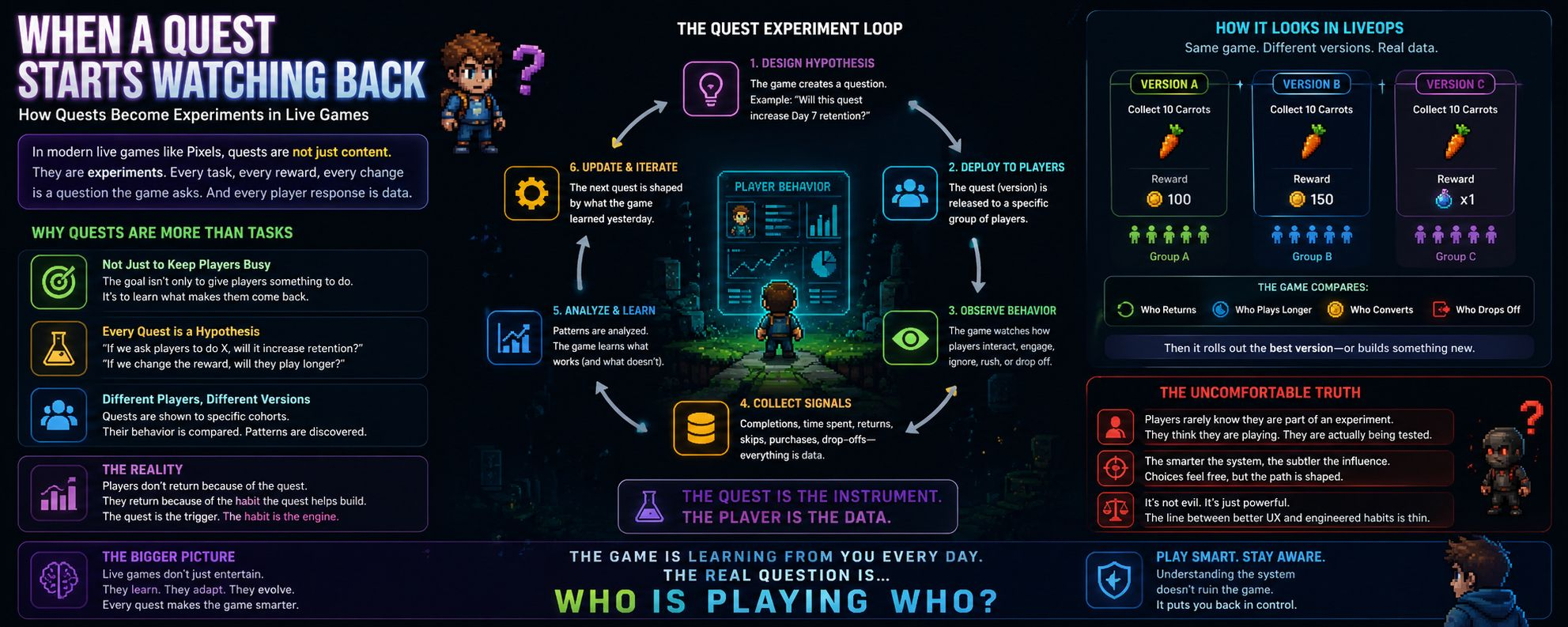
Because a quest is no longer just a task placed in front of the player. It is also a question being asked by the game.
Will this objective bring people back? Will this reward change how long they stay? Will this version work better for one group than another? Will players behave differently if the same activity is wrapped in a slightly different reason?
That is where the whole thing becomes more interesting, and also a little more uncomfortable.
The old idea was that quests existed to give players something to do. That still sounds true on the surface. But in LiveOps, a quest can become much more than content. It becomes a way of observing behavior. It becomes a small controlled experiment hidden inside the rhythm of play.
One group gets one version. Another group sees something else. A reward is adjusted. A requirement is moved. A task returns later with a small change. Nothing dramatic happens from the player’s point of view. The game simply feels alive, updated, responsive.
But behind that movement, the system is learning.
It learns who comes back because they enjoy the loop. It learns who only shows up when the reward is worth farming. It learns which players are becoming regulars, which ones are drifting, and which ones can be pulled back with just the right nudge at the right time.
That is the part people often skip over. The reward is not only a prize anymore. It is also a signal. When a player accepts it, ignores it, rushes toward it, or changes their routine because of it, the system receives information.
And once rewards become signals, quests stop being simple pieces of game design. They become instruments.
Not in some distant theoretical sense. This is exactly how modern live games operate. They do not just release content and hope for the best. They watch, adjust, compare, repeat. Every small change becomes a way to measure attention. Every action leaves behind a clue.
There is something genuinely impressive about that. A game that can respond to its players daily is not static. It can become sharper, more adaptive, more aware of what actually works instead of what designers only assume will work.
But that same intelligence carries a strange pressure.
Because when a game keeps testing, someone is always being tested on.
Most players do not enter a quest thinking they are part of an experiment. They think they are playing. They think they are choosing how to spend their time. And maybe they are. But their choices are also being shaped, measured, and fed back into the next design decision.
That does not automatically make the system evil. Games have always guided players. Good design has always involved some kind of invisible hand. The difference now is scale, speed, and precision.
The game no longer has to guess broadly. It can learn from yesterday. It can notice what worked this morning. It can change what appears tomorrow.
That is powerful.
It is also not neutral.
The more refined these systems become, the less obvious the guidance feels. A player may feel free while moving through a path that has been carefully softened, tested, and optimized around them. The choice remains real, but the environment around that choice has been arranged with increasing intelligence.
That is where the discomfort begins.
Not because experimentation is wrong. Not because LiveOps is bad. But because the line between designing a better experience and engineering a habit can become very thin.
A quest can help a game feel alive. It can also quietly teach the player when to return, what to value, and how to behave.
And maybe that is the real story here. Not that quests have become smarter. But that they have become observant.
They no longer just sit inside the game waiting to be completed. They watch what completion means. They study the player through the act of play itself.
At some point, the question stops being whether the player finished the quest.
The sharper question is what the quest learned from the player while they were finishing it.