
Everyone builds a token.
Very Few build the inFrastructure that makes the token worth holding across more thn one game.
I have been sitting with this distinction for a while. Because It is the difference bEtween a project that peaks at launch and one that compounds over time. And it is rarely the part that gets discussed.
Pixels spent years Inside a single game economy learning what breaks. Token inflation. Mis targeted rewards. Extractors Draining liqidity before the data caught up. They did not just document these failures they built a system specifically designed around them. That system is now called Stacked.
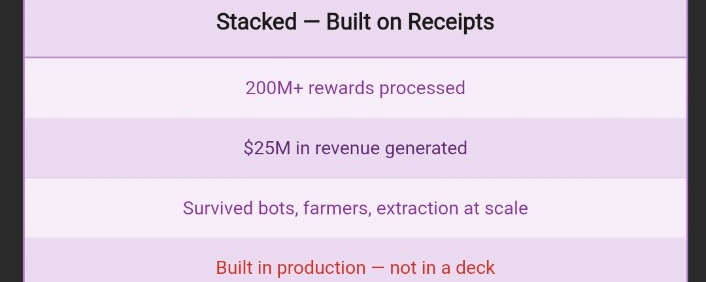
Stacked is not a new product bolted onto an existi g game. It is the reward infrastructure Pixels built in production, battle tested across millions of real player interactions now opening to external studios. The diStinction matters. Most reward platforms are built on assumptions. This one was built on receipts.
The numbers are cOncrete. Over 200 million rewards processed. $25 million in revenue generated across the ecosystem. These are not projections from a whitepaper. They are the output of a system that survived real adversarial usage at scale bots farmers extraction patterns that would have collapsed a less hardened architecture.
What changes for $PIXEL inside this model is structural. The token moves from being the currency of a single game to being the cross ecosystem rewards and loyalty layer across every studio that integrates Stacked. More games joining does not dilute the tokens role it expands the surface area where the token creates value.
The AI layer sitting on top is THe part I find most underrated. Studios can query it like an analyst. Why are players dropping between Day 3 and Day 7 Which mechanics correlate with long term retention Where is reward budget leaking The answers come back as actionable experiments not just data exports. Insight to action inside the same system.
I spent time thinking about what actually differentiates this from every other ecosystem
pitch in Web3 gaming.
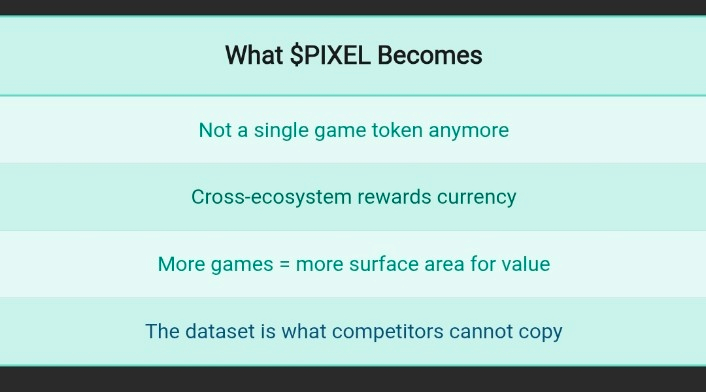
The honest answer is the data. First party behavioral signals across multiple titles, fraud filtered, continuously updated. That dataset took years and scale to build. It is the part of this that a well funded comPetitor cannot replicate in twelve months by copying the mechanism.
The risk I keep returning to is integration quality. Every studio that joins adds data but only if their API integration is clean. One poorly integrated title does not just contribute N0ise. It degrades the model for every other game in the ecosystem.
dependency is real. And it is the part the whitepaper does not dwell on.
Whether the platform scales without degrading the data quality that makes it valuable 1 that is the question worth asking before assuming the flywheel compounds indefinitely.
What would you need to see from Stacked before trusting it with your games reward budget?